• Two Takes on ‘Imitation of Life’: Exploitation in Eastmancolor

    The New York Times
    2015-05-14

    J. Hoberman

    “I would have made the picture just for the title,” Douglas Sirk said of his last Hollywood production, “Imitation of Life” (1959). But, newly released on Blu-ray by Universal, along with its original version, directed in 1934 by John M. Stahl, the movie is far more than an evocative turn of phrase.

    This tale of two single mothers, one black and the other white — and of maternal love, exploitation and crossing the color line — is a magnificent social symptom. Both versions were taken from the 1933 best seller by Fannie Hurst, a generally maligned popular writer if one whose novels, the historian Ann Douglas notes in “Terrible Honesty,” her study of Jazz Age culture, constitute “a neglected source on the emergence of modern feminine sexuality.”

    Mr. Stahl’s “Imitation of Life” movie was certainly the “shameless tear-jerker” that the New York Times reviewer Andre Sennwald called it, as well as a prime example of the melodramatic mode known in the Yiddish theater as “mama-drama.” But it was not without progressive intent and, released during the second year of the New Deal, addressed issues of race, class and gender almost head-on.

    The white protagonist, Bea Pullman (Claudette Colbert), is a not-quite-self-made businesswoman; the most complex and sympathetic character, Peola Johnson (Fredi Washington), is a casualty of American racism, both institutionalized and internalized. Behind both is the self-effacing powerhouse known as Aunt Delilah (Louise Beavers), who is the light-skinned Peola’s black mother and the source of the secret recipe on which Bea founds her pancake empire — not to mention its smiling trademark.

    Happily ripped off by her white partner for the rest of her life, Beavers embodies exploited African-American labor, something the movie acknowledges by giving her a funeral on the level of a state occasion. The real martyr, however, is Washington’s Peola. The film historian Donald Bogle called her “a character in search of a movie” — but the tragic mulatto is the only part Hollywood would allow this accomplished and politically aware actress to play. In effect, she dramatizes her own segregated condition on screen…

    Read the entire article here.
  • Mixed Race in Australia and the region

    University of Western Australia (UWA)
    2015-06-08 through 2015-06-10

    Conveners: Farida Fozdar

    People of ‘mixed race’ are often seen as marginal individuals managing cultural and psychological tensions, or alternatively valorised as the vanguard of an integrated, post-racial, cosmopolitan world (Edwards et al. 2012). Such dichotomies ignore the complex lived reality of being mixed – ranging from ‘passing’, to constructing multiracial identities, to embracing a cultural identity not necessarily reflected in one’s appearance (see Perkins, 2007; Paradies, 2006; Song and Aspinall, 2012; Jones, 2011). Mixed identities are not singular and fixed, but multiple and fluid (Nandi & Platt 2012; Tilbury, 2007; Paradies, 2006), often characterised by ‘ordinariness’ (Caballero, 2012). The lived experience of being ‘mixed’ is strongly influenced by political and social context (Luke and Luke, 1999). While a growing body of research exists on ‘mixed race’, more productive approaches are needed to investigate the cultural production of ‘mixedness’.

    Perhaps surprisingly, Australia and the region lag behind the rest of the world in research on ‘mixed race’. There has been little public debate about the place of ‘mixed race’ in Australia and New Zealand (see Fozdar and Perkins, 2014). The subject does rate a hearing in Australia, however, in regard to people of mixed Aboriginal descent (Andrew Bolt style) (see Paradies, 2006). The social and political contexts of mixed race in Australia, New Zealand and the region offer complex histories of colonisation and migration, making this region an important counterpoint to the large bodies of research undertaken in the UK and US.

    We invite papers on mixed race in Australia and surrounding countries, with a particular focus on mixed race across the life course (Csizmadia, 2012), the health and development of young people and families; cross-country comparison, and transgenerational effects. We are keen to include papers on mixed race of all types.

    Invited speakers include:

    • Prof Rosalind Edwards (Southampton)
    • Dr Chamion Caballero (LSE)
    • Prof Yin Paradies (Deakin)
    • Prof David Trigger (UQ)
    • Dr Kirsten McGavin (UQ)

    View the program guide here.

  • A Look At People’s ‘Race Experience’ In NC

    WUNC 91.5, North Carolina Public Radio
    2015-05-15

    Charlie Shelton, Digital News Producer

    We recently released a survey asking people about their experience with race in North Carolina. The responses ranged from personal stories on race’s influence in daily interactions to how race is affecting public opinion. From the state’s rural communities to its larger cities, people recognized that race relations are changing, but we still have a ways to go.

    Here are some of the responses:…

    Michi Vojta, 44 years old, Raleigh

    “As a mixed race person (mother from Japan), I can generally “pass“, as it was called — people don’t often notice, or care, about my non-white heritage.

    Years ago I visited a friend living in Columbia, NC. As a teacher she went to work and I hung out killing time and went for a jog. I thought it was odd how there were two gas stations from the same exact company on the same road within spitting distance. I was telling her where I jogged, and she asked what I thought were odd questions: ‘Did the folks seem surprised to see you?’ I thought, ‘Gosh, it can’t be that small a town, right?’…

    Read the entire article here.

  • Black Miss Japan fights for race revolution’

    Agence France Presse (via Yahoo)
    2015-05-12

    Alastair Himmer, Sport and Lifestyle Correspondent


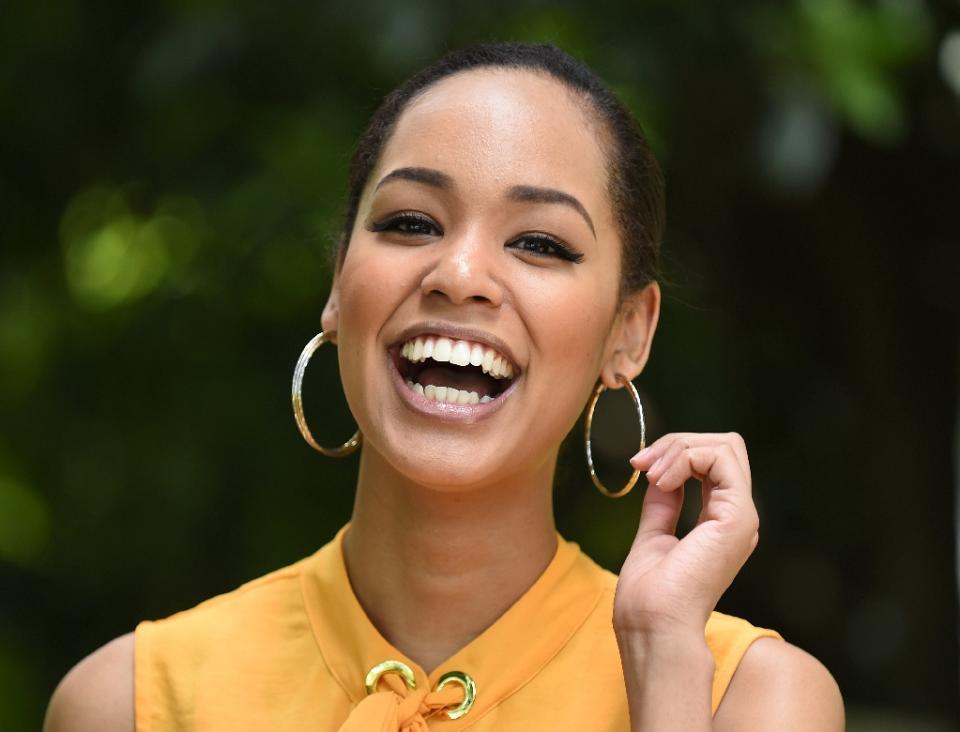
    Ariana Miyamoto

    Tokyo (AFP) – Ariana Miyamoto entered the Miss Universe Japan beauty contest after a mixed-race friend committed suicide. And she endured abuse after winning the crown because of her skin colour.

    Far from being put off by the backlash, Miyamoto resolved to use her new-found fame to help fight racial prejudice — in much the same way British supermodel Naomi Campbell broke down cultural barriers in the fashion industry a generation ago.

    “I’m stubborn,” said Miyamoto, the daughter of a Japanese mother and black American father, who turned 21 on Tuesday.

    “I was prepared for the criticism. I’d be lying to say it didn’t hurt at all. I’m Japanese — I stand up and bow when I answer the phone. But that criticism did give me extra motivation,” she told AFP in an interview.

    “I didn’t feel any added pressure because the reason I took part in the pageant was my friend’s death. My goal was to raise awareness of racial discrimination,” added Miyamoto, who was bullied as a schoolgirl growing up in the port town of Sasebo, near Nagasaki.

    “Now I have a great platform to deliver that message as the first black Miss Universe Japan. It’s always hard to be the first, so in that respect what Naomi Campbell did was really amazing.”…

    Read the entire article here.

  • Movie about Va.’s now-defunct ban on interracial marriage to be shot in state

    The Washington Post
    2014-05-14

    Laura Vozzella, Richmond Bureau Reporter

    RICHMONDVirginia has landed a movie project about Richard and Mildred Loving, the real-life Virginia couple arrested in 1958 for violating the state’s interracial marriage ban.

    The Lovings filed a lawsuit that eventually made its way to the Supreme Court, which in 1967 struck down bans on interracial marriage. The case is often invoked today amid legal challenges to bans on same-sex marriage.

    Gov. Terry McAuliffe (D) announced on Thursday that makers of the movie had chosen to shoot the project in the state. A statement from his office noted that the court case at the center of the story was “a landmark civil rights case in defense of marriage equality that is still relevant today.”

    Loving is a significant American story that should be told, and I am happy to announce it will be filmed in Virginia,” said McAuliffe, who supports same-sex marriage. “Attracting these projects to the Commonwealth helps build the new Virginia economy by generating new revenues, creating good-paying jobs for our citizens and continuing to highlight Virginia’s historical significance.”

    The film will star Ruth Negga and Joel Edgerton, and will be directed by acclaimed film director Jeff Nichols. It was inspired by “The Loving Story,” a documentary produced and directed by Nancy Buirski that aired on HBO, the governor’s office said…

    Read the entire article here.

  • “Well, I’ve always identified myself as black… and mixed kind of simultaneously. But as far as my identity, I see my mixed-race as being part of a broader black experience, or within the African diaspora. I don’t see that as a white experience or an Austrian experience, just because I see myself as a black woman or a black person within a place where it’s predominantly white. So I know that whiteness is not something I’m a part of, even though my mother is white and I have a cultural background as far as my Austrian side. But, to identify as white or solely as mixed without understanding how much my black experience and my blackness plays a part in my life, to me, just personally, I couldn’t do that.” —Annina Chirade

    Kim Chakanetsa, “Being ‘Mixed Race’: Kira Lea Dargin and Annina Chirade,” The Conversation on BBC World Service, May 11, 2015. (00:14:20-00:14:38). http://www.bbc.co.uk/programmes/p02qm960.

  • “I identify as both [black (Australian Aboriginal) and white]. So you know and I’ve had no secret of who I am and what my background is. I think that it’s important for me to identify strongly as both because it’s quite evident that I’m not particularly one or the other. You know, I’m one of those people who looks mixed-race. So you’re going to look at me and immediately say, ‘what are you?’ And so just being able to relate and identify strongly with both of my cultural backgrounds is something that’s really important for me.” —Kira Lea Dargin

    Kim Chakanetsa, “Being ‘Mixed Race’: Kira Lea Dargin and Annina Chirade,” The Conversation on BBC World Service, May 11, 2015. (00:14:20-00:14:38). http://www.bbc.co.uk/programmes/p02qm960.

  • Both men said [Trevor] Noah distinguished himself from other comics by resisting labels and “genre-based comedy.” [Schalk] Bezuidenhout noted that Noah always identified himself as a mixed-race South African raised in straitened circumstances in Soweto without “using it as a crutch.” Contemporaries who have shared the stage with him say he’s unusually attuned to the audience, shifting direction based on the feel in the room, and Bezuidenhout has seen Noah drop chunks of material based on the city he’s performing in. This was a quality that a number of immigrants in South Africa had already mentioned to me. Omega Chembhere, a waiter, told me that when he had arrived from Zimbabwe 10 years earlier, much of South African pop culture had seemed inaccessible. “Trevor’s different, so good at it,” he said. “His strength is that everything springs from his experience in life, but you understand his reality because he makes an effort to explain.”

    Douglas Foster, “Trevor Noah’s World,” The Atlantic, April 5, 2015. http://www.theatlantic.com/international/archive/2015/04/trevor-noah-world-south-africa-comedy/389697.

  • The Challenge of Mixed-Blood Nations

    Indian Country Today Media Network
    2015-04-25

    Duane Champagne, Professor of Sociology and American Indian Studies; Professor of Law
    University of California, Los Angeles

    Countries with indigenous nations usually also have mixed-blood nations composed of people of indigenous descent and other nations or races. In an increasingly shrinking world where ethnicity is a quantity in flux, it is sometimes difficult to get a handle on how they relate to one another. The two groups would seem to be natural allies. But the reality isn’t that simple.

    To begin with, much depends on the relations of the mixed bloods to the larger nation state. Take Canada, where the mixed-blood community is called Métis, a French word meaning—well, mixed blood. The Métis historically have had friendly relations with Indian communities. But currently they claim their own history and culture, a hybrid of European and indigenous community. Some Métis identify and live with tribal communities, while others do not. These separatists believe themselves to be a distinct nation or ethnic group from the indigenous nations and from Canada. Métis communities in Canada have separate land claims and negotiations with the Canadian government.

    Meanwhile, in Latin and South America, as well as in Africa, people of mixed blood usually do not strongly identify with indigenous nations. They tend to reject indigenous ways in favor of national culture. Mestizos, for instance, are persons of indigenous ancestry who have taken up national culture and do not live in or engage with members of indigenous tribal communities.

    This disengagement, in fact, can be quite vehement. Mestizo nations like Mexico, El Salvador, Honduras, and many others segregate their indigenous communities and maintain hostile and repressive political and cultural relations over indigenous nations. As for assimilated Mestizos, they can generally be relied on to embrace the values and lifestyles of modern market economies and broad national culture while openly rejecting their indigenous counterparts.

    In the United States, the situation is particularly complex because there is no official designation of a mixed-blood nation…

    Read the entire article here.

  • What is Systemic Racism?

    Race Forward
    2015-05-13

    Rinku Sen President of Race Forward & Publisher of Colorlines introduces the “What Is Systemic Racism?” video series featuring our very own Jay Smooth.

    Watch the entire video series here.