Pardo is the New Black: The Urban Origins of Argentina’s Myth of Black Disappearance
Global Urban History
2016-12-19
Erika Edwards, Associate Professor of History
University of North Carolina, Charlotte
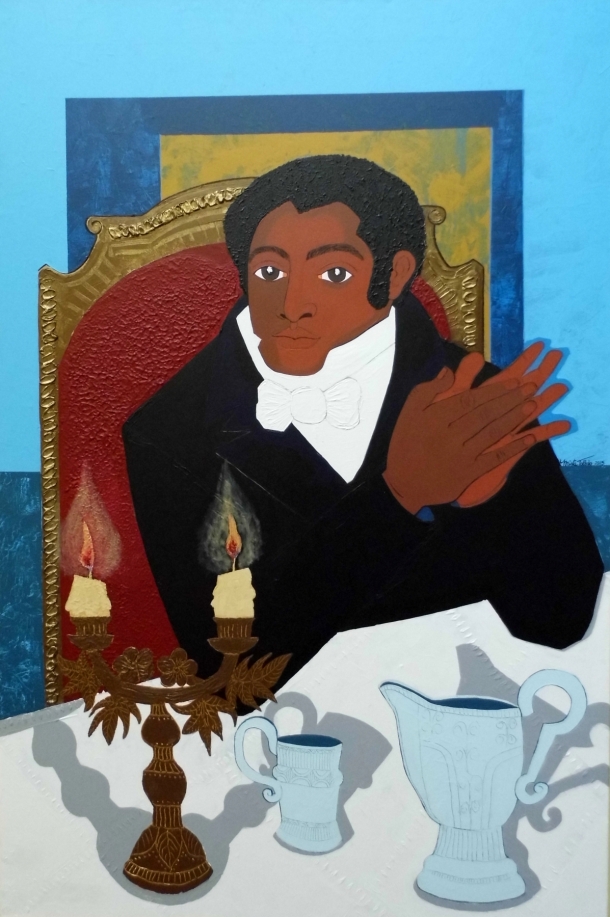 Bernardino Rivadavia, Argentina’s first president (1826-27) was nicknamed “Doctor Chocolate.” Painting by Mirta Toledo, 2013 |
It was a typical day, nothing out of the ordinary. I, a young, small-town girl had landed in a foreign country to begin my study abroad. I knew nothing about Argentina and was excited to discover the country. It did not take long for me to realize that my experience would be life changing. Black in a very white country, I stood out like a sore thumb. I was the “other.” At first I was uncomfortable, but then, I realized that my blackness was not the same in Argentina as in the United States. My blackness meant something else. I was exotic, if not exceptional, and surprisingly I was not black! Instead I was morocha (a non-offensive term referring to darker skin). How could that be? I had transformed into a lighter version of myself. As I grew accustomed to being called morocha, I could not help wondering who constituted a morocha. Over time the answer became apparent: anyone who was not white. Other countries had mestizos (Indian and white mixture/descendant), or mulattos (black and white), but Argentina had grouped African and Indian descendants and people with tanned skin tones, often descendants of immigrants from Mediterranean countries, into a single category. Argentines proclaimed there “were no blacks in their country,” but the country certainly had a lot of morochos! Despite the lack of African descendants’ visibility today, in 1778 they had a significant share of the national population. Concentrated in cities, African descendants amounted to 44 percent of the inhabitants of the provincial city of Córdoba, for instance.[1] The decline of this population a national question for Argentina, whose black population dwindled from roughly 30 percent of the total population to 0.37 percent according to the 2010 census…
Read the entire article here.