• Memorial Drive: A Daughter’s Memoir

    Ecco (an imprint of HarperCollins)
    2020-07-28
    224 pages
    6x8in
    Hardcover ISBN: 9780062248572
    Large Print ISBN: 9780063076709
    E-book ISBN: 9780062248596
    Digital Audio, MP3 ISBN: 9780063005860

    Natasha Trethewey, Board of Trustees Professor of English
    Northwestern University, Evanston, Illinois

    An Instant New York Times Bestseller

    A chillingly personal and exquisitely wrought memoir of a daughter reckoning with the brutal murder of her mother at the hands of her former stepfather, and the moving, intimate story of a poet coming into her own in the wake of a tragedy

    At age nineteen, Natasha Trethewey had her world turned upside down when her former stepfather shot and killed her mother. Grieving and still new to adulthood, she confronted the twin pulls of life and death in the aftermath of unimaginable trauma and now explores the way this experience lastingly shaped the artist she became.

    With penetrating insight and a searing voice that moves from the wrenching to the elegiac, Pulitzer Prize–winning poet Natasha Trethewey explores this profound experience of pain, loss, and grief as an entry point into understanding the tragic course of her mother’s life and the way her own life has been shaped by a legacy of fierce love and resilience. Moving through her mother’s history in the deeply segregated South and through her own girlhood as a “child of miscegenation” in Mississippi, Trethewey plumbs her sense of dislocation and displacement in the lead-up to the harrowing crime that took place on Memorial Drive in Atlanta in 1985.

    Memorial Drive is a compelling and searching look at a shared human experience of sudden loss and absence but also a piercing glimpse at the enduring ripple effects of white racism and domestic abuse. Animated by unforgettable prose and inflected by a poet’s attention to language, this is a luminous, urgent, and visceral memoir from one of our most important contemporary writers and thinkers.
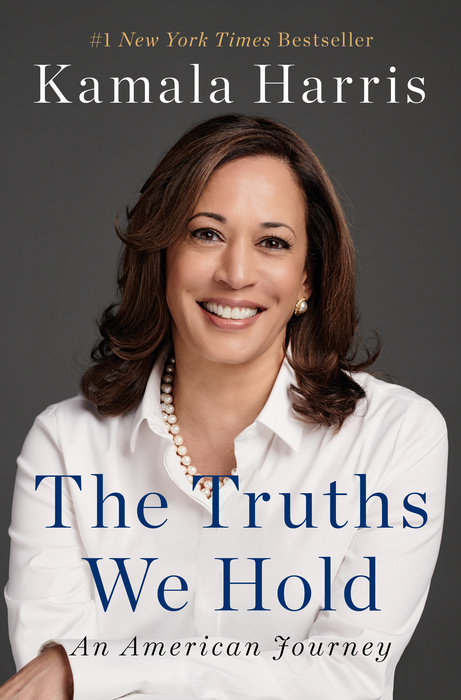
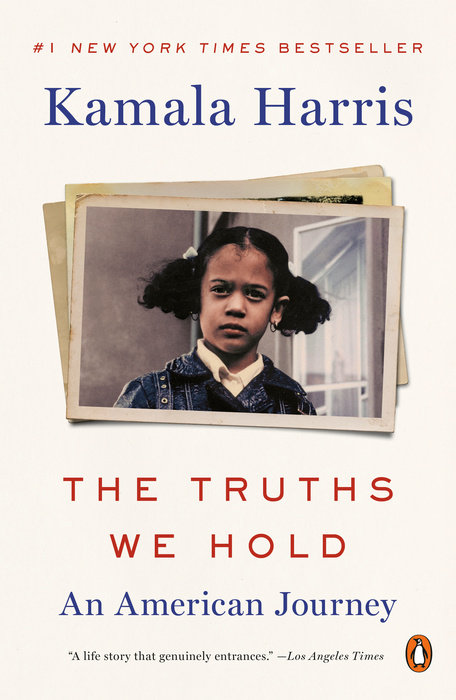
  • The Truths We Hold: An American Journey

    Penguin Press
    2019-01-08
    336 Pages
    6-1/8 x 9-1/4
    Hardcover ISBN: 9780525560715
    Paperback ISBN: 9780525560739
    eBook ISBN: 9780525560722

    Kamala D. Harris

    A New York Times bestseller

    From one of America’s most inspiring political leaders, a book about the core truths that unite us, and the long struggle to discern what those truths are and how best to act upon them, in her own life and across the life of our country.

    Senator Kamala Harris’s commitment to speaking truth is informed by her upbringing. The daughter of immigrants, she was raised in an Oakland, California community that cared deeply about social justice; her parents–an esteemed economist from Jamaica and an admired cancer researcher from India–met as activists in the civil rights movement when they were graduate students at Berkeley. Growing up, Harris herself never hid her passion for justice, and when she became a prosecutor out of law school, a deputy district attorney, she quickly established herself as one of the most innovative change agents in American law enforcement. She progressed rapidly to become the elected District Attorney for San Francisco, and then the chief law enforcement officer of the state of California as a whole. Known for bringing a voice to the voiceless, she took on the big banks during the foreclosure crisis, winning a historic settlement for California’s working families. Her hallmarks were applying a holistic, data-driven approach to many of California’s thorniest issues, always eschewing stale “tough on crime” rhetoric as presenting a series of false choices. Neither “tough” nor “soft” but smart on crime became her mantra. Being smart means learning the truths that can make us better as a community, and supporting those truths with all our might. That has been the pole star that guided Harris to a transformational career as the top law enforcement official in California, and it is guiding her now as a transformational United States Senator, grappling with an array of complex issues that affect her state, our country, and the world, from health care and the new economy to immigration, national security, the opioid crisis, and accelerating inequality.

    By reckoning with the big challenges we face together, drawing on the hard-won wisdom and insight from her own career and the work of those who have most inspired her, Kamala Harris offers in The Truths We Hold a master class in problem solving, in crisis management, and leadership in challenging times. Through the arc of her own life, on into the great work of our day, she communicates a vision of shared struggle, shared purpose, and shared values. In a book rich in many home truths, not least is that a relatively small number of people work very hard to convince a great many of us that we have less in common than we actually do, but it falls to us to look past them and get on with the good work of living our common truth. When we do, our shared effort will continue to sustain us and this great nation, now and in the years to come.

  • Biden’s VP pick: Why Kamala Harris embraces her biracial roots

    BBC News
    2020-08-11

    Soutik Biswas, India correspondent


    Getty Images

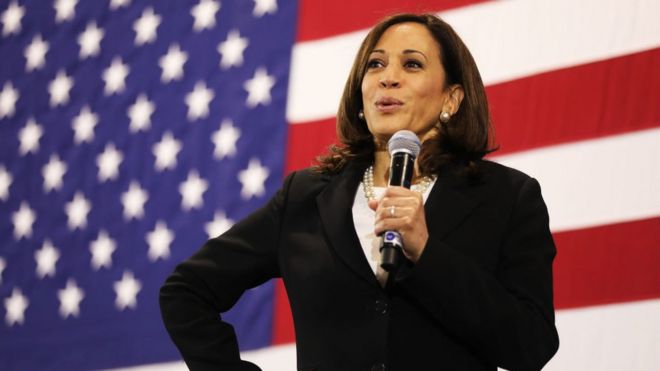
    US Senator Kamala Harris – chosen by Joe Biden as his Democratic vice-presidential candidate – is known as a prominent black politician. But she has also embraced her Indian roots.

    “My name is pronounced “Comma-la”, like the punctuation mark,” Kamala Harris writes in her 2018 autobiography, The Truths We Hold.

    The California senator, daughter of an Indian-born mother and Jamaican-born father, then explains the meaning of her Indian name.

    “It means ‘lotus flower’, which is a symbol of significance in Indian culture. A lotus grows underwater, its flowers rising above the surface while the roots are planted firmly in the river bottom.”

    Early in life, young Kamala and her sister Maya grew up in a house filled with music by black American artists. Her mother would sing along to Aretha Franklin’s early gospel, and her jazz-loving father, who taught economics at Stanford University, would play Thelonius Monk and John Coltrane on the turntable.

    Shyamala Gopalan and Donald Harris separated when Ms Harris was five. Raised primarily by her Hindu single mother, a cancer researcher and a civil rights activist, Kamala, Maya and Shyamala were known as “Shyamala and the girls”.

    Her mother made sure her two daughters were aware of their background.

    “My mother understood very well she was raising two black daughters. She knew that her adopted homeland would see Maya and me as black girls, and she was determined to make sure we would grow into confident black women,” she wrote…

    Read the entire article here.

  • Joe Biden picks Sen. Kamala Harris to be his vice presidential running mate, making her the first black woman on a major ticket

    CNBC
    2020-08-11

    Christina Wilkie, White House Reporter

    • Presumptive Democratic nominee Joe Biden has chosen California Sen. Kamala Harris to be his running mate.
    • Widely considered at moderate Democrat, Harris will be the first Black woman to join a major party ticket.
    • The announcement caps off a monthslong process that saw nearly a dozen prospective running mates vetted by the Biden campaign.

    WASHINGTON – Former Vice President Joe Biden has chosen Sen. Kamala Harris of California to join him on the Democratic ticket, fulfilling his pledge to select a female running mate and making Harris the first Black person ever tapped as the vice presidential nominee of a major party.

    His campaign announced the pick Tuesday afternoon through his webpage.

    Biden’s selection of Harris, 55, lends racial diversity, gender parity and generational breadth to his campaign. It also represents a strategic decision by the 77-year-old former vice president to keep his ticket firmly within the more moderate wing of the Democratic Party.

    “Back when Kamala was Attorney General, she worked closely with Beau,” tweeted Biden, referring to his late son, Beau Biden. “I watched as they took on the big banks, lifted up working people, and protected women and kids from abuse. I was proud then, and I’m proud now to have her as my partner in this campaign.”…

    Read the entire article here.

  • Joe Biden Just Made History and Picked Kamala Harris as His VP Candidate

    Mother Jones
    2020-08-11

    Jamilah King, Reporter


    Tom Williams/CQ Roll Call/AP

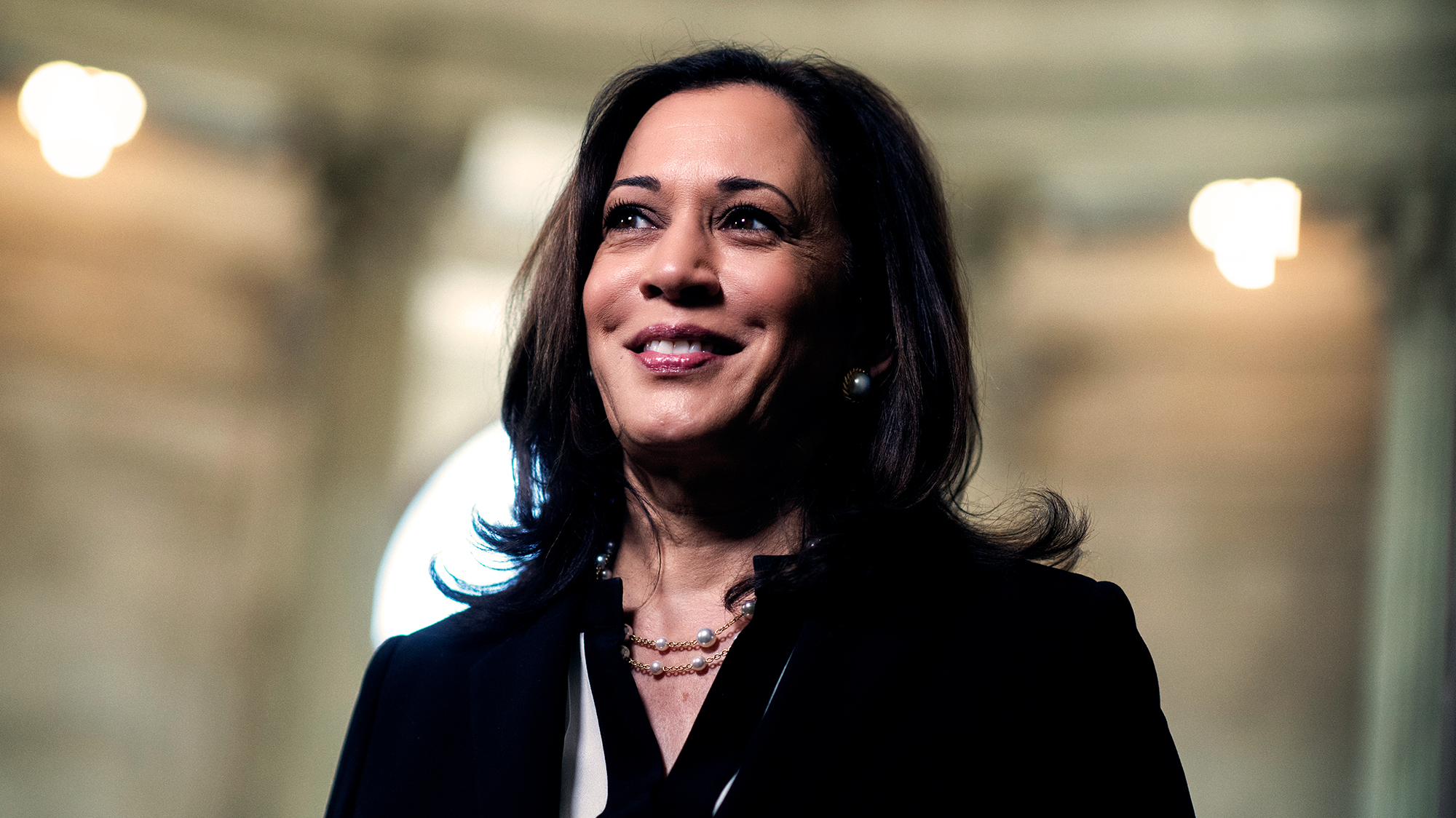
    Former Vice President Joe Biden has officially selected Sen. Kamala Harris (D-Calif.) as his running mate, and in doing so has made history, as Harris will be the first Black woman on a major party’s presidential ticket. Harris was long rumored to be a top choice for the slot, and now she’s tasked with energizing a Democratic electorate that’s torn between a moderate forebearer at the top and an increasingly large proportion of voters who want to see dramatic change during a summer marked by a broad uprising over deep-seated racial injustice and a pandemic that’s killed more than 160,000 Americans.

    In Harris, Biden has chosen a Democratic favorite who toiled long and hard in California politics before breaking through on the national stage in the Senate and in running for president last year. She’s also a plainly strategic pick for the moment; Biden clearly thinks that choosing a Black woman—and this Black woman specifically—will help him overcome the lukewarm response he’s gotten from more liberal voters and criminal justice activists who still cite his baggage, like the 1994 crime bill and his praise of segregationist senators. Just this summer, prison abolitionist and academic Angela Davis said she was voting for Biden but admitted, “Biden is very problematic in many ways, not only in terms of his past and the role that he played in pushing toward mass incarceration, but he has indicated that he is opposed to disbanding the police, and this is definitely what we need.” She added later on Democracy Now, “The election will not so much be about who gets to lead the country to a better future, but rather how we can support ourselves and our own ability to continue to organize and place pressure on those in power. And I don’t think there’s a question about which candidate would allow that process to unfold.”…

    Read the entire article here.

  • It’s Not Just Black and White: Exploring a Pedagogy of Racial Visibility and the Biracial Korean/White Self

    Departures in Critical Qualitative Research
    Volume 4, Issue 4 (Winter 2015)
    pages 8–32
    DOI: 10.1525/dcqr.2015.4.4.8

    Stephanie L. Young, Associate Professor of Communication Studies
    University of Southern Indiana

    In this autoethnography, I offer a pedagogy of racial visibility. Drawing on my embodied experiences both in and outside of the classroom, I explore how I engage in dialogue with my students about theoretical and critical approaches toward understanding rhetorics of race in the United States. Specifically, as an embodied storyteller, I reflect upon my personal stories as a biracial Korean American woman and investigate the instabilities of racial identities, the taken-for-granted racial understandings, and racism and white privilege in America.

    Read the entire article here.

  • Dark secrets: The Vanishing Half, by Brit Bennett, reviewed

    The Spectator
    2020-07-18

    Rabeea Saleem


    Brit Bennett. Credit: Getty Images

    Brit Bennett, The Vanishing Half, A Novel (New York: Riverhead Books, 2020)

    Bennett’s compelling novel explores the fraught subject of what it means to ‘pass for white’ in a black community

    Passé Blanc is the Creole expression — widely used in the US — for black people ‘passing for white’ to seek social and economic privileges otherwise denied them. Brit Bennett has a panoptic approach to racial passing in this intergenerational family saga, which takes us on a 20-year journey into the lives of twin sisters Desiree and Stella Vignes.

    We meet them in the 1950s as children living in Mallard, a small town in the Deep South known for its light-skinned negroes. For Desiree, the local obsession with skin colour makes little sense, since being light-skinned didn’t save her father from being lynched by white men. In their teens, the twins run away to New Orleans, but their paths soon diverge: ‘Stella became white and Desiree married the darkest man she could find.’

    Fourteen years later Desiree is spotted back in Mallard with a ‘blueblack’ child in tow called Jude. She is an anomaly in a town where ‘nobody married dark’, adhering to the strict colour code of its mixed-race founder, who was determined that the town would see ‘each generation lighter than the one before’. Stella, meanwhile, remains estranged from her family and now lives a life of luxury with her white husband and their daughter Kennedy in an affluent, all-white neighbourhood in LA. She has kept her past a secret from them, with her daughter realising how Stella would cite lack of money as an excuse not to discuss her background — ‘as if poverty were so unthinkable to Kennedy that it could explain everything’. Eventually, Jude’s and Kennedy’s paths cross, dismantling Stella’s carefully constructed façade…

    Read the entire review here.

  • Large DNA Study Traces Violent History of American Slavery

    The New York Times
    2020-07-23

    Christine Kenneally


    An 1823 cross-section diagram of a ship used to carry enslaved people. incamerastock/Alamy

    Scientists from the consumer genetics company 23andMe have published the largest DNA study to date of people with African ancestry in the Americas.

    More than one and a half centuries after the trans-Atlantic slave trade ended, a new study shows how the brutal treatment of enslaved people has shaped the DNA of their descendants.

    The report, which included more than 50,000 people, 30,000 of them with African ancestry, agrees with the historical record about where people were taken from in Africa, and where they were enslaved in the Americas. But it also found some surprises.

    For example, the DNA of participants from the United States showed a significant amount of Nigerian ancestry — an unexpected finding, as the historical record does not show evidence of enslaved people taken directly to the United States from Nigeria.

    At first, historians working with the researchers “couldn’t believe the amount of Nigerian ancestry in the U.S.,” said Steven Micheletti, a population geneticist at 23andMe who led the study…

    …The 23andMe project found this general pattern, but also uncovered a startling difference in the experience of men and women between regions in the Americas.

    The scientists calculated that enslaved women in the United States contributed 1.5 times more to the modern-day gene pool of people of African descent than enslaved men. In the Latin Caribbean, they contributed 13 times more. In Northern South America, they contributed 17 times more.

    What’s more, in the United States, European men contributed three times more to the modern-day gene pool of people of African descent than European women did. In the British Caribbean, they contributed 25 times more…

    Read the entire article here.

  • Genetic Consequences of the Transatlantic Slave Trade in the Americas

    The American Journal of Human Genetics
    Published: 2020-07-23
    37 pages
    DOI:10.1016/j.ajhg.2020.06.012

    Steven J. Micheletti
    23andMe, Inc., Sunnyvale, California

    Kasia Bryc
    23andMe, Inc., Sunnyvale, California

    Samantha G. Ancona Esselmann
    23andMe, Inc., Sunnyvale, California

    William A. Freyman
    23andMe, Inc., Sunnyvale, California

    Meghan E. Moreno
    23andMe, Inc., Sunnyvale, California

    G. David Poznik
    23andMe, Inc., Sunnyvale, California

    Anjali J. Shastri
    23andMe, Inc., Sunnyvale, California

    23andMe Research Team
    23andMe, Inc., Sunnyvale, California

    Sandra Beleza
    University of Leicester, Leicester, United Kingdom

    Joanna L. Mountain
    23andMe, Inc., Sunnyvale, California


    GettyImages

    According to historical records of transatlantic slavery, traders forcibly deported an estimated 12.5 million people from ports along the Atlantic coastline of Africa between the 16th and 19th centuries, with global impacts reaching to the present day, more than a century and a half after slavery’s abolition. Such records have fueled a broad understanding of the forced migration from Africa to the Americas yet remain underexplored in concert with genetic data. Here, we analyzed genotype array data from 50,281 research participants, which—combined with historical shipping documents—illustrate that the current genetic landscape of the Americas is largely concordant with expectations derived from documentation of slave voyages. For instance, genetic connections between people in slave trading regions of Africa and disembarkation regions of the Americas generally mirror the proportion of individuals forcibly moved between those regions. While some discordances can be explained by additional records of deportations within the Americas, other discordances yield insights into variable survival rates and timing of arrival of enslaved people from specific regions of Africa. Furthermore, the greater contribution of African women to the gene pool compared to African men varies across the Americas, consistent with literature documenting regional differences in slavery practices. This investigation of the transatlantic slave trade, which is broad in scope in terms of both datasets and analyses, establishes genetic links between individuals in the Americas and populations across Atlantic Africa, yielding a more comprehensive understanding of the African roots of peoples of the Americas.


    Figure 1 Location of Individuals and Cohorts
    Arrows highlight the general direction of the triangular trade routes between continents during the transatlantic slave trade. Pie charts indicate the documented number of enslaved people embarking out of regions of Africa (∼12.5 million total) and disembarking in regions of the Americas (∼10.5 million total) between 1515 and 1865. Representatives of regions of the Americas and Europe indicated that they each have four grandparents born within the same country or US state. Representatives of Atlantic Africa either indicated four grandparents born within or historical ties to a country. Points indicate the ∼16,000 unique grandparental geo-coordinates provided by participants. ∗Cape Verde is an Atlantic African island country that, in the 15th century, was colonized by the Portuguese and inhabited primarily by enslaved people from Senegambia.

    Read the entire article in HTML or PDF format.

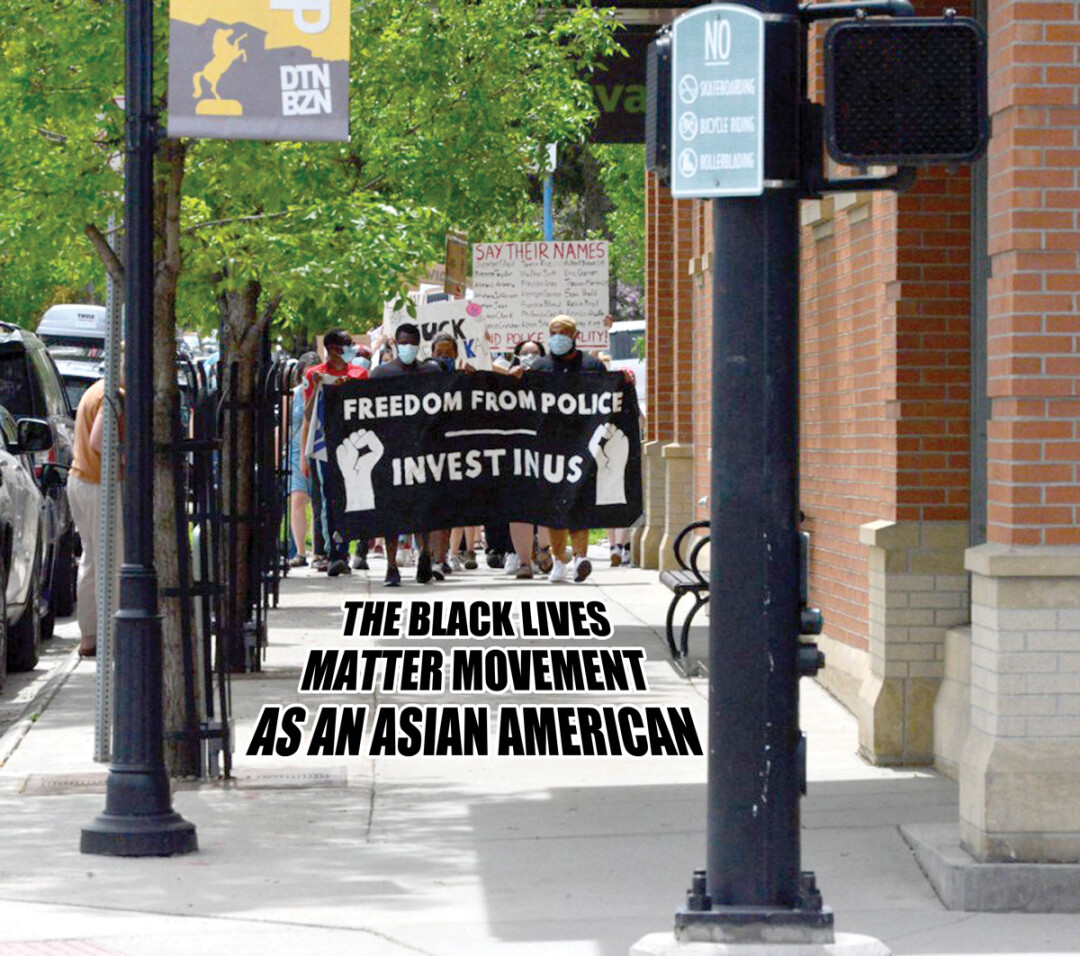
  • The Black Lives Matter Movement As An Asian American

    Bozeman Magazine
    Bozeman, Montana
    2020-07-01

    Cassie Pfannenstiel

    The issue of race in America is complex. Many communities of varying cultures exist together often without accepting one another in a meaningful way. Growing up in a multicultural home as a mixed-race child, I often felt as a cultural outsider to either half of me. Around my white friends and family, I was the minority and with other Asians, I was “too white” to really fit in.

    I had two different sides of me that were never really brought together. I wasn’t allowed to learn Tagalog from my mother growing up, which caused me to miss out on a lot of Filipino culture and deeper relationships. Even today, my mother and I have a strained relationship because of the language barrier between us. The lack of that half of my culture was filled by the other half of my upbringing: a mostly white-washed experience in which I still wasn’t fully accepted because of my mixed origins. As a child, I was unable to understand where I stood amongst the white kids with “normal” upbringings. When I looked at myself, I couldn’t tell if I even looked Asian or not. I became used to random strangers asking questions like: “What are you?” “What’s your heritage?” “Where are you from? No, originally.” These questions solidified my racial ambiguity. I became used to identifying as white and American first before my more prominent Asian culture. The questioning reminded me that although I had embraced and assimilated into white culture, I was not white…

    Read the entire article here.