• ‘Complicating my place:’ multiracial women faculty navigating monocentricity in higher education––a polyethnography

    Race Ethnicity and Education
    Published online: 2020-04-23
    DOI: 10.1080/13613324.2020.1753679

    Kelly F. Jackson, Associate Professor of Social Work
    Arizona State University

    Dana J. Stone, Associate Professor of Educational Psychology and Counseling
    California State University, Northridge

    E. Namisi Chilungu, Clinical Assistant Professor of Psychology
    Georgia State University

    Jillian Carter Ford, Associate Professor of Social Studies Education
    Kennesaw State University, Kennesaw, Georgia

    This polyethnography is an interdisciplinary collaboration between four multiracial women faculty employed at different universities across the US to examine their experiences navigating monocentricity in higher education. This insightful study amplifies the voices of a particular subset of women of color faculty who identify multiracially – a group overlooked in existing literature examining diverse faculty experiences in higher education. Utilizing Multiracial Critical Race Theory (MultiCrit), we reflex on the similarities and nuances that exist within and between our written stories of experience. Conjointly, our critical reflections reveal the prevalence of monoracism within institutions of higher education, which places both internal and external pressures on multiracial women faculty to demarcate themselves monoracially, while simultaneously maintaining a clandestine borderland identity within their departments. Implications for this study reveal the importance of multiracial counterspaces for multiracial faculty as a form of resistance against monocentricity in US institutions of higher education.

    Read or purchase the article here.

  • How Should I Think About Race When Considering a Sperm Donor?

    The Ethicist
    The New York Times Magazine
    2020-06-16

    Kwame Anthony Appiah, Professor of Philosophy, Law
    New York University


    Illustration by Tomi Um

    I am an American woman, of Ashkenazi Jewish ancestry, and I strive to live my life as an active agent against racism and white supremacy. I am beginning to consider having children and am open to bearing a child as a single mother. It is possible to sort through sperm donors by race, eye color, education level and so on. If I choose a donor of color, am I condemning my child to be born into a system designed not to serve them? Or can I use my white privilege to help them fight that system? Would my future child of color feel separated from their heritage with me as their mother? If I choose a white donor, am I succumbing to racist ideas of what traits are “desirable,” or taking the “easy road” in knowing my child will look more like me? What do you think? Name Withheld

    Women have been making choices about their children’s possible appearance and identity from the beginning of human history. Long before genetics, people knew that parental characteristics show up in their offspring. With modern technologies, the prospects for trying to fix your child’s heritable characteristics are expanding, raising plenty of ethical issues. Race, however, is not a biological fact but a social fact — a social fact that, for example, Americans who are known to have African ancestry are regarded as African-American. What’s more, having an African-American donor doesn’t tell you what your child’s skin or hair will look like. You can be socially black without looking black, like Walter White, the longtime head of the N.A.A.C.P.

    I’m spelling all this out because your question about having a child with a sperm donor of color presupposes that it will produce a child who won’t look “white,” and that’s not necessarily the case. Suppose you have a white-looking son with an African-American sperm donor. Then you and your child will have a choice to make about whether he or she should identify as African-American. Some people think that failing to do so — “passing for white” — is somehow dishonest. Yet to hold that you must identify as black in those circumstances would be to accede to a longstanding American notion (“the one-drop rule”) that one black ancestor makes you black. You could reasonably reject that notion, which is rooted in the history of slavery and the nonsensical racial theories that grew up with it…

    Read the entire article here.

  • The Accident of Color: A Story of Race in Reconstruction

    W. W. Norton
    2020-06-18
    336 pages
    6.4 x 9.6 in
    Hardcover ISBN: 978-0-393-24744-2
    Paperback ISBN: 978-0-393-53172-5

    Daniel Brook

    A technicolor history of the first civil rights movement and its collapse into black and white.

    In The Accident of Color, Daniel Brook journeys to nineteenth-century New Orleans and Charleston and introduces us to cosmopolitan residents who elude the racial categories the rest of America takes for granted. Before the Civil War, these free, openly mixed-race urbanites enjoyed some rights of citizenship and the privileges of wealth and social status. But after Emancipation, as former slaves move to assert their rights, the black-white binary that rules the rest of the nation begins to intrude. During Reconstruction, a movement arises as mixed-race elites make common cause with the formerly enslaved and allies at the fringes of whiteness in a bid to achieve political and social equality for all.

    In some areas, this coalition proved remarkably successful. Activists peacefully integrated the streetcars of Charleston and New Orleans for decades and, for a time, even the New Orleans public schools and the University of South Carolina were educating students of all backgrounds side by side. Tragically, the achievements of this movement were ultimately swept away by a violent political backlash and expunged from the history books, culminating in the Jim Crow laws that would legalize segregation for a half century and usher in the binary racial regime that rules us to this day.

    The Accident of Color revisits a crucial inflection point in American history. By returning to the birth of our nation’s singularly narrow racial system, which was forged in the crucible of opposition to civil rights, Brook illuminates the origins of the racial lies we live by.

  • Black Tommies: British Soldiers of African Descent in the First World War

    Liverpool University Press
    2015-12-04
    208 pages
    Hardback ISBN: 978-1-781-38018-5
    Paperback ISBN: 978-1-781-38019-2
    eBook ISBN: 978-1-781-38427-5

    Ray Costello

    Black Tommies is the first book entirely dedicated to the part played by soldiers of African descent in the British regular army during the First World War. If African colonial troops have been ignored by historians, the existence of any substantial narrative around Black British soldiers enlisting in the United Kingdom during the First World War is equally unknown, even in military circles. Much more material is now coming to light, such as the oral testimony of veterans, and the author has researched widely to gather fresh and original material for this fascinating book from primary documentary sources in archives to private material kept in the metaphorical (and actual) shoe boxes of descendants of black Tommies. Reflecting the global nature of the conflict, Black Tommies takes us on a journey from Africa to the Caribbean and North America to the streets of British port cities such as Cardiff, Liverpool and those of North Eastern England. This exciting book also explodes the myth of Second Lieutenant Walter Tull being the first, or only, black officer in the British Army and endeavours to give the narrative of black soldiers a firm basis for future scholars to build upon by tackling an area of British history previously ignored.

  • My Wife Is Black. My Son Is Biracial. But White Supremacy Lives Inside Me

    Cognoscenti
    WBUR
    Boston, Massachusetts
    2020-06-22

    Calvin Hennick


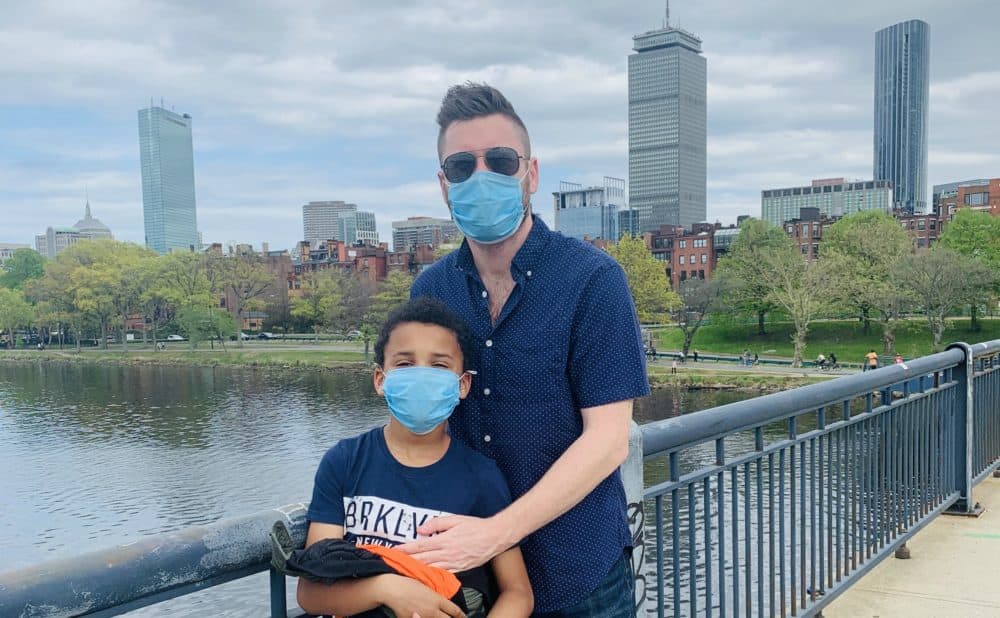
    The author and his son (Courtesy)

    My son is 9 years old. He’s big and beautiful and biracial, and although my wife and I have always known we would need to prepare him to face racism, we’ve never talked to him or his little sister about police violence against Black people. Not until now.

    He wept when we told him about George Floyd. His voice shaking, he asked whether the same thing would one day happen to him.

    My wife and I told him to draw about his feelings, and what he brought back to us broke both our hearts. In pen, he’d drawn a white police officer standing in front of a cruiser, holding up a smoking gun and looking down at an unseen corpse. My son had written the words “Killed Me,” with an arrow pointing down at his own body, lying lifeless just outside the frame of the page.

    There’s nothing my son can do to prevent this nightmare from becoming a reality. There’s nothing he can do to change the way the world will see him when he grows into a tall, broad-shouldered Black man.

    To protect my son, and every other Black boy and girl in America, white people must change the way our own eyes see the world. We must do the work of stamping out white supremacy where it lives: in our systems, and in ourselves…

    Read the entire article here.

  • Public Secrets: Race and Colour in Colonial and Independent Jamaica

    Liverpool University Press
    2019-09-10
    280 pages
    Hardback ISBN: 978-1-789-62000-9

    Henrice Altink, Professor of Modern History; Co-Director of the Interdisciplinary Global Development Centre
    University of York

    Informed by critical race theory and based on a wide range of sources, including official sources, memoirs, and anthropological studies, this book examines multiple forms of racial discrimination in Jamaica and how they were talked about and experienced from the end of the First World War until the demise of democratic socialism in the 1980s. It also pays attention to practices devoid of racial content but which equally helped to sustain a society stratified by race and colour, such as voting qualifications. Case studies on the labour market, education, the family and legal system, among other areas, demonstrate the extent to which race and colour shaped social relations in the island in the decades preceding and following independence and argue that racial discrimination was a public secret – everybody knew it took place but few dared to openly discuss or criticise it. The book ends with an examination of race and colour in contemporary Jamaica to show that race and colour have lost little of their power since independence and offers some suggestions to overcome the silence on race to facilitate equality of opportunity for all.

  • As a White Mom to Black Children, I Question Other Parents’ Intentions 24/7

    Working Mother
    2020-06-12

    Audrey Goodson Kingo, Deputy Editor


    I must protect my 4-year-old son and 9-month-old daughter.

    To be a good mom to my kids, I must be their fiercest advocate at all times, because the world won’t be.

    I remember my biggest parenting mistake with perfect clarity. The shame still turns my stomach when I recall the moment I sided with white parents, who look like me, instead of my Black son…

    Read the entire article here.

  • Comfortable in My Own Skin

    Sojourners
    January 2020

    Maika Llaneza
    New Orleans, Louisiana

    My theology says brown skin is beautiful, but my Pinterest page said otherwise.

    MY EXPERIENCE BEING color-shamed began when I was 5 years old and still living in the Philippines. My mom and aunts often told me that I could be mistaken for “the maid’s daughter,” due to my darker brown skin. Even at a young age, I understood it was intended as an insult.

    As I grew up, billboards, films, television shows, and magazines bombarded me with images of white Americans and Filipinas with white facial features. Mestiza Filipina models and actresses—celebrities admired by young girls like me—advertised skin-whitening products.

    Color-shaming by other Filipinas continued after I moved to the United States at age 7. My mom, titas (aunts or older women), and lolas (grandmothers or elderly women) told me to “stay away from the sun” and “try not to get so dark.” They told me I would look even prettier if I had lighter skin…

    Read the entire article here.

  • Afro-Mexican Women in Saint-Domingue: Piracy, Captivity, and Community in the 1680s and 1690s

    Hispanic American Historical Review
    Volume 100, Issue 1 (2020-02-01)
    pages 3-34
    DOI: 10.1215/00182168-7993067

    Pablo Miguel Sierra Silva, Assistant Professor of History
    University of Rochester, Rochester, New York

    This article focuses on the experiences of women of African descent who were made captives (and, in some cases, recaptives) after the 1683 buccaneer raid on Veracruz, the most important port in the Viceroyalty of New Spain (colonial Mexico). Although the raid is well known to historians of piracy, its implications for women’s history and African diaspora studies have not been properly contextualized in a period of expanding Atlantic slavery. This article proposes a close reading of contraband cases, parochial registers, slave codes, and eyewitness accounts centered on Afro-Mexican women who were kidnapped to Saint-Domingue (modern-day Haiti). A focus on displacement and resilience opens new narratives through which to understand women who transcended their captivity by becoming spouses to French colonists and free mothers to Saint-Domingue’s gens de couleur (people of mixed race).

    Read or purchase the article here.
  • The Confederate Flag Didn’t Bother Bubba Wallace. Until It Did.

    The New York Times
    2020-06-19

    Juliet Macur


    Barry Cantrell

    The only black driver in NASCAR’s top tier, he has emerged as an impassioned activist who got the flag banned at races in the largely white sport after years of putting up with it.

    Darrell “Bubba” Wallace Jr., the only black driver in NASCAR’s top racing series, has drawn widespread attention and acclaim for his principled stand that got the Confederate flag banned from races in a largely white sport.

    Yet, after years of often quiet acceptance of the sport’s “racist label,” as he put it, nobody was more surprised than his mother that he had become a central figure in the sports world’s upheaval regarding race.

    “I was shocked,” his mother, Desiree Wallace, said in a telephone interview. “I said, ‘Wait a minute, is this my son? The one who doesn’t really care about anything but getting in the car and driving?’ I’m tripping that he’s gone from being a racecar driver to becoming a daggone activist. Who does that? Not Bubba.”

    Yet a series of events, particularly the killing of a black man, Ahmaud Arbery, while he was jogging in a predominantly white neighborhood in Georgia, flipped a switch in Wallace, he and those who know him said…

    Read the entire article here.