• “I got plenty of African American friends — I’ve known ’em since I was 14,” said [Lonnie] Miles, adding that he learned to say ‘African American’ out of respect. “They know if they need anything, all they have to do is ask me. I have supper with them, and they have supper with me too. Only thing I don’t like is blacks and whites mixing, but I keep that to myself.”

    Stephanie McCrummen, “Wrapped up in the Confederate flag,” The Washington Post, June 20, 2020. https://www.washingtonpost.com/nation/2020/06/20/heflin-alabama-confederate-flags.

  • [Florence] Price and her music were well received in Chicago. The great contralto Marian Anderson closed her legendary 1939 Lincoln Memorial concert with a piece arranged by Price. Still, she scraped to make ends meet, writing pop tunes and accompanying silent films. In 1943, she sent a letter to Serge Koussevitzky, conductor of the Boston Symphony Orchestra, acknowledging what she was up against. “I have two handicaps,” she wrote: “I am a woman and I have some Negro blood in my veins.”

    Tom Huizenga, “Revisiting The Pioneering Composer Florence Price,” All Things Considered, National Public Radio, January 21, 2019. https://www.npr.org/2019/01/21/686622572/revisiting-the-pioneering-composer-florence-price.

  • Rediscovering Frank Yerby: Critical Essays

    University Press of Mississippi
    2020-05-15
    208 pages
    Hardcover ISBN: 9781496827821
    Paperback ISBN: 9781496827838

    Edited by:

    Matthew Teutsch, Director, Lillian E. Smith Center
    Piedmont College, Demorest, Georgia

    The first book-length sounding of the major contributions of the first black American novelist to sell more than a million copies

    Contributions by Catherine L. Adams, Stephanie Brown, Gene Andrew Jarrett, John Wharton Lowe, Guirdex Massé, Anderson Rouse, Matthew Teutsch, Donna-lyn Washington, and Veronica T. Watson

    Rediscovering Frank Yerby: Critical Essays is the first book-length study of Yerby’s life and work. The collection explores a myriad of topics, including his connections to the Harlem and Chicago Renaissances; readership and reception; representations of masculinity and patriotism; film adaptations; and engagement with race, identity, and religion. The contributors to this collection work to rectify the misunderstandings of Yerby’s work that have relegated him to the sidelines and, ultimately, begin a reexamination of the importance of “the prince of pulpsters” in American literature.

    It was Robert Bone, in The Negro Novel in America, who infamously dismissed Frank Yerby (1916–1991) as “the prince of pulpsters. ” Like Bone, many literary critics at the time criticized Yerby’s lack of focus on race and the stereotypical treatment of African American characters in his books. This negative labeling continued to stick to Yerby even as he gained critical success, first with The Foxes of Harrow, the first novel by an African American to sell more than a million copies, and later as he began to publish more political works like Speak Now and The Dahomean.

    However, the literary community cannot continue to ignore Frank Yerby and his impact on American literature. More than a fiction writer, Yerby should be put in conversation with such contemporaneous writers as Richard Wright, Dorothy West, James Baldwin, William Faulkner, Margaret Mitchell, and more.

  • Revisiting The Pioneering Composer Florence Price

    All Things Considered
    National Public Radio
    2019-01-21

    Tom Huizenga, Music Producer


    Florence Price was the first African-American woman to have her music performed by a major symphony orchestra.
    Special Collections, University of Arkansas Libraries

    In 1933, the Chicago Symphony Orchestra gave the world premiere of Symphony No. 1 by a then little-known composer named Florence Price. The performance marked the first time a major orchestra played music by an African-American woman.

    Price’s First Symphony, along with her Fourth, has just been released on an album featuring the Fort Smith Symphony, conducted by John Jeter.

    Fans of Price, especially in the African-American community, may argue that her music has never really been forgotten. But some of it has been lost. Not long ago, a couple bought a fixer-upper, south of Chicago, and discovered nearly 30 boxes of manuscripts and papers. Among the discoveries in what turned out to be Price’s abandoned summer home was her Fourth Symphony, composed in 1945. This world-premiere recording is another new piece of the puzzle to understanding the life and music of Price, and a particular time in America’s cultural history.

    Read the story here. Listen to the story (00:04:00) here.

  • Are you raising a Biracial child? If so – we want to learn more about their experiences in your family!

    McKenzie N. Stokes, B.S., Doctoral Candidate
    Applied Social and Community Psychology
    North Carolina State University

    2020-06-15

    We are currently conducting a research study on if and how multiracial families communicate about race and culture. We are reaching out to ask if your child could participate in our study which will include completing 2 brief surveys and partaking in a 1-hour group discussion with other Biracial youth on Zoom.

    Participation is completely voluntary, and their answers will be confidential. They will receive a $10 (USD) Amazon gift card for participating. Information from this project will help researchers and family psychologists understand how to best serve Biracial youth and multiracial families like yours.

    In order to participate, your child must be:

    • Between the ages of 12 and 17
    • Biracial Black-White (e.g. the biological child of 1 White parent and 1 Black parent)
    • Live with 1 at least of their biological parents in the United States

    If you are interested, please click on this link for our brief eligibility questionnaire https://tinyurl.com/ProjectBASES. Once we confirm eligibility, we will send you an email with more information about the study and the activities your child will participate in. If your child is not eligible to participate, the data will be destroyed.

    If you have any questions, please do not hesitate to contact me by phone (919) 438-3176 or email: mnstokes@ncsu.edu.

    Thank you!

  • My family was thoroughly racialized long before we moved out of Puerto Rico. I suppose when one grows up in a Black family designated as such by history, economics, society, and experiences of racism, along with the embodied trauma it produces, as much as by one’s cultural practices, one is likely, in the context of the archipelago, to also thoroughly understand that: 1. being evidently Black is a disadvantage; 2. that being mixed-race while publicly aspiring to be white is acceptable; and 3. being light-skin and/or white means privilege and access.

    Hilda Lloréns, “‘Racialization works differently here in Puerto Rico, do not bring your U.S.-centric ideas about race here!’,” Black Perspectives, March 3, 2020. https://www.aaihs.org/racialization-works-differently-here-in-puerto-rico-do-not-bring-your-u-s-centric-ideas-about-race-here.

  • Rebecca Hall Talks Complicated Notions Of Bi-Racial Identity In Directorial Debut ‘Passing,’ ‘Tales From The Loop’ & More [Deep Focus Podcast]

    The Playlist
    2020-06-10

    Rodrigo Perez

    Actor Rebecca Hall comes from a unique and interesting pedigree and lineage. There’s the surface element of that pedigree which could be seen as aristocratic privilege in the world of the arts. She is the daughter of the famous theatre director Sir Peter Hall (who passed away in 2017) and her mother is the legendary opera singer and stage actress Maria Ewing. Hall attended Cambridge University’s constitute school, St Catharine’s College, studied English, and eventually found her way back to acting after some time briefly spent as an actor during childhood.

    Known for an eclectic career that took off after an early breakthrough performance in Christopher Nolan’s “The Prestige,” Hall’s also appeared in such movies as “Vicky Cristina Barcelona,” “Frost/Nixon,” Nicole Holofcener’s “Please Give,” Ben Affleck’s “The Town,” Joel Edgerton’s “The Gift,” and Antonio Campos’ striking indie “Christine” which brought her much extra acclaim to an already celebrated career.

    But her personal identity, or at least the one of her parents, is much different. Hall’s mother is from Detroit, Michigan—perhaps an unlikely place as any to birth an opera singer—and bi-racial with African American and Dutch ancestry. Her grandfather was also bi-racial and to hear Hall tell it, both of them had a very complicated and complex struggle with their identity and how they appeared to others in the world.

    This struggle, this question of identity and who you pass as in the world is something Hall tries to reckon with in “Passing,” her upcoming directorial debut which probably couldn’t be more timely. An adaption written by Hall as well, and something she’d been hoping to make for years, “Passing” is based on Nella Larsen’s 1920s Harlem Renaissance novel of the same name that explores the practice of racial passing, a term used for a person classified as a member of one racial group who seeks to be accepted by a different racial group. The film stars Tessa Thompson and Oscar nominee Ruth Negga as two reunited high school friends, whose renewed acquaintance ignites a mutual obsession that threatens both of their carefully constructed realities.

    In this latest episode of our Deep Focus Podcast, Hall discussed “Passing” at length, including the ideas of permission and permits needed to try and tell these kinds of stories and the charges of cultural appropriation that can be lobbied at one when making them. But her original statement of intent is perhaps most succinct and eloquent when she said: “I came across [Passing] at a time when I was trying to reckon creatively with some of my personal family history, and the mystery surrounding my bi-racial grandfather on my American mother’s side. In part, making this film is an exploration of that history, to which I’ve never really had access.”

    At the time, she described “Passing” as an astonishing book “about two women struggling not just with what it meant to be Black in America in 1929, but with gender conventions, the performance of femininity, the institution of marriage, the responsibilities of motherhood, and the ways in which all of those forces intersect.”…

    Read the entire article and listen to the podcast (01:04:15) here.

  • Local Voices: What Does it Mean to “Pass” as White?

    The Coronado Times
    Coronado, California
    2020-06-07

    Carolyn Osorio
    Barrio Logan, San Diego, California


    Carolyn Osorio

    The Coronado Times asked its writers to tackle the topic of race in Coronado. Given the current environment, we were asked to address the topic head-on and at first, I’ll admit, I wasn’t sure how to tackle it. I do not live in Coronado, I am not black, and I would not presume to imagine the lived experience of being black in America today. However, tensions are high everywhere and an altercation with one of my Barrio Logan neighbors about my whiteness this past week highlighted a very important topic that I do feel qualified to tackle: What does it mean to “pass” as white?

    This is a question I, and other mixed-race people, ask ourselves constantly. Born from a combination of cultures, we have a foot in two (or more) worlds but, oftentimes, none of them fits quite right. For many of us, our racial makeup can be physically ambiguous and this ambiguity often allows us to “pass.” I’d like to think we are the living embodiment of America’s melting pot, a celebration of mixed cultures and languages, the product of two people choosing to love a different race than their own. Instead, we are often not quite white enough to be “white” but not quite brown or black or Asian or native enough to belong entirely to part of our cultural makeup. When we fill out the racial demographic section of forms, we are forced to select just one box that might define us. This has never felt more important than it does now in the face of protests and movements dedicated to abolishing racial prejudice…

    Read the entire article here.

  • How to Talk to Multiracial Kids About Race

    KQED News
    San Francisco, California
    2020-06-12

    Lakshmi Sarah, Digital Producer
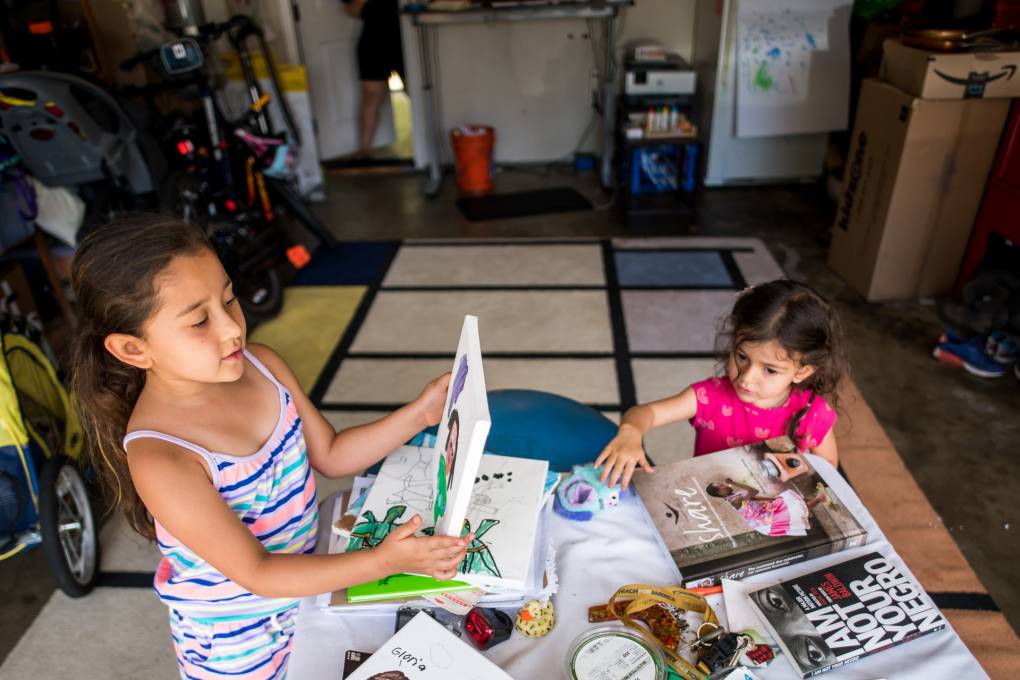

    Eva Lourdes, 7 Stella Marèsol, 3, at a table in their garage filled with art and books on June 11, 2020. (Beth LaBerge/KQED)

    June 12 is celebrated as “Loving Day,” a day commemorating Loving v. Virginia — the landmark 1967 Supreme Court case that declared laws against interracial marriage unconstitutional in the United States. With this in mind, we spoke with a few Bay Area families and experts on the importance of talking about race in multiracial families.

    Sarah Baltazar-Pinheiro identifies as Filipino American and works in the education field. She lives in Walnut Creek with her husband, who is Afro-Brazilian, and their two daughters, ages 7 and 3-years-old.

    “What is the right way to educate a 7-year-old who’s, like, half farts, half losing her teeth? And also 10% attention span?” she said.

    At home, they are doing history lessons she calls “American heroes are Black women.” Baltazar-Pinheiro calls to her daughter to see if she remembers who they talked about the last few days — Rosa Parks, Ida B. Wells and Shirley Chisholm. Her daughter recounts the names, with a few small hints…

    …“If you think your whiteness will protect your mixed kids from this country as it currently stands, you’re misguided,” she said. “We have words and we have language to talk about … race and class and gender — and gender fluidity and how we all want to live in this world. I just want to teach her the words that she needs so that she can always express herself.”…

    …We also spoke with Mark and Kelley Kenney, who are both counselors teaching and working in academic settings. They co-authored the book Counseling Multiracial Families and led the writing of Competencies for Counseling the Multiracial Population.

    “It’s kind of interesting to me that, on some level, things have shifted,” Kelley Kenney said, when thinking back on their years of studying the topic. “But, you know, we’re still dealing with the same inherent issue of racism and bias and lack of understanding. … I’m hoping that we’re moving forward in at least starting to dialogue more about it.”

    Kelley Kenney said talking about race within family is not just a singular event. “It’s not just a one time conversation, but it’s very, very, very much a part of the whole family dynamic.”…

    …“In cases where the relationship involves a white partner for whom this is perhaps their first interactions … dealing with issues of slavery, it is important to spend some time being honest with folks and really talking about what that all means in terms of how they want to proceed in a relationship and a family and all of those things.” — Mark Kenney, counselor…

    Read the entire article here.

  • I’m a black man with white privilege. I see how it distorts America.

    The Washington Post
    2020-06-11

    Steve Majors
    Takoma Park, Maryland


    A demonstrator speaks to the crowd on a bullhorn during a protest against racial inequality. (Kevin Mohatt/Reuters)

    I walk a racial tightrope. It’s one I’ve struggled to balance on for my entire life. But over the past several weeks, I’ve felt myself teetering. I’m black and outraged that racism continues to kill black people like George Floyd, Ahmaud Arbery and Breonna Taylor while burdening the lives of so many others in our country. But I know that I am not one of those people. I know the freedom of moving through a world that magically removes many barriers from my life and shields me from harm — all because of my ability to pass as white.

    My skin tone has given me white privilege. For more than five decades of the journey across my tightrope, I’ve had what feminist researcher Peggy McIntosh calls an “invisible weightless knapsack of special provisions, maps, passports, codebooks, visas, clothes, tools, and blank checks.” These are the tools of white privilege, unwanted and conferred on me at birth by a white father who had a fleeting relationship with my divorced black mother. I was the youngest of five and grew up with older siblings in a large, extended black family. They were quick to remind me that what they jokingly called my “light, bright, almost-white skin” did not grant me any special advantage in our family. But they and I could see that wasn’t going to be the case in the outside world.

    I want to assure my white friends that white privilege is real, because I benefit from it every day. And I want to explain to my black family that even though this knapsack that whites carry is invisible, weightless and present from birth, it’s possible to teach yourself that it’s there. I say that not so I can seek forgiveness for myself or offer absolution for any others. It’s to explain why so many claim to be blind and unfeeling to something that has been present throughout the history of this country. Even as I continue to reap its benefits, I am ashamed of the white privilege I carry around because I know it comes at the expense of others who have every right to the same opportunities, advantages and freedoms…

    Read the entire article here.