• When Stuart Hall was White

    Public Books
    2017-01-23

    James Vernon, Professor of History
    University of California, Berkeley


    Dawoud Bey, Stuart Hall (1998)

    I do not recall when I discovered that Stuart Hall was black. Growing up in Britain as neoliberalism first began to take shape under the rule of Margaret Thatcher, I found that Hall’s work helped me comprehend what was happening to the world around me. I think I began reading him with “The Great Moving Right Show,” an article published in Marxism Today, the ecumenical and “reform”-minded journal of the Communist Party of Great Britain, in January 1979. It is the piece now celebrated as having named “Thatcherism” as a new political formation. Thatcherism, he argued, represented a new type of politics, one that had mobilized a populist revolt to Make Britain Great Again by running it like a business and stopping immigration. It is strangely unnerving to read it again now. Later that year Hall became a professor of sociology at the Open University and began to appear regularly on its television programs designed (in the era before profit-seeking online classes) for their distance learning, nontraditional, students. It was probably on one of those superb programs, no doubt several years later, that I first saw and heard Stuart Hall.

    In retrospect, it is not surprising that I had once assumed Hall was white. Growing up in the countryside as a white middle-class boy, people of color were almost completely absent from my life. I suspect that I was not the only person to imagine he was white. There has long been a way of narrating Hall’s life and work that erases his formation in Jamaica as a colonial subject and a black man. It is a narrative that claims him as part of the British canon, as probably the country’s most influential social and cultural theorist of the late 20th century. It is a narrative that was rehearsed in many of the obituaries that followed his death in 2014.

    In this telling, Hall’s life begins when he arrives on the shores of Albion dressed like an English gentleman and goes up to Oxford University to study English literature. It continues with Hall, while writing a PhD on Henry James, beginning to forge, alongside other students there like Raphael Samuel and Charles Taylor, a New Left attuned to the changed social and cultural conditions of Britain in the 1950s. The big question for Britain’s New Left was if or how culture mattered in shaping the working class. For Hall and many of his comrades, the urtexts for thinking through this question were Richard Hoggart’s The Uses of Literacy (1957), Raymond Williams’s Culture and Society (1958), and E. P. Thompson’s The Making of the English Working Class (1963)…

    Read the entire article here.

  • Why Some Black Puerto Ricans Choose ‘White’ on the Census

    The New York Times
    2020-02-09

    Natasha S. Alford


    A bomba dance class at the Corporación Piñones Se Integra community center in Loíza, P.R.
    Erika P. Rodriguez for The New York Times

    The island has a long history of encouraging residents to identify as white, but there are growing efforts to raise awareness about racism.

    LOÍZA, P.R. — A dozen dancers wearing bright, colorful ankle-length skirts gathered around five wooden drums. Their shoulders and hips pulsed with the percussion, an upbeat, African-inspired rhythm.

    Loíza, a township founded by formerly enslaved Africans, is one of the many places in Puerto Rico where African-inspired traditions like the bomba dance workshop at the Corporación Piñones se Integra community center thrive.

    But that doesn’t mean all of the people who live there would necessarily call themselves black.

    More than three-quarters of Puerto Ricans identified as white on the last census, even though much of the population on the island has roots in Africa. That number is down from 80 percent 20 years ago, but activists and demographers say it is still inaccurate and they are working to get more Puerto Ricans of African descent to identify as black on the next census in an effort to draw attention to the island’s racial disparities…

    Read the entire article here.

  • The importance of learning to style my multiracial son’s hair

    The Washington Post
    2020-02-05

    Nevin Martell


    Nevin Martell and his son, Zephyr. (Indira Martell)

    When I look at my son, Zephyr, I see a blend of his mother and me. His golden caramel skin is made with her browned butter and my heavy cream and white sugar. Both of us lent him elements for his face — her smile, my eyes. When he makes jokes, I hear echoes of myself, but when he laughs, it reminds me of my wife. He got her speed and my endurance.

    Despite my paternal desire to see a piece of me in every part of him, soon after his birth I became convinced that somehow my genes played no role in the creation of his hair. He got that solely from his mother, whose tightly coiled curls require patient care and attention. All her diligent work pays off. From buns to braids to an Afro — whatever style she chooses elicits compliments. I have a head of straight strands, requiring little maintenance and styled in a fashion my barber calls a disconnected cut, which is appropriate given how little thought I give it.

    As it began to grow into its curl pattern, Zephyr’s hair became less and less like my own. Though I tried, I never seemed to be able to dress or style it in the way he preferred. So, for the first few years of his life, it became solely his mother’s purview. Whenever it needed to be done, I would throw up my hands like a sitcom father from another era and exasperatedly declare to my wife, “You take care of it, because I can’t do it!”

    “You’re perfectly capable,” she would always admonish me as she deftly coaxed his curls into place. “It’s not rocket science.”…

    Read the entire article here.

  • The claim that genetics supports any form of racism – or that it supports the idea of race as a biologically meaningful concept – is a fallacy, argues the geneticist, author and Twitter warrior Adam Rutherford, in this slim, two-fingered salute to the haters: “The continual failure to settle on the number of races is indicative of its folly. No one has ever agreed how many races there are, nor what their essential features might be, aside from the sweeping generalisations about skin colour, hair texture and some facial features.” The clear genetic boundaries that racists crave to bolster their narrative are simply absent from the analyses of our 20,000-odd genes and their variants.

    Anjana Ajuha, “The pseudoscience of hate,” The New Statesman, February 5, 2020. https://www.newstatesman.com/culture/books/2020/02/how-to-argue-with-a-racist-adam-rutherford-review.

  • Ahamefule J. Oluo: Susan

    The Clarice Smith Performing Arts Center
    University of Maryland
    8270 Alumni Drive
    College Park, Maryland 20742-1625
    2020-02-07 and 2020-02-08, 20:00 EST (Local Time)

    After moving audiences at The Clarice in 2017, trumpeter, composer and comedian Ahamefule J. Oluo returns with “Susan,” a memoir delivered through wry comedic monologue and live, grand-scale big-band and jazz.

    When Susan Hawley was a sophomore in college, she fell in love with a doctoral student from Nigeria. They got married, had two children, and just as their dream life seemed like it was coalescing, her husband went back to Nigeria to visit his family and never contacted her again—leaving her a Midwestern white lady with two African babies. They were desperately poor; Susan began gaining weight rapidly, soon reaching 400 pounds. These were the cards she was dealt. Ahamefule J. Oluo’s theatrical work, Susan, tells his mother’s story as a means to tell the story of millions of women. It is a tangible crystallization of how race, class and size affect people all over the world every day. Despite all that darkness, Susan will be funny. It’s a collection of wry, black, but humane monologues, interspersed with live, grand-scale orchestral music.

    This vulnerable theatrical work about his childhood tells the story of how his Midwestern mother was left to raise two bi-racial babies after the sudden departure of her husband. There’s obvious chemistry between Oluo’s singular voice and the grand creation of the music; at times, when the story is too painful for him, the ensemble carries the show. “Susan” is a category-defying reflection on how race, class, and appearance impact everyone—and how we play the hand that we’re dealt.

    In 2002, after being selected as Town Hall Seattle’s first-ever artist-in-residence, Oluo realized he wanted to do something different. After years of performing and recording with prominent musicians like John Zorn, Hey Marseilles, Wayne Horvitz and Macklemore, Oluo knew he had his own story to tell—and the diverse set of skills to do it. During his time in residency, he began experimenting with blending big-band, jazz, standup and memoir to formulate a new musical and theatrical identity.

    For more information, click here.

  • Andrea Levy, my brilliant friend

    The New Statesman
    2020-02-05

    Gary Younge

    Remembering the novelist, one year after her death.

    While Bill Mayblin, the novelist Andrea Levy’s widower, was gathering her things for the British Library archive, he came across a red Moleskine book containing a handwritten tale that he’d never seen before.

    Entitled “Two”, it is a brief dialogue between two unnamed functionaries working for the Grim Reaper . They are discussing Andrea’s impending death. With a mixture of wry cynicism, callous ambivalence and bureaucratic nonchalance they ponder her admittance, as though standing at a water cooler in a celestial call centre.

    I have someone for you.
    Good. Male or female?
    Female.
    Childbirth?
    Don’t be silly, we haven’t done childbirth in ages. It’s a bit rare you know.
    Around here maybe but not in other parts.
    Well, maybe so. But childbirth… no. Cancer.
    Breast?
    Of course.
    I’m not going to have to hang about for ages am I? Only the last one took years.
    It’s on. It’s off. Tries my patience.

    As a close friend of Andrea’s, who talked with her a lot about the cancer she had and the death that was coming, I found the voices were recognisably hers. She lived with cancer for a decade – long enough for her to joke that she stopped telling people about it because some looked almost disappointed when they bumped into her and found her looking fine…

    Read the entire article here.

  • The pseudoscience of hate

    The New Statesman
    2020-02-05

    Anjana Ajuha, Contributing Science Writer
    The Financial Times

    Genetics does not recognise race as a biologically meaningful concept, but that doesn’t stop racists invoking its findings.

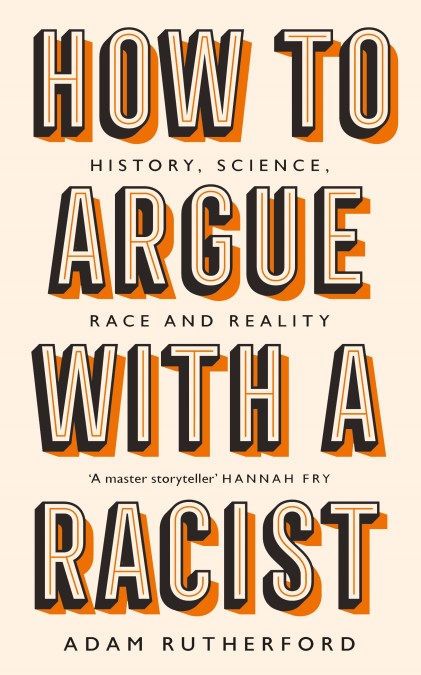
    How To Argue With a Racist: History, Science, Race and Reality. Adam Rutherford Weidenfeld & Nicolson, 224pp, £12.99

    Accidental encounters with racists lead me to believe that they are open to neither reason nor self-improvement. I must conclude, then, that a book entitled How to Argue With a Racist will remain untouched by those who would most benefit from reading it. This is a pity, as there is a growing army who have succumbed to a phenomenon known as “race realism”. This is racism reinterpreted for the internet age: a heady brew of misunderstood science, ugly conspiracy and plain old prejudice that forms the basis of (usually) far-right and white supremacist thinking.

    Race realism promotes the spurious idea that science has uncovered distinct and meaningful differences between races but that this “truth” is somehow suppressed by snowflake scientists in hock to political correctness. Those supposed truths are then contorted by their abusers into parodies of racial destiny: black men are born to sprint but not to swim; Jews are born into moneylending; and, of course, whites are born above all others. Black people are several rungs below white peers on the social ladder not because of systemic oppression and discrimination but because they are naturally more stupid.

    It is a perverse system of thought that seeks to justify racial separateness and conveniently reinforce assertions of white superiority. This is an ideology treading water amid the flood of data pouring out of genetics studies and a mistaken concept of ancestry propagated by the consumer DNA testing market – which happily nurtures fantasies of Viking descent…

    Read the entire review here.

  • How to Argue With a Racist: History, Science, Race and Reality

    Weidenfeld & Nicolson an (imprint of The Orion Publishing Group)
    2020-02-06
    224 pages
    Hardcover ISBN-13: 9781474611244
    eBook ISBN-13: 9781474611268

    Adam Rutherford

    How to Argue With a Racist

    Race is real because we perceive it. Racism is real because we enact it. But the appeal to science to strengthen racist ideologies is on the rise – and increasingly part of the public discourse on politics, migration, education, sport and intelligence. Stereotypes and myths about race are expressed not just by overt racists, but also by well-intentioned people whose experience and cultural baggage steers them towards views that are not supported by the modern study of human genetics. Even some scientists are uncomfortable expressing opinions deriving from their research where it relates to race. Yet, if understood correctly, science and history can be powerful allies against racism, granting the clearest view of how people actually are, rather than how we judge them to be.

    How to Argue With a Racist is a vital manifesto for a twenty-first century understanding of human evolution and variation, and a timely weapon against the misuse of science to justify bigotry.

  • Overlooked No More: Homer Plessy, Who Sat on a Train and Stood Up for Civil Rights

    The New York Times
    2020-01-31

    Glenn Rifkin


    A mural in New Orleans shows what Homer Plessy, right, might have looked like. On the left is P.B.S. Pinchback, the first black man to serve as a governor in the United States, in Louisiana. Pinchback is often mistaken for Plessy.
    Mural by Ian Wilkinson; Photo by Jane Morse Rifkin

    He boarded a whites-only train car in New Orleans with the hope of getting the attention of the Supreme Court. But it would be a long time before he got justice.

    Since 1851, many remarkable black men and women did not receive obituaries in The New York Times. This month, with Overlooked, we’re adding their stories to our archives.

    When Homer Plessy boarded the East Louisiana Railway’s No. 8 train in New Orleans on June 7, 1892, he knew his journey to Covington, La., would be brief.

    He also knew it could have historic implications.

    Plessy was a racially mixed shoemaker who had agreed to take part in an act of civil disobedience orchestrated by a New Orleans civil rights organization.

    On that hot, sticky afternoon he walked into the Press Street Depot, purchased a first-class ticket and took a seat in the whites-only car…

    Read the entire article here.

  • Mahomes’ performance leaves no doubt: Black NFL QB’s have arrived

    NBC News
    2020-02-04

    Curtis Bunn


    Patrick Mahomes, 24, of the Kansas City Chiefs became the youngest quarterback to be named Super Bowl MVP. Mike Blake / Reuters

    “Mahomes’ performance was uplifting and annihilates the narrative that African American quarterbacks are somehow less capable.”

    Doug Williams did it first. Russell Wilson came next. And Patrick Mahomes is now the third African American quarterback to win a Super Bowl, and his explosive performance on Sunday confirmed, if anyone still questioned, that the era of the black NFL QB is upon us.

    With the world watching, Mahomes brought the Kansas City Chiefs back from a 10-point deficit in the final minutes, catapulting the franchise to its first Super Bowl win in 50 years, 31-20, over the shell-shocked San Francisco 49ers.

    For the first time in a week, there was an athletic performance impressive enough to distract sports fans from the tragic death of NBA legend Kobe Bryant.

    “Mahomes’ performance was uplifting and annihilates the narrative that African American quarterbacks are somehow less capable,” said Clint Crawford, an engineer, after getting a haircut at his favorite barbershop in Los Angeles Monday. “He executed when it counted most and demonstrated the kind of toughness and fiery resolve we came to expect from athletes like Tom Brady and Kobe Bryant.”…

    Read the entire article here.