• “Who Inherits?”: A Conversation Between Tao Leigh Goffe and Hazel V. Carby

    Public Books
    2020-02-03

    Tao Leigh Goffe, Assistant Professor of Literary Theory and Cultural History
    Cornell University, Ithaca, New York

    Over the decades of her transatlantic career, distinguished Yale University professor emerita of American and African American studies Hazel V. Carby has considered how one negotiates ancestral ties to two islands intimately entangled by empire, Britain and Jamaica. Her new book, Imperial Intimacies: A Tale of Two Islands, is her answer to that question.

    As Hazel explains in Imperial Intimacies, hers was an unlikely path to academia. She started out training as a ballerina and went on to teach at a secondary school in East London. When she moved to the West Midlands to pursue a master’s degree and then a PhD at the University of Birmingham, her life was altered forever by the influence of a mentor—Stuart Hall, esteemed professor and cofounder of the university’s Centre for Contemporary Cultural Studies—who also negotiated a family history strung between Britain and Jamaica.

    Hazel and I sat down to speak about the publication of Imperial Intimacies, a book that, she realized, she had been writing her whole life. We discussed the influence of books such as Jane Austen’s Mansfield Park and Octavia Butler’s Kindred. Like Dana, the main character in Butler’s Afrofuturist novel—who finds herself teleported into the plantations of the antebellum past, meeting her black and white ancestors—Hazel traces her African and European Carby lineage. She does so through meticulous research on her ancestors in England, Wales, and Jamaica.

    Hazel speculates on the subjectivity of one of her white forbears: an English man named Lilly Carby, who arrived in Jamaica in 1788 as a member of the British Army. What can Hazel possibly inherit from him, when her other ancestors were his property? Her experimental rendering in Imperial Intimacies presents the reader with a kaleidoscopic view of the ongoing coloniality of the present…

    Read the entire interview here.

  • “The best thing about it is you’re showing kids that no matter where you grow up, what race you are, that you can achieve your dream,” [Patrick] Mahomes said during the lead-up to the Super Bowl. “For me, being a black quarterback — having a black dad and a white mom — it just shows that it doesn’t matter where you come from.”

    Jason Reid, “Patrick Mahomes ushers in Era of the Black Quarterback,” The Undefeated, February 2, 2020. https://theundefeated.com/features/patrick-mahomes-ushers-in-era-of-the-black-quarterback/.

  • Fateful Triangles in Brazil: A Forum on Stuart Hall’s The Fateful Triangle: Race, Ethnicity, Nation, Part II

    Contexto International
    Volume 41, Number 2, Rio de Janeiro (May/Aug. 2019)
    pages 449-470
    DOI: 10.1590/s0102-8529.2019410200012

    Sharon A. Stanley, Professor of Political Science
    University of Memphis, Memphis, Tennessee

    João Nackle Urt, Assistant Professor
    Federal University of Grande Dourados (UFGD), Dourados-MS, Brazil

    Thiago Braz, Ph.D. Candidate
    Institute of International Relations
    Pontifical Catholic University of Rio de Janeiro (PUC-Rio), Rio de Janeiro-RJ, Brazil

    Stuart Hall, a founding scholar in the Birmingham School of cultural studies and eminent theorist of ethnicity, identity and difference in the African diaspora, as well as a leading analyst of the cultural politics of the Thatcher and post-Thatcher years, delivered the W. E. B. Du Bois Lectures at Harvard University in 1994. In the lectures, published after a nearly quarter-century delay as The Fateful Triangle: Race, Ethnicity, Nation (2017), Hall advances the argument that race, at least in North Atlantic contexts, operates as a ‘sliding signifier,’ such that, even after the notion of a biological essence to race has been widely discredited, race-thinking nonetheless renews itself by essentializing other characteristics such as cultural difference. Substituting Michel Foucault’s famous power-knowledge dyad with power-knowledge-difference, Hall argues that thinking through the fateful triangle of race, ethnicity and nation shows us how discursive systems attempt to deal with human difference.

    In ‘Fateful Triangles in Brazil,’ Part II of Contexto Internacional’s forum on The Fateful Triangle, three scholars work with and against Hall’s arguments from the standpoint of racial politics in Brazil. Sharon Stanley argues that Hall’s account of hybrid identity may encounter difficulties in the Brazilian context, where discourses of racial mixture have, in the name of racial democracy, supported anti-black racism. João Nackle Urt investigates the vexed histories of ‘race,’ ‘ethnicity’ and ‘nation’ in reference to indigenous peoples, particularly Brazilian Indians. Finally, Thiago Braz shows, from a perspective that draws on Afro-Brazilian thinkers, that emphasizing the contingency of becoming in the concept of diaspora may ignore the myriad ways by which Afro-diasporic Brazilians are marked as being black, and thus subject to violence and inequality.

    Part I of the forum – with contributions by Donna Jones, Kevin Bruyneel and William Garcia – critically examines the promise and potential problems of Hall’s work from the context of North America and western Europe in the wake of #BlackLivesMatter and Brexit.

    Read the entire article here.

  • When we’re young, it’s already incredibly difficult to figure out where we belong. It’s human nature to want to be liked, and sometimes we’ll do anything for approval. We’ll change the way we dress and what we listen to; we’ll code-switch our dialect depending on the people we’re with; whatever it takes to feel a part of something. Bobby had to do that as a child, as do a great number of mixed-race people who have been asked at far too young an age, “What are you, anyway?” Heard often enough, you begin to ask that question of yourself subconsciously, and seek to find the answers in others. Bobby had only his mother and his grandfather in his life, and Isabel could hardly take care of herself. That left his grandfather a hateful bigot. It didn’t take much to steer Bobby down the path he eventually took, and even embraced, because when he emulated his grandfather, he received love and approval, which is all he was every looking for. —John Vercher

    Alex Segura, “Throwing Rocks: An Interview with John Vercher,” Los Angeles Review of Books, January 29, 2020. https://lareviewofbooks.org/article/throwing-rocks-an-interview-with-john-vercher.

  • Patrick Mahomes ushers in Era of the Black Quarterback

    The Year of the Black Quarterback
    The Undefeated
    2020-02-02

    Jason Reid

    With dramatic Super Bowl win, the Chiefs star punctuates spectacular year

    MIAMI GARDENS, Fla. – The Year of the Black Quarterback has evolved into the Era of the Black Quarterback, because Patrick Mahomes and his contemporaries are just that good.

    On sports’ biggest stage here Sunday night, Mahomes emphatically punctuated the NFL’s 100th season – the one in which African American passers shined brighter than at any time previously in NFL history – leading the Kansas City Chiefs to a 31-20 victory over the San Francisco 49ers in Super Bowl LIV at Hard Rock Stadium. In only his third season and second as a starter, Mahomes added the Super Bowl most valuable player award to the long list of accomplishments in his nascent career. And for a fitting capper to it all, here’s his biggest feat to date: At only 24, Mahomes is the youngest player ever to have both a Super Bowl title and a league MVP award, having been selected the 2018 winner by the Associated Press.

    Any scout, coach or player-personnel official worth their salt will tell you there’s no doubt as to who is currently the game’s top player. Mahomes is the face of the NFL and is expected to shatter the mark for the game’s biggest contract soon. Not only does Mahomes, the seventh black signal-caller to direct a team to the Super Bowl and third to win the championship, throw the game’s best deep ball and possess second-to-none improvisational skills, he’s also smart as a whip, tough and a leader beyond his years.

    Any scout, coach or player-personnel official worth their salt will tell you there’s no doubt as to who is currently the game’s top player. Mahomes is the face of the NFL and is expected to shatter the mark for the game’s biggest contract soon. Not only does Mahomes, the seventh black signal-caller to direct a team to the Super Bowl and third to win the championship, throw the game’s best deep ball and possess second-to-none improvisational skills, he’s also smart as a whip, tough and a leader beyond his years.

    “The best thing about it is you’re showing kids that no matter where you grow up, what race you are, that you can achieve your dream,” Mahomes said during the lead-up to the Super Bowl. “For me, being a black quarterback — having a black dad and a white mom — it just shows that it doesn’t matter where you come from.”…

    Read the entire article here.

  • Is the Black Quarterback Revolution Going to Last?

    The New York Times
    2020-02-02

    Elena Bergeron

    Patrick Mahomes of the Kansas City Chiefs is part of a vanguard redefining the position. But it is a watershed only if it is widespread and persistent.

    MIAMI — The N.F.L.’s longtime leading men, the ones with the pizza commercials and the Super Bowl rings, whose names adorn the league’s most-sold jerseys, showed their mortality this season in ways that were uncomfortable to watch.

    Tom Brady and Drew Brees didn’t make it through the first round of the playoffs. Aaron Rodgers missed the Super Bowl, too, by losing in a later round. Eli Manning retired, usurped as the Giants’ leader after 16 years. Ben Roethlisberger played like he should be considering it, too.

    Together they helmed 12 of the last 18 Super Bowl-winning teams. And all are pushing 40 years old or past it.

    Yet their aging out of the game leaves no void, as these playoffs have highlighted the rise of quarterbacks whose savvy and daring have stolen our attention. Russell Wilson’s third-down scramble to survive the Philadelphia Eagles, Patrick Mahomes’s bionic touchdown run for the Chiefs against the Tennessee Titans, Deshaun Watson of the Texans’ magical escape from a sack to beat the Buffalo Bills. Everything that Lamar Jackson did…

    Read the entire article here.

  • Am I Black Enough?

    KQED.org
    KQED Perspectives
    San Francisco, California
    2020-01-23

    Valencia White
    El Cerrito, California

    Picking a college isn’t easy. For teens weighing their options there are a lot of factors to consider. YR Media’s Valencia White says her racial identity played a big role.

    As a senior, the question I get asked the most is: Where do you want to go to college? My answer is always the same. I want to go to Howard University or Spelman College, both of which are historically Black colleges. But sometimes I ask myself, “Am I Black enough to go to an HBCU?

    I’m biracial — my mom is mixed with Black and Filipino and my dad is white. In seventh grade, my parents switched me from a majority-white Catholic school to a more diverse school. I quickly realized how little diversity I had been exposed to at my old school. I was happy for once not to be the only Black kid in the class.

    But adjusting to a new school didn’t come easily.

    Kids would ask me, “Why do you act so white?” I felt like I had to change my personality just to be accepted. I know I’m Black and that’s something I’ve never doubted. But when my peers constantly doubted my blackness, I started to question my identity…

    Read the entire story here. Listen to the story (00:02:08) here.

  • White supremacy rhetoric lectures – Bella da Costa Greene’s symbolic legacy

    University News: UMKC’s Independent Student Newspaper
    2019-02-20

    Chelsea Engstrom

    UMKC’s Medieval and Early Modern Studies program held the first of four lectures last week in a series that aims to help dismantle white supremacist rhetoric while making academia more accessible and diverse.

    Each of the four lectures covers a different topic, but the underlying purpose remains the same. Dr. Sierra Lomuto, the first lecture’s speaker, focused on Belle da Costa Greene and her symbolic legacy as a medievalist and woman of color.

    Lomuto, an English professor at Macalester College in St. Paul, Minnesota, is one of the founding members of the Medievalists of Color (MoC) organization.

    MoC is “an international professional organization that advocates for the advancement of racial minority scholars working in Medieval Studies.”

    Bella da Costa Greene, born Belle Marion Greener in 1883, spent her life passing as a white woman.

    According to Lomuto, Greene’s parents separated when she was around 5 years old, and that was when her mother changed all her children’s surname to Greene in an effort to distance themselves from her estranged husband and the black community as a whole.

    Greene, with her “white-sounding” surname and light skin, would explain away her olive-toned complexion by claiming to be of Portuguese descent…

    Read the entire article here.

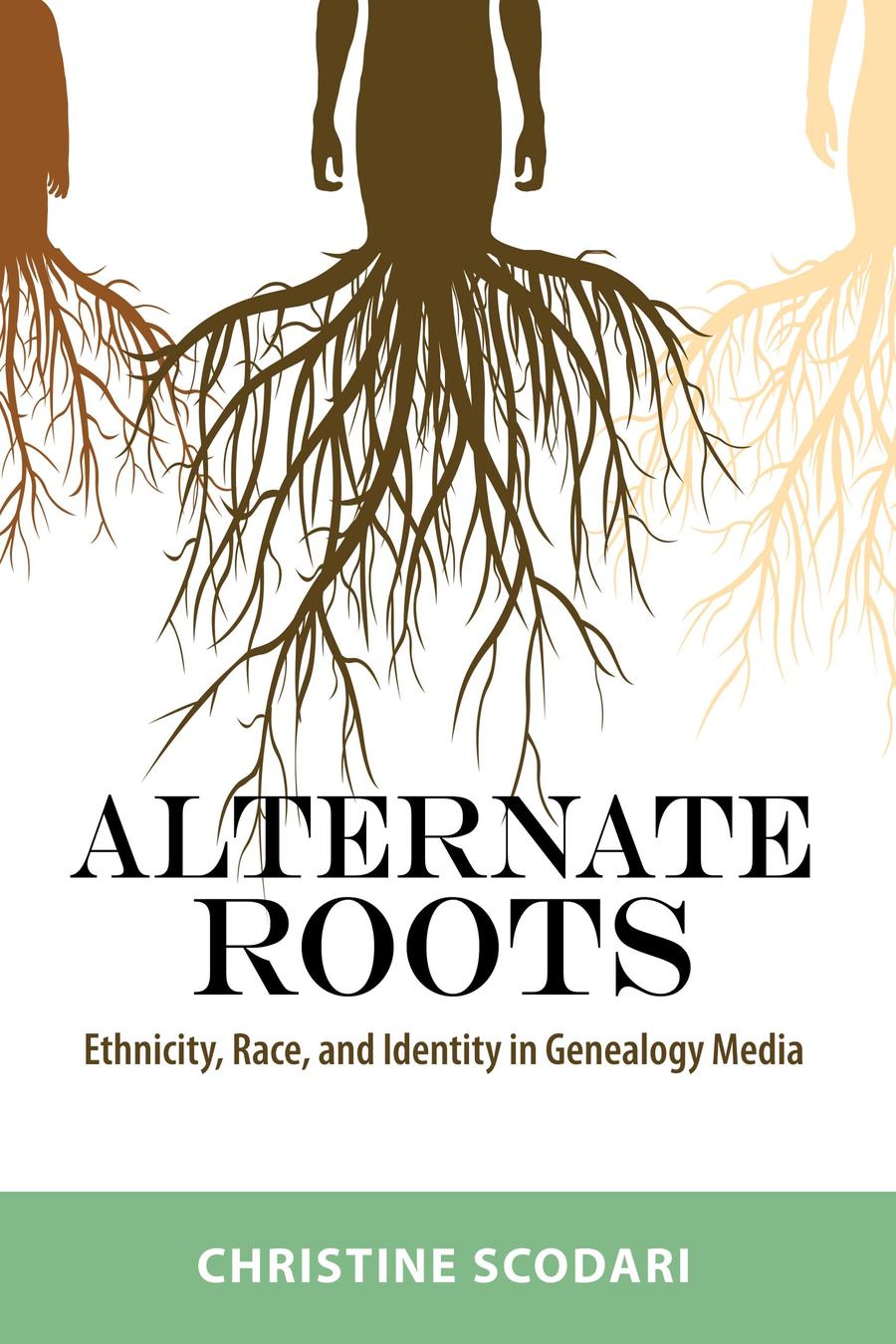
  • Alternate Roots: Ethnicity, Race, and Identity in Genealogy Media

    University Press of Mississippi
    June 2018
    167 pages
    14 b&w illustrations, 2 tables
    Hardcover ISBN: 9781496817785
    Paperback ISBN: 9781496828224

    Christine Scodari, Professor of Media Studies and a Women, Gender, and Sexuality Studies
    Florida Atlantic University, Boca Raton, Florida

    How popular media cultivates genealogy but buries its cultural context

    In recent years, the media has attributed the increasing numbers of people producing family trees to the aging of baby boomers, a sense of mortality, a proliferation of internet genealogy sites, and a growing pride in ethnicity. A spate of new genealogy-themed television series and internet-driven genetic ancestry testing services have now emerged, capitalizing on the mapping of the human genome in 2003. This genealogical trend poses a need for critical analysis, particularly along the lines of race and ethnicity.

    In contextual ways, as she intersperses an account of her own journey chronicling her Italian and Italian American family history, Christine Scodari lays out how family historians can understand intersections involving race and/or ethnicity and other identities inflecting families. Through engagement in and with genealogical texts and practices, such as the classic television series Roots, Ancestry. com, and Henry Louis Gates’s documentaries, Scodari also explains how to interpret their import to historical and ongoing relations of power beyond the family. Perspectives on hybridity and intersectionality gesture toward making connections not only between and among identities, but also between localized findings and broader contexts that might, given only cursory attention, seem tangential to chronicling a family history.

    Given current tools, texts, practices, cultural contexts, and technologies, Scodari’s study determines whether a critical genealogy around race, ethnicity, and intersectional identities is viable. She delves into the implications of adoption, orientation, and migration while also investigating her own genealogy, examining the racial, ethnic experiences of her forebears and positioning them within larger, cross-cultural contexts.

    There is little research on genealogical media in relation to race and ethnicity. Thus, Scodari blends cultural studies, critical media studies, and her own genealogy as a critical pursuit to interrogate issues bound up in the nuts-and-bolts of engaging in family history.

  • Throwing Rocks: An Interview with John Vercher

    Los Angeles Review of Books
    2020-01-29

    Alex Segura interviews John Vercher

    JOHN VERCHER’S TAUT, impressive debut crime novel, Three-Fifths, follows Bobby Saraceno — a mixed-race man living a lie. Saraceno has spent his life passing as a white man, raised by his racist maternal grandfather in Pittsburgh. Bobby’s kept his true self hidden from everyone, even his fellow comic book fan/best friend, Aaron, who’s just returned home after a prison stint. Aaron not only comes back as a more hardened man, but also as a radical white supremacist. When Bobby witnesses Aaron commit a hateful, race-based crime, his world begins to pull apart. Not only must Bobby keep his mixed race a secret from his militant friend, but he must also make sure he doesn’t land on the police’s radar as an accomplice to Aaron’s vicious crime. But an unexpected return threatens to destroy Bobby’s tricky balancing act.

    Three-Fifths is a tale of lost histories, identity, dangerous secrets, and deadly obsessions. It’s a confident, thoughtful novel that doesn’t hesitate to show the brutality of violence and the complexities of race relations, without pumping the brakes for the faint of heart. It’s a confident, mannered debut that feels carefully seasoned — like the work of an author leveling up after a string of starter novels, as opposed to a newcomer. I talked to Vercher about his motivations and influences.

    ALEX SEGURA: John, can you talk a bit about why Three-Fifths was the story you wanted to tell now? It feels remarkably urgent, but pensive at the same time, if that makes sense.

    JOHN VERCHER: It’s a story I always wanted to tell, in the sense that little to nothing has changed in our country in regards to race between 1995 when the story takes place to now. Similarly, little was different from the same 24-year time span from 1971 to 1995, and even further back. Having said that, I was fortunate that Three-Fifths found a home when it did, because there does seem to be, as a function of our increased access to all forms of media, more talk than ever about race and identity. It would be better if we were having conversations about it rather than talking at each other, and as always, books are some of the best means to spark those kinds of conversations. It was my hope that Three-Fifths could do that, even for the smallest of audiences…

    Read the entire interview here.