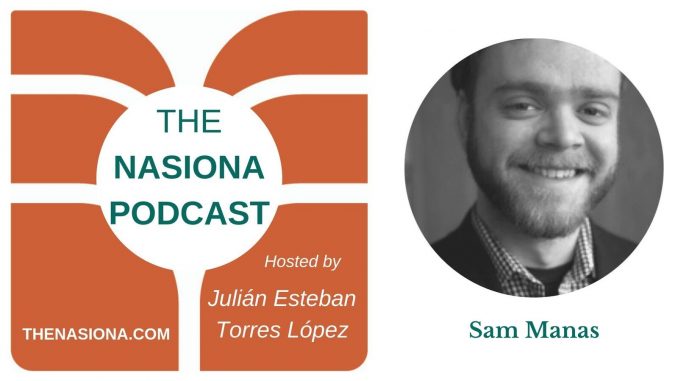
• Episode 13: Passing as White

    The Nasiona Podcast
    Being Mixed-Race Series
    2019-09-12

    Julián Esteban Torres López, Host, Founder, Executive Director, and Editor-in-Chief
    Nicole Zelniker, Interviewer
    Sam Manas, Guest

    Since European settlers brought enslaved Africans to the United States, there has been passing. In terms of race, passing means presenting as a race you don’t identify as, such as when an escaped enslaved person pretended to be white to avoid being sold back into slavery. More recently, former Spokane NAACP president Rachel Dolezal made headlines when it came out that she was a white woman passing as black for many years.

    Not all passing is intentional, however. Sam Manas, for example, is white and Panamanian, although because he is much lighter-skinned than most people from Panama, people tend to think he’s only white.

    Sam Manas is a reporter from Baltimore, Maryland, currently studying investigative journalism at the University of Missouri. He writes about local politics and his interests include technology and society. At the time of this interview, he was an intern at The Conversation.

    Listen to the episode (00:35:41) here.

  • Three-Fifths, A Novel

    Agora (an imprint of Polis Books)
    2019-09-10
    240 pages
    5.5” x 8’5”
    Hardcover ISBN: 978-1-947993-67-9
    eBook ISBN: 978-1-947993-82-2

    John Vercher

    The very first title from Agora, the new Polis Books imprint dedicated to crime fiction from diverse and underrepresented voices. Available in hardcover and ebook September 10, 2019.

    A compelling and timely debut novel from an assured new voice: Three-Fifths is about a biracial black man, passing for white, who is forced to confront the lies of his past while facing the truth of his present when his best friend, just released from prison, involves him in a hate crime.

    Pittsburgh, 1995. The son of a black father he’s never known, and a white mother he sometimes wishes he didn’t, twenty-two-year-old Bobby Saraceno is passing for white. Raised by his bigoted maternal grandfather, Bobby has hidden his truth from everyone, even his best friend and fellow comic-book geek, Aaron, who has just returned home from prison a hardened racist. Bobby’s disparate worlds collide when his and Aaron’s reunion is interrupted by a confrontation where Bobby witnesses Aaron assault a young black man with a brick. Fearing for his safety and his freedom, Bobby must keep his secret from Aaron and conceal his unwitting involvement in the hate crime from the police. But Bobby’s delicate house of cards crumbles when his father enters his life after more than twenty years.

    Three-Fifths is a story of secrets, identity, violence and obsession with a tragic conclusion that leave all involved questioning the measure of a man, and was inspired by the author’s own struggles with identity as a biracial man during his time as a student in Pittsburgh amidst the simmering racial tension produced by the L.A. Riots and the O.J. Simpson trial in the mid-nineties.

  • Black Like Me: A Pittsburgh native’s memoir of racial identities lost and found

    Pittsburgh Post-Gazette
    2019-08-30

    Bill O’Driscoll

    Sarah Valentine, author of
    Sarah Valentine

    Of all the racist things people do, living out white privilege might be the most insidious. White privilege is not just the assumptions that get white people treated better by employers and loan officers. It’s also the mental architecture that permits white people to avoid thinking of themselves as “white” — even as whiteness is assumed as the norm, and everyone who lacks it as “other.” White privilege is most potent when it goes unconsidered.

    It will be nearly impossible to avoid considering white privilege after reading “When I Was White: A Memoir.” Author Sarah Valentine is that rare person who has lived both with white privilege and without it, and her account is moving and analytically rigorous.

    Literature has given us light-skinned blacks who “passed” as white, from famed critic Anatole Broyard to figures in the poetry of Pittsburgh-based poet Toi Derricotte. Ms. Valentine’s story is something else again. She was born in 1977, and grew up mostly in the North Hills, one of three children in a tightly knit Catholic family. Her parents were white, and so, therefore, was she — until she learned, at age 27, that her biological father, whom she never knew, was African American…

    Read the entire article here.

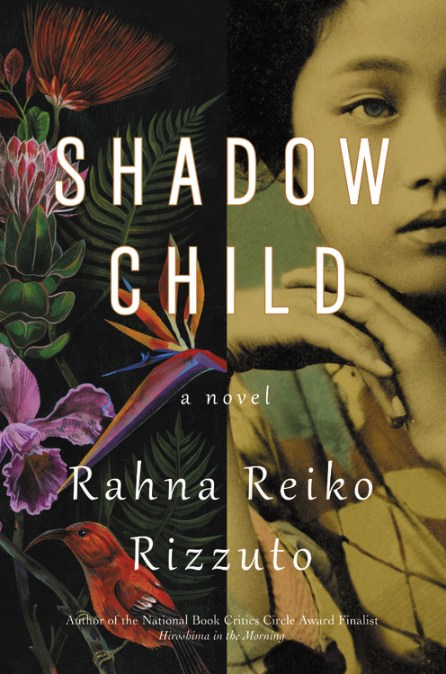
  • Shadow Child, A Novel

    Grand Central Publishing (an imprint of Hachette Book Group)
    2018-05-08
    352 pages
    6.4 x 1.2 x 9.4 inches
    Hardcover ISBN: 978-1538711453

    Rahna Reiko Rizzuto

    Shadow Child

    For fans of Tayari Jones and Ruth Ozeki, from National Book Critics Circle Award finalist Rizzuto comes a haunting and suspenseful literary tale set in 1970s New York City and World War II-era Japan, about three strong women, the dangerous ties of family and identity, and the long shadow our histories can cast.

    Twin sisters Hana and Kei grew up in a tiny Hawaiian town in the 1950s and 1960s, so close they shared the same nickname. Raised in dreamlike isolation by their loving but unstable mother, they were fatherless, mixed-race, and utterly inseparable, devoted to one another. But when their cherished threesome with Mama is broken, and then further shattered by a violent, nearly fatal betrayal that neither young woman can forgive, it seems their bond may be severed forever–until, six years later, Kei arrives on Hana’s lonely Manhattan doorstep with a secret that will change everything.

    Told in interwoven narratives that glide seamlessly between the gritty streets of New York, the lush and dangerous landscape of Hawaii, and the horrors of the Japanese internment camps and the bombing of Hiroshima, Shadow Child is set against an epic sweep of history. Volcanos, tsunamis, abandonment, racism, and war form the urgent, unforgettable backdrop of this intimate, evocative, and deeply moving story of motherhood, sisterhood, and second chances.

  • Your book covers academic arguments surrounding these things and the culture surrounding these topics, but it was born from a very personal place. What was it like for you growing up in a larger white society as a person of colour?

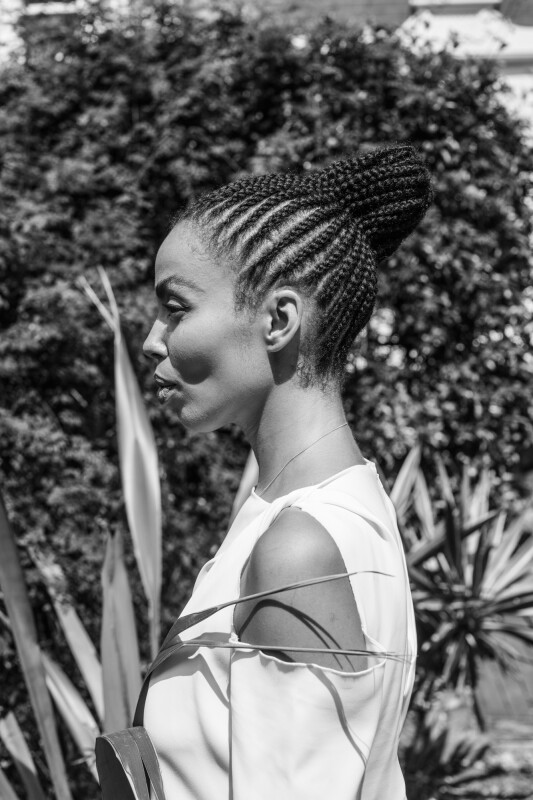
    The term person of colour is quite generic; I feel like if I’d been a person of colour who had straight hair I would have had a very different experience than somebody who was racialised as black and had extremely Afro-textured hair. My blackness and my hair texture was a very defining feature of that experience, and my hair was treated very much like it was an affliction. Certainly something to be ashamed of. I didn’t see anybody with this type of hair, so there was very much a sense of “why have I been sabotaged in this way?”

    Growing up in Dublin, the expertise and the products that were required to maintain my hair were sorely absent. My Mum would bring me to the UK occasionally and I remember when I was 12 she brought me to Tottenham, and I got a Jheri curl. When I was 17 I got my hair properly relaxed in a salon and had all this weave attached for like the first time — honey blond tracks, I was overjoyed. It felt like salvation.

    Mariko Finch, “Emma Dabiri on the Politics of Black Hair,” Sotheby‘s: African Modern & Contemporary Art, September 3, 2019. https://www.sothebys.com/en/articles/emma-dabiri-on-the-politics-of-black-hair.

  • Anthony Ekundayo Lennon on being accused of ‘passing’ as a black man: ‘It felt like an assassination’

    The Guardian
    2019-09-07

    Simon Hattenstone

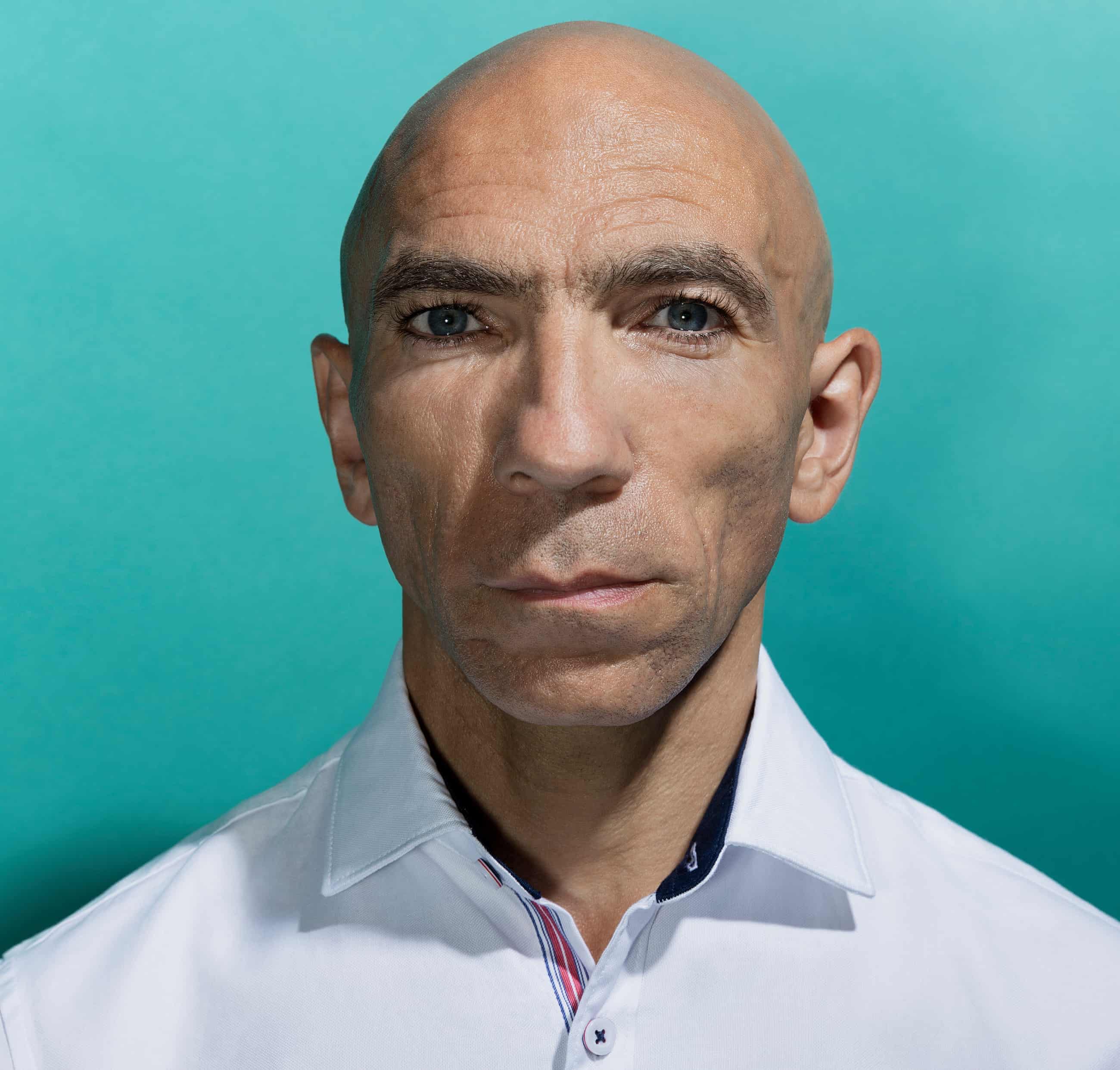
    Head shot of actor and director Anthony Ekundayo Lennon against turquoise background
    Anthony Ekundayo Lennon: ‘I didn’t think I had anything to answer.’ Photograph: David Vintiner/The Guardian

    All his life, people have assumed the theatre director is mixed race – and he was happy to embrace that identity. Then he was accused of faking it

    Anthony Ekundayo Lennon remembers the moment his life spun out of control. It was late morning, Friday 2 November 2018. The actor and director was giving a talk about the performing arts to university students, and his phone kept flashing. It was so incessant that the students suggested he’d better take a look. He told them it wouldn’t be anything important, turned the phone over and got on with his lecture. When the class broke for lunch, he saw missed calls from Talawa theatre company, where he had been working for the past year, as well as several unknown numbers and messages.

    One text stood out. It was from a journalist at the Sunday Times, asking for a comment on a story the paper was preparing to run about Lennon’s place on a prestigious scheme – the artistic director leadership programme (ADLP) for black, Asian and minority ethnic (BAME) theatre practitioners. Lennon had been awarded an 18-month residency with Talawa, Britain’s best-known black-led theatre company. He scrolled down the text…

    Read the entire article here.

  • Reaching for the Moon: The Autobiography of NASA Mathematician Katherine Johnson

    Atheneum Books for Young Readers (an imprint of Simon and Schuster)
    2019-07-02
    288 pages
    Hardcover ISBN 13: 9781534440838
    eBook ISBN 13: 9781534440852

    Katherine Johnson

    The inspiring autobiography of NASA mathematician Katherine Johnson, who helped launch Apollo 11.

    Throughout Katherine Johnson’s extraordinary career, there hasn’t been a boundary she hasn’t broken through or a ceiling she hasn’t shattered. In the early 1950s, she joined the organization that would one day become NASA, and which had only just begun to hire black mathematicians. Her job there was to analyze data and calculate the complex equations needed for successful space flights. As a black woman in an era of brutal racism and sexism, Katherine faced daily challenges and often wasn’t taken seriously by the scientists and engineers she worked with. But her colleagues couldn’t ignore her obvious gifts—or her persistence. Soon she was computing the trajectory for Alan Shepard’s first flight and working on the Apollo 11 mission that landed the first men on the moon. Katherine’s life has been a succession of achievements, each one greater than the last.

    Katherine Johnson’s story was made famous in the bestselling book and Oscar-nominated film Hidden Figures. Now in Reaching for the Moon she tells her own story for the first time, in a lively autobiography that will inspire young readers everywhere.

  • Emma Dabiri on the Politics of Black Hair

    Sotheby’s
    African Modern & Contemporary Art
    2019-09-03

    Mariko Finch, Deputy Editor, Deputy Director
    London, United Kingdom

    Emma Dabiri wearing Nigerian Yoruba suku braids

    Emma Dabiri is a broadcaster, author and academic who recently published Don’t Touch My Hair — a book that charts the shifting cultural status of black hair from pre-colonial Africa through to Western pop culture and beyond. Ahead of the Modern & Contemporary African Art sale in London on 15 October, in which a number of works depicting traditional African hair are offered, we sat down with her to discuss the history of hairstyles.

    Mariko Finch: When did you decide that you wanted to turn your research into a book?

    Emma Dabiri: In around 2016. The conversation about black hair had been happening for a while at that stage but I was finding it often quite repetitive. There is so much more to engage with through hair, so I wanted to do that research. There is so much more to engage with through hair; social history, philosophy, metaphysics, mathematical expression, coding, maps…

    This topic has recently made it to the mainstream media; through Beyoncé and Solange Knowles, Kim Kardashian and the issue of cultural appropriation. It is very timely to have that debate anchored in something historical.

    I felt somewhat exasperated by the way people’s frustrations around cultural appropriation by celebrities were being disregarded and dismissed as just something very superficial; as if those weren’t valid or legitimate concerns. I wanted to provide the historical context for why this anger exists. Let me show that it’s not just vacuous, or petty policing of culture. There are like very strong historical antecedents as to why these emotions run so high…

    Read the entire interview here.

  • Symbol of Racial Reconciliation, Pasadenan Joan Williams Dies at 86

    Pasadena Now
    Pasadena, California
    2019-03-01

    Stephen Siciliano, Managing Editor
    Photography courtesy Robert “Chip” Williams

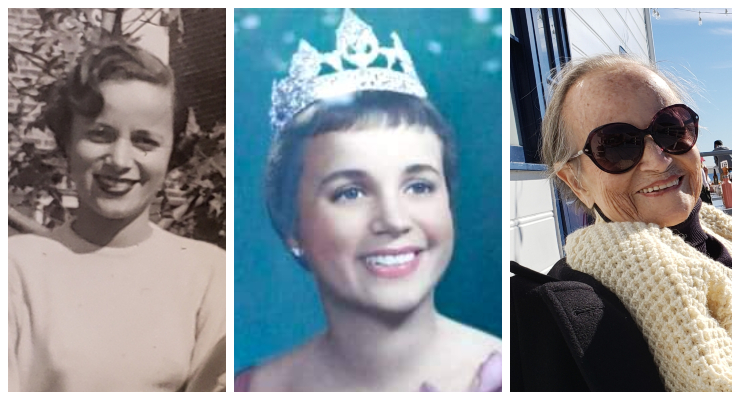
    Joan Williams, who did not leave Pasadena after being stripped of her 1958 “Miss Crown City” title but stayed and watched her hometown change with time has died, according to her son Robert “Chip” Williams.

    Williams passed away on Feb. 20 in Pasadena, at the age of 86, enough time to be denied a rightful ride in the Rose Parade because of her race and decades later to see that wrong righted.

    When officials discovered Williams was a light-complexioned African American, the float she was to ride was canceled. Her story finally publicized, Williams got her trip down Colorado Boulevard in the 2015 Rose Parade

    Read the entire obituary here.

  • ‘Aryan’ and ‘Octoroon’: Couples challenge racial labels to get married in Virginia

    The Washington Post
    2019-09-06

    Rachel Weiner


    Brandyn Churchill and Sophie Rogers are challenging a Virginia requrement to list race when applying for a marriage license. (Christophe Genty/Christophe Genty Photography)

    When they applied for a marriage license in Rockbridge County, Va., Brandyn Churchill and Sophie Rogers were told they could not have one unless they each chose a race, from a list that included “Aryan” and “Octoroon.”

    The Supreme Court struck down Virginia’s ban on interracial marriage over half a century ago. Yet the mechanism by which that prohibition was enforced remains on the books: a requirement that all would-be newlyweds identify by race. To fill out the form falsely is a felony.

    So, weeks away from their planned Oct. 19 wedding at a barn in Fincastle, Va., the couple is challenging the law in Virginia federal court. Joined by two other engaged couples, they argue the law is a racist holdover that has no place in modern marriage.

    The suit is part of both efforts to scrape away vestiges of segregation in Virginia and to move away from institutional categorization in both race and gender. The plaintiffs say people should be free in their personal lives to identify by race but shouldn’t be forced to, under the First, 13th and 14th amendments. But the lawsuit raises a more challenging question: Can the government address discrimination without labels created from it?…

    Kevin Maillard, a law professor at Syracuse University who has studied interracial marriage, said that while researchers might use the data, “I don’t know what the compelling reason that the state would have in retaining tracking of those categories would be.”

    But he was skeptical of an effort to move away from race altogether.

    “I think with the deep history of racial strife we have in the United States, these categories are going to remain incredibly important,” Maillard said. “My mother is racially mixed, but she considers herself a black person.”

    Civil rights groups rely on government data to investigate inequality in schools and the criminal justice system and challenge voting restrictions.

    “We need data on who people are to see if there are patterns,” said Myrna Pérez of the Brennan Center for Justice…

    Read the entire article here.