• Genesis of U.S. Colorism and Skin Tone Stratification: Slavery, Freedom, and Mulatto-Black Occupational Inequality in the Late 19th Century

    The Review of Black Political Economy
    First Published 2018-05-21
    21 pages
    DOI: 10.1177/0034644618770761

    Robert L. Reece, Assistant Professor of Sociology
    University of Texas, Austin

    Studies show lighter skinned Black people are advantaged on a number of social indicators—a phenomenon called “colorism.” These studies generally contend preferences for light-skinned and/or Mulatto slaves endured the postbellum period to shape social outcomes into today. Following this idea, other studies examine differences in social outcomes between Mulattos and Blacks in the 19th century, but few empirically connect antebellum life to postbellum Mulatto–Black stratification. With that in mind, I examine whether the socio-economic differences between Mulattos and Blacks varied across geographic space in proportion to places’ reliance on slave labor and the characteristics of its free African American population. This allows me to examine whether differences in economic status between Mulattos and Blacks are a result of Mulatto advantage in the form of privileged positions during slavery. My results reveal that Mulattos have higher occupational statuses relative to Blacks in places where slavery was more prominent and where free Mulattos were literate. This suggests the intraracial hierarchy established during slavery was more likely to be replicated in places where slavery was more important, and Mulattos were able to capitalize on freedom by leveraging their literacy into better economic statuses after emancipation. These results support the idea that skin color stratification was initiated at least in part by practices during chattel slavery and offers some plausible mechanisms for its transmission.

    Read the entire article here.

  • Japanese Mom, Non-Japanese Kid

    Hapa Japan
    2018-11-29

    Fredrick Cloyd


    Featured Image by Edward M. Haugh

    Perhaps one of the most interesting things about a mixed-Japanese child either born and/or raised outside of Japan, is the personal-cultural aspects of the relationship between the Japanese parent and the child, who grows up to be an adult. Since my ethnographic focus for my book, as well as my life experiences with Amerasians are with my mother and her friends and their families, and Japanese mothers in general, this will be my focus here, rather than families with Japanese fathers.

    One aspect of the Japanese mother-American child relationship growing up in the United States, is the fact of loneliness…

    Read the entire article here.

  • The DNA Industry and the Disappearing Indian

    TomDispatch.com: A regular antidote to the mainstream media
    2018-11-29

    Aviva Chomsky, Professor of History; Coordinator of Latin American, Latino and Caribbean Studies
    Salem State University, Salem, Massachusetts

    DNA, Race, and Native Rights

    Amid the barrage of racist, anti-immigrant, and other attacks launched by President Trump and his administration in recent months, a series of little noted steps have threatened Native American land rights and sovereignty. Such attacks have focused on tribal sovereignty, the Indian Child Welfare Act (ICWA), and the voting rights of Native Americans, and they have come from Washington, the courts, and a state legislature. What they share is a single conceptual framework: the idea that the long history that has shaped U.S.-Native American relations has no relevance to today’s realities.

    Meanwhile, in an apparently unrelated event, Senator Elizabeth Warren, egged on by Donald Trump’s “Pocahontas” taunts and his mocking of her claims to native ancestry, triumphantly touted her DNA results to “prove” her Native American heritage. In turning to the burgeoning, for-profit DNA industry, however, she implicitly lent her progressive weight to claims about race and identity that go hand in hand with moves to undermine Native sovereignty.

    The DNA industry has, in fact, found a way to profit from reviving and modernizing antiquated ideas about the biological origins of race and repackaging them in a cheerful, Disneyfied wrapping. While it’s true that the it’s-a-small-world-after-all multiculturalism of the new racial science rejects nineteenth-century scientific racism and Social Darwinism, it is offering a twenty-first-century version of pseudoscience that once again reduces race to a matter of genetics and origins. In the process, the corporate-promoted ancestry fad conveniently manages to erase the histories of conquest, colonization, and exploitation that created not just racial inequality but race itself as a crucial category in the modern world.

    Today’s policy attacks on Native rights reproduce the same misunderstandings of race that the DNA industry is now so assiduously promoting. If Native Americans are reduced to little more than another genetic variation, there is no need for laws that acknowledge their land rights, treaty rights, and sovereignty. Nor must any thought be given to how to compensate for past harms, not to speak of the present ones that still structure their realities. A genetic understanding of race distorts such policies into unfair “privileges” offered to a racially defined group and so “discrimination” against non-Natives. This is precisely the logic behind recent rulings that have denied Mashpee tribal land rights in Massachusetts, dismantled the Indian Child Welfare Act (a law aimed at preventing the removal of Native American children from their families or communities), and attempted to suppress Native voting rights in North Dakota

    Read the entire article here.

  • Mostly White

    Torrey House Press
    November 2018
    200 pages
    Trade Paperback ISBN: 978-1-937226-95-4
    Electronic ISBN: 978-1-937226-99-2

    Alison Hart

    Spanning four generations of a mixed-race family, Mostly White is a powerful tale of inter-generational trauma and the healing brought by wildness, music, and the resilience of women. The novel begins with Emma, who survives the abuse of an Indian residential school in 1890s Maine. Beaten and locked in a closet for days, Emma flees to the woods, where she meets Bird Man, an Irish bootlegger. Three generations later, aspiring actor Ella contends with her mixed-race heritage as she navigates color lines in 1980s New York City.

    Throughout this sweeping and compassionate novel, Alison Hart’s unforgettable characters struggle with racism, poverty, and how to honor the call of their ancestors while forming their own identities. Mostly White unflinchingly examines facets of America’s difficult past—and the many ways this past pervades our present.

  • A Family Tree With Roots Deep In Slavery

    Code Switch: Race and identity, remixed
    National Public Radio
    2018-11-21

    Nabil Ayers

    All families have histories.
    Man_Half-tube/Getty Images

    “Well hello there Nabil!

    “I welcome your letter.

    “So in the little bit of information you shared with me, I am intrigued.

    “I have worked for a number of years, 26 in fact, on my genealogy. It has been a passion and at times an obsession.”

    In her initial email to me, Karen surprised me with her excitement and candor — neither of which I was expecting from the woman whom I had gently accused of being the descendant of the man who owned my ancestors…

    …My mother, who is white, chose to have me and raise me on her own. My father is black, but because he has never been part of my life, I’ve never held a strong black identity or felt I belonged to any single race. I grew up in very diverse and liberal surroundings where, if anyone asked, I was racially mixed, and that was fine.

    I’m often asked the question, “What are you?” Or the less invasive, but still pointed, “Where are you from?” I’ve always described myself as “half black and half white.” It’s a phrase I still use for simplicity…

    Read the entire article here.

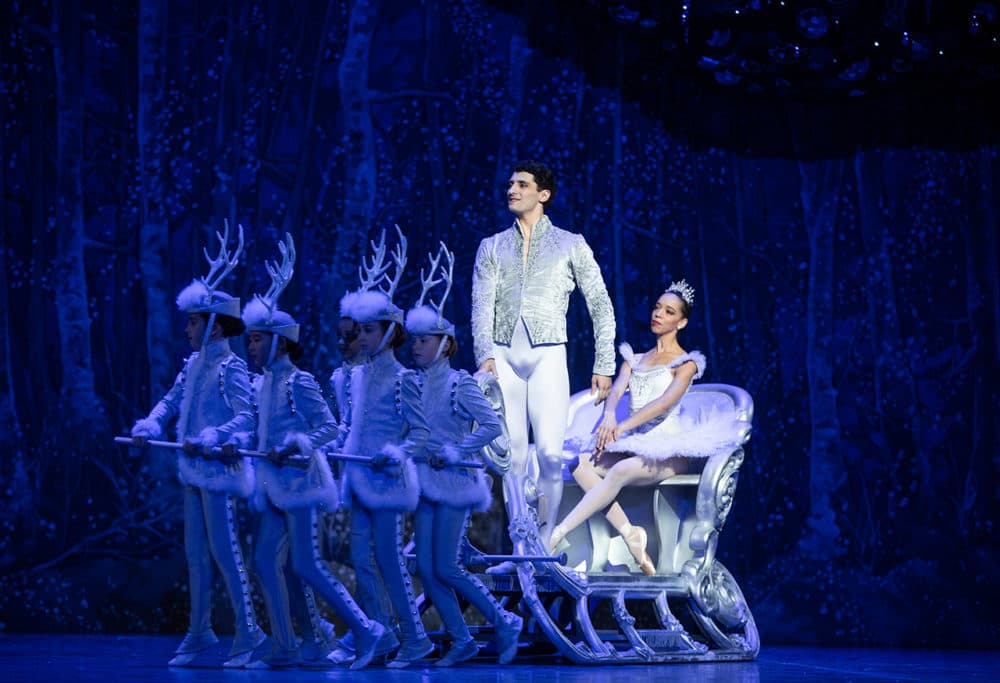
  • Chyrstyn Fentroy — First Black Woman To Join Boston Ballet In A Decade — Debuts As Snow Queen In ‘The Nutcracker’

    WBUR 90.9 FM
    Boston, Massachusetts
    2018-11-30

    Arielle Gray, Arts Fellow

    Lasha Khozashvili and Chyrstyn Fentroy in Mikko Nissinen's The Nutcracker (Photo by Angela Sterling, courtesy of Boston Ballet)
    Lasha Khozashvili and Chyrstyn Fentroy in Mikko Nissinen’s The Nutcracker (Photo by Angela Sterling, courtesy of Boston Ballet)

    Artificial snow falls gently from the top of the stage of the Boston Opera House, encasing the space in an ethereal glittering glow. Beneath it dances Chyrstyn Fentroy as the Snow Queen, entwined in an elegant flow of limbs and carefully choreographed steps with the Snow King. The Boston Ballet is rehearsing for its opening night of “The Nutcracker,” the other worldly production based off of E.T.A Hoffman’s novella. Fentroy debuted as the Snow Queen on Thursday evening and will star in the role again on Sunday, Dec. 2.

    Fentroy makes a stunning Snow Queen, traversing the stage in a series of light, precise steps. The role is a notable milestone for Fentroy, who has been deeply involved in the world of dance since she was old enough to walk. She tells me she’s the first black female dancer to join the Boston Ballet in the last decade.

    Growing up as the daughter of two dancers in Los Angeles, Fentroy spent a lot of time in the dance studio. “’The Nutcracker’ specifically is something that’s kind of been a part of my life forever,” Fentroy told WBUR. “I grew up watching my mom do the Sugarplum Fairy variation and spent so many years in the wings watching performances.”…

    Read the entire article here.

  • Michael Tisserand: “Krazy Kat and the Poetics of Passing” | Talks at Google

    Talks at Google
    2018-06-26

    Michael discusses his book, “Krazy: George Herriman, A Life in Black and White,” winner of the 2017 Eisner Award for best comics-related book, and a finalist in both the National Book Critics Circle Awards for Biography and the PEN America/Jacqueline Bograd Weld Award for Biography. Krazy was also selected as a Kirkus Best Nonfiction Book of 2016 and as one of Vanity Fair‘s “Must-Read Books of the Holiday Season.”

    Tisserand’s previous books include THE KINGDOM OF ZYDECO, an exploration of Louisiana music that received the ASCAP-Deems Taylor award for music writing, and the Hurricane Katrina memoir SUGARCANE ACADEMY. His work has appeared in The New York Times, The Washington Post, and The Los Angeles Times. When not writing, he coaches scholastic chess and is a member of The Laissez Boys, a Mardi Gras parading organization.

    More information about Tisserand and his work can be found at www.MichaelTisserand.com.

    Moderated by Camille Gennaio.

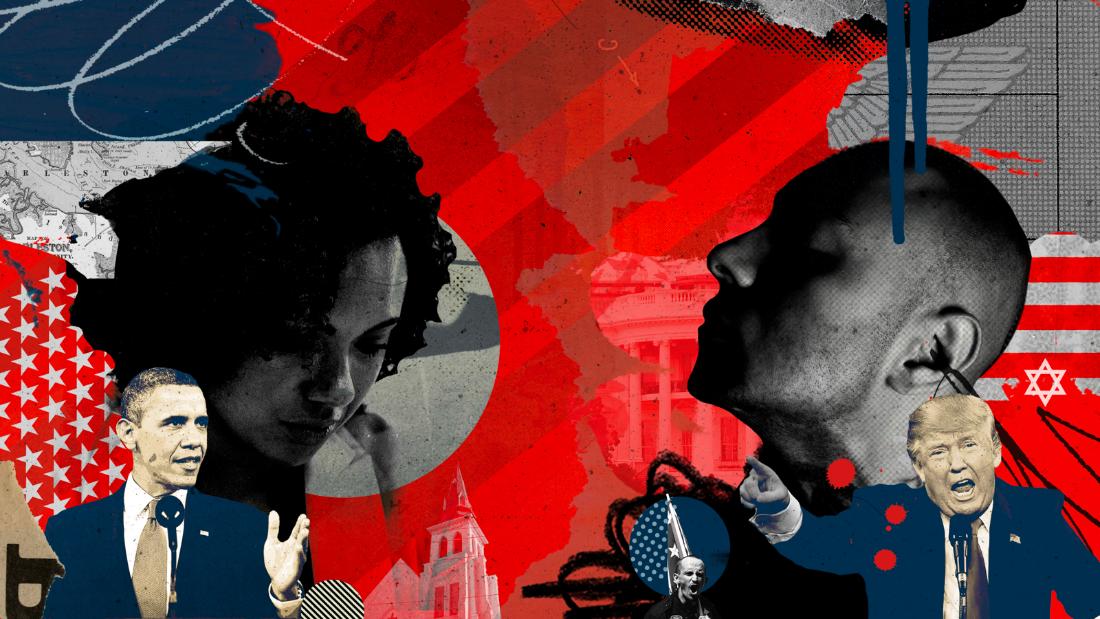
  • In 2008, there was hope. In 2018, there is hurt. This is America’s state of hate.

    Cable News Network (CNN)
    2018-11-26

    By Mallory Simon and Sara Sidner, CNN

    (CNN) On Election Night in 2008, Americans gathered in Grant Park, Chicago. They cried tears of joy knowing Barack Obama would become the first black president.

    For millions of Americans, Obama lifted the nation. For white supremacists, he lit a powder keg.

    His election supercharged the divisions that have existed since the country’s birth.

    The hate created two Americas. Two realities. Split-screen reactions to the same events, that continued and were exacerbated with President Trump’s victory and time in office…

    Read the entire article here.

  • Ways of Grace: Stories of Activism, Adversity, and How Sports Can Bring Us Together

    Amistad (an imprint of HarperCollins)
    2017-06-27
    256 pages
    Hardcover ISBN: 9780062354525
    Paperback ISBN: 9780062354532
    EPUB ISBN: 9780062354549

    James Blake, with Carol Taylor

    Inspired by Arthur Ashe’s bestselling memoir Days of Grace, a collection of positive, uplifting stories of seemingly small acts of grace from across the sports world that have helped to bridge cultural and racial divides.

    Like many people of color, James Blake has experienced the effects of racism firsthand—publicly—first at the U.S. Open, and then in front of his hotel on a busy Manhattan street, where he was tackled and handcuffed by a police officer in a case of “mistaken identity.” Though rage would have been justified, Blake faced both incidents with dignity and aplomb.

    In Ways of Grace he reflects on his experiences and explores those of other sports stars and public figures who have not only overcome adversity, but have used them to unite rather than divide, including:

    • Aisam-Ul-Haq Qureshi, a Pakistani Muslim and Amir Hadad, an Israeli Jew, who despite the conflicts of their countries, paired together in the 2002 Wimbledon men’s doubles draw.
    • Muhammad Ali, who transcended racism with a magnetic personality and a breathtaking mastery of boxing that was unparalleled.
    • Nelson Mandela, who spent twenty-seven years in prison for his commitment to social reform, peace, and equality yet never gave up his battle to end apartheid—a struggle that led to his eventual freedom and his nation’s transition to black majority rule.
    • Groundbreaking tennis legend Arthur Ashe, who was a model of courage, elegance, and poise on the court and off; a gifted player who triumphed in the all-white world of professional tennis, and became one of his generation’s greatest players.

    Weaving together these and other poignant and unforgettable stories, Blake reveals how, through seemingly small acts of grace, we can confront hatred, bigotry, and injustice with virtue—and use it to propel ourselves to greater heights.

  • Writer and actor Indigo Griffiths: ‘Mixed-race identity is not reflected in theatre, so I wanted to explore that’

    The Stage
    London, United Kingdom
    2018-11-22

    Giverny Masso

    Writer and actor Indigo Griffiths. Photo: Michael Wharley
    Writer and actor Indigo Griffiths. Photo: Michael Wharley

    Actor Indigo Griffiths started writing to address the lack of roles for mixed-race performers. She tells Giverny Masso about her first full-length play, Passing, which is to receive a rehearsed reading on a West End stage as part of the Masterclass Trust’s Pitch Your Play competition.

    How did you get into theatre?

    Theatre has always been something I’ve done. As a kid I was always in youth groups and I knew early on I wanted to be an actor. I studied drama and English literature at the University of East Anglia, which gave me an amazing grounding. I then did a postgraduate course at Drama Studio London, which I graduated from in 2016. Since then I’ve been working as an actor, before I started writing…

    Tell me about Passing?

    Passing is the first full-length play I’ve written. It’s part of a trilogy of mixed-race themed plays I have been working on. It’s set in 1940s Chicago and is about the lives of three mixed-race siblings. The play explores how lives change when you make the decision to pass as a white person. Passing as a concept is something that fascinates me…

    Read the entire interview here.