Mixed Race Studies

Scholarly perspectives on the mixed race experience.

    • About This Site
    • Bibliography
    • Contact Information
    • Date and Time Formats
    • Forthcoming… (Updated 2021-09-01)
    • Likely Asked Questions
    • List of Book Publishers
    • List of Definitions and Terms
    • My Favorite Articles and Papers
    • My Favorite Posts
    • My Recent Activities
    • Praise for Mixed Race Studies
    • Tag Listing
      • Tag Listing (Ordered by Count)
    • US Census Race Categories, 1790-2010
    • 1661: The First ‘Mixed-Race’ Milestone
    • 2010 U.S. Census – Some Thoughts

recent posts

  • The Routledge International Handbook of Interracial and Intercultural Relationships and Mental Health
  • Loving Across Racial and Cultural Boundaries: Interracial and Intercultural Relationships and Mental Health Conference
  • Call for Proposals: 2026 Critical Mixed Race Studies Conference at UCLA
  • Participants Needed for a Paid Research Study: Up to $100
  • You were either Black or white. To claim whiteness as a mixed child was to deny and hide Blackness. Our families understood that the world we were growing into would seek to denigrate this part of us and we would need a community that was made up, always and already, of all shades of Blackness.

about

  • Twitter
  • Facebook
  • Instagram
  • Alien Citizen: An Earth Odyssey, the Movie

    2018-08-28

    Alien Citizen: An Earth Odyssey, the Movie

    HapaLis Productions
    2017

    Written by: Elizabeth Liang
    Directed by: Sofie Calderon

    Winner: 2018 Calcutta International Cult Film Festival

    Elizabeth Liang in ALIEN CITIZEN: An Earth Odyssey (2017)

    Who are you when you’re from everywhere and nowhere?

    ALIEN CITIZEN: An Earth Odyssey is a funny and poignant one-woman show about growing up as a dual citizen of mixed heritage in Central America, North Africa, the Middle East, and New England. Elizabeth Liang is a Global Nomad or Third Culture Kid (TCK). Third Culture Kids are the children of educators, international business people, diplomats, missionaries, the military–anyone whose family has relocated overseas, usually because of a job placement.

    Liang weaves humorous stories about growing up as an Alien Citizen abroad with American commercial jingles providing her soundtrack through language confusion, first love, “racial ambiguity,” culture shock, Clark Gable, bullying, and sandstorms. Our protagonist deals with the decisions every global nomad has to make repeatedly: to adapt or to simply cope; to build a bridge or to just tolerate. From being a Guatemalan-American teen in North Africa to attending a women’s college in the USA, Alien Citizen reflects her experience that neither one was necessarily easier than the other. Where is the line between respecting others and betraying yourself? Humor is a great survival mechanism – and friends make all the difference.

  • Hawaiian Family Drama From Viola Davis, Lisa Takeuchi Cullen Set at ABC (Exclusive)

    2018-08-28

    Hawaiian Family Drama From Viola Davis, Lisa Takeuchi Cullen Set at ABC (Exclusive)

    The Hollywood Reporter
    2018-08-22

    Rebecca Sun

    Former Time journalist Lisa Takeuchi Cullen will write ''Ohana,' based on Kiana Davenport's 1994 novel 'Shark Dialogues.'
    Lisa Takeuchi Cullen (Matt Dine; Courtesy of Plume)

    ABC is headed back to Hawaii.

    The network is teaming with Viola Davis and Julius Tennon’s JuVee Productions to develop the hourlong drama ‘Ohana. The potential series is based on Kiana Davenport’s 1994 novel Shark Dialogues and follows four hapa women who reunite when their grandmother, a mystic known as a kahuna, dies mysteriously and leaves them the family plantation.

    Former Time staff writer and foreign correspondent Lisa Takeuchi Cullen will pen the adaptation.

    “So many Hawaii-set stories have been told from the white point of view,” Cullen tells The Hollywood Reporter. “This is a story we’re passionate about telling from the point of view of native Hawaiians — Pacific Islanders, people of Asian descent and people of hapa heritage.”

    Each of the four protagonists is of a different mixed ethnicity — half-white, half-Japanese, half-Filipino and half-black — and their unexpected shared inheritance will force them to overcome years of jealousies, misunderstandings, resentments and secrets…

    Read the entire article here.

  • Zazie Beetz on ‘Atlanta,’ Her Emmy Nomination and Impostor Syndrome

    2018-08-28

    Zazie Beetz on ‘Atlanta,’ Her Emmy Nomination and Impostor Syndrome

    The New York Times
    2018-08-24

    Aisha Harris, Assistant Television Editor, Culture Desk


    Zazie Beetz received her first Emmy nomination, for her work in “Atlanta” on FX. Guy D’Alema/FX

    Zazie Beetz has had quite the year. The burgeoning actor returned for Season 2 of FX’s critically acclaimed dramedy “Atlanta,” unpacking more layers of her character Van in some particularly memorable episodes. (One scene from the episode “Champagne Papi” took on new life thanks to Drake, who included one of her lines at the end of his No. 1 hit “In My Feelings.”) This summer, she reached an even wider audience with “Deadpool 2,” receiving accolades for her performance as Domino, a mutant whose superpower is luck.

    And last month Ms. Beetz received her first Emmy nomination, for best supporting actress in a comedy for “Atlanta.” As someone who suffers from severe anxiety, however, the awards recognition and the increased visibility that comes with it have not been easy to process. “I don’t even know if I should say this publicly, but I feel kind of like, ‘O.K., cool,’” she said.

    “I’m glad that shows like ‘Atlanta’ and our other contemporaries are having an opportunity to be seen and to be appreciated,” she continued, “and I’m glad that I can contribute in that way. That’s really what I’m happy about.”

    In a phone interview, Ms. Beetz discussed exploring new facets of Van, her own biracial identity and experiencing anxiety and impostor syndrome in Hollywood. These are edited excerpts from the conversation…

    Read the entire interview here.

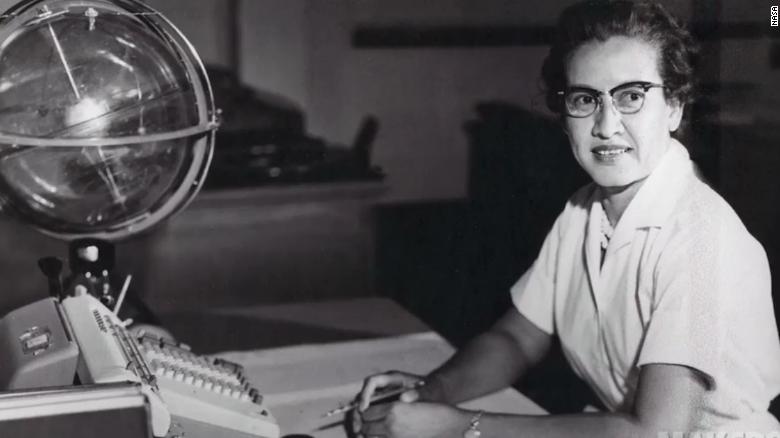
  • Katherine Johnson, who hand-crunched the numbers for America’s first manned space flight, is 100 today

    2018-08-27

    Katherine Johnson, who hand-crunched the numbers for America’s first manned space flight, is 100 today

    Cable News Network (CNN)
    2018-08-26

    Saeed Ahmed, Senior Editor, Trends, CNN Digital

    Emanuella Grinberg, Digital news reporter

    Katherine Johnson worked in the "Computer Pool" at NASA.
    Katherine Johnson worked in the “Computer Pool” at NASA.

    (CNN)—Katherine Johnson, the woman who hand-calculated the trajectory for America’s first trip to space, turns 100 today.

    Before the arrival of electronic data processors, aka, computers in the 1960s, humans — mainly women — comprised the workforce at NASA known as the “Computer Pool.”

    Black women, especially, played a crucial role in the pool, providing mathematical data for NASA’s first successful space missions, including Alan Shepherd’s 1961 mission and John Glenn’s pioneering orbital spaceflight…

    Read the entire article here.

  • Representation Is More Than Skin Color

    2018-08-27

    Representation Is More Than Skin Color

    The New York Times
    2018-08-27

    Bianca Vivion Brooks, Host
    ASK VIV


    The Poet, Robert Hayden. Pach Brothers/Corbis, via Getty Images

    Is it enough to look like the artist if you do not recognize yourself in the art?

    I remember the first time I fell in love with poetry.

    I was in 10th grade, and my world literature teacher, Ms. Joe, had assigned us the poem “Those Winter Sundays” by Robert Hayden. I read the poem and at once found myself engrossed in my own memory. I, too, recalled the coldness of my childhood home and the “austere and lonely offices” of my father’s love.

    In his verses, Hayden made me feel seen. The poem provided a kind of relief, to know that my childhood was not a complete anomaly, and that others had grown up in similar spaces where love was convoluted by anger and loneliness. That day Robert Hayden became my favorite poet. I held on to this particular poem for years, memorizing it not only for the comfort it provided, but also as a reminder of what good art could do.

    Five years later, I discovered Robert Hayden was black. It was the first day of my African-American Literature seminar at Columbia, and I was skimming the syllabus while deciding whether or not to enroll in the course. There in italics, just beneath James Baldwin’s “Notes of a Native Son” read Words in the Mourning Time (1970) by Robert Hayden. I Googled a picture of my favorite poet and laughed aloud. “So he’s black,” I thought to myself…

    Read the entire article here.

  • Shark Dialogues, a Novel

    2018-08-27

    Shark Dialogues, a Novel

    Scribner (an imprint of Simon & Schuster)
    March 2010
    512 pages
    eBook ISBN: 9781439192436

    Kiana Davenport

    “An epic saga of seven generations of one family encompasses the tumultuous history of Hawaii as a Hawaiian woman gathers her four granddaughters together in an erotic tale of villains and dreamers, queens and revolutionaries, lepers and healers” (Publishers Weekly).

  • The mixed-race experience: ‘There are times I feel like the odd one out’

    2018-08-26

    The mixed-race experience: ‘There are times I feel like the odd one out’

    The Guardian
    2018-08-26

    Alex Moshakis

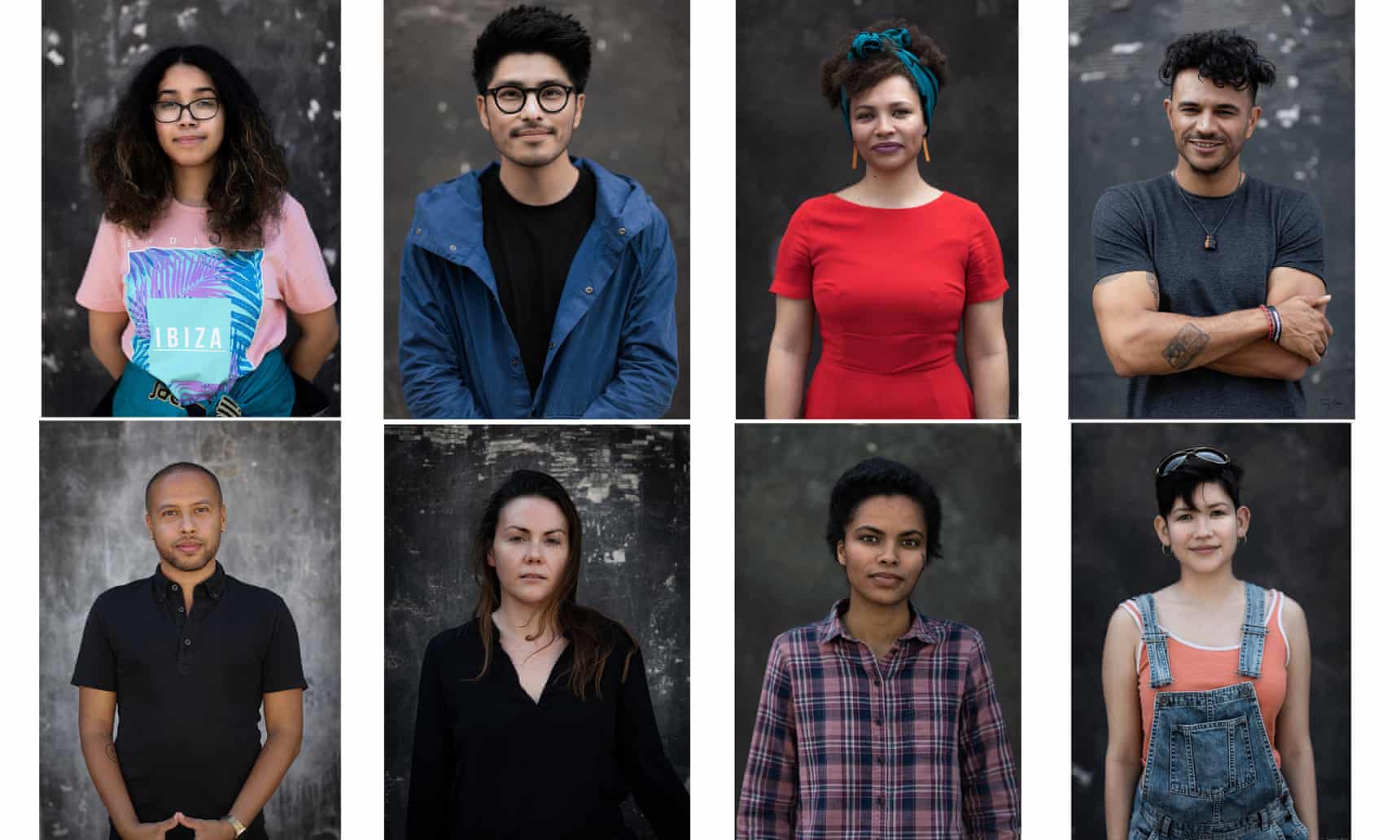
    ‘It has given people a sense of belonging’: photographer Tenee Attoh on her photography project.
    ‘It has given people a sense of belonging’: photographer Tenee Attoh on her photography project. Composite: Tenee Attoh

    A series of portraits of mixed-race people from around the world has cast new light on how we see ourselves

    Last year the photographer Tenee Attoh began taking portraits of multiracial friends and acquaintances against a mottled black background at the Bussey Building in Peckham, southeast London. Attoh is half-Dutch on her mother’s side, half-Ghanaian on her father’s, and identifies as mixed-race. Born in the UK, she spent most of the first 23 years of her life in Accra and Amsterdam, shuttling between cities and cultures, an experience she found enlightening but problematic. “On the one hand it allows you to develop a different understanding of the world,” she says of her duality. “But there’s still a lot of ignorance in society. People perceive you as either black or white, and you’re not – you’re mixed.”

    Working in London, Attoh heard similar stories from other mixed-race people, and soon she began publishing her images online (at mixedracefaces.com and on Instagram) alongside small texts that allowed her subjects to share personal thoughts on identity, race and self, something they couldn’t do elsewhere. Following the death of her mother, to whom the series is dedicated, the project helped Attoh dissect her own multiracial experience – what it means to be connected to two worlds at once, and how society perceives that condition – but it has also sparked an open forum on diversity. “It’s not a topic people usually talk about,” Attoh says. “So the website has become a platform for people with mixed heritage. It’s given a lot of them a sense of belonging.”…

    Read the entire article here.

  • “And then I had to get comfortable making people uncomfortable. And so, for me, on the act of coming out as a black person in white spaces was where I think the seeds of that came.”

    2018-08-25

    “Very early on, I learned to, I‘d say, “Ruin the dinner party,” and that became something. I think of that as my origins as a writer, actually, was that I learned very early on that I was going to disrupt, and that I was going… My presence was not going to always be comfortable. And then I had to get comfortable making people uncomfortable. And so, for me, on the act of coming out as a black person in white spaces was where I think the seeds of that came. And it was about learning speech over silence, ’cause there was a very easy solution, which was just not to say anything. And having my parents’ politics drummed into me from a very early age.”—Danzy Senna

    “Danzy Senna’s Life Isn’t Black and White,” Articulate, April 24, 2018. https://www.articulateshow.org/articulate/danzy-sennas-life-isnt-black-and-white. (00:08:58-00:09:40).

  • “I see myself as a woman of color with light skinned privileges. I hold the duality as both a recipient and an ally of a legacy of oppression and colonialism.”

    2018-08-25

    “My inclusion in general POC spaces is a tricky one. While my ethnicity is very rarely discounted, the white privilege I’m afforded and responsible for owning quickly screws up the POC binary, too. Other people of color can respond with a hint of caution. Some openly recognize the complexity that I am holding and accept my lens as meaningful in the POC experience. Some do not. While prejudices I’ve experienced have punctured my bubble, guilt inevitably arises over how much to talk about these experiences as valid in contrast to my other advantages, especially with other people of color. I see myself as a woman of color with light skinned privileges. I hold the duality as both a recipient and an ally of a legacy of oppression and colonialism.” —Deva Segal

    Tiffany McLain LMFT, “A Part and Apart,” Psychology Today, August 21, 2018. https://www.psychologytoday.com/intl/blog/living-between-worlds/201808/part-and-apart.

  • The very first time I became aware of how my ethnicity affected me was when I was asked what my race was on a form when I was in elementary school.

    2018-08-25

    The very first time I became aware of how my ethnicity affected me was when I was asked what my race was on a form when I was in elementary school. Ten to twenty years ago, official documents didn’t give you the option to say that you were multiracial or choose more than one race. I remember being a little confused because I knew my skin was Black, but both my parents weren’t. In the end, I chose “Black” and sometimes I still just choose “Black” when I think my ethnicity is too complicated for others to understand.

    Latonya Pennington, “Being Proud of my Blasian Identity Didn’t Come Without Some Pain,” Wear Your Voice, May 30, 2018. https://wearyourvoicemag.com/identities/race/proud-blasian.

Previous Page
1 … 195 196 197 198 199 … 1,428
Next Page

Designed with WordPress