Mixed Race Studies

Scholarly perspectives on the mixed race experience.

    • About This Site
    • Bibliography
    • Contact Information
    • Date and Time Formats
    • Forthcoming… (Updated 2021-09-01)
    • Likely Asked Questions
    • List of Book Publishers
    • List of Definitions and Terms
    • My Favorite Articles and Papers
    • My Favorite Posts
    • My Recent Activities
    • Praise for Mixed Race Studies
    • Tag Listing
      • Tag Listing (Ordered by Count)
    • US Census Race Categories, 1790-2010
    • 1661: The First ‘Mixed-Race’ Milestone
    • 2010 U.S. Census – Some Thoughts

recent posts

  • The Routledge International Handbook of Interracial and Intercultural Relationships and Mental Health
  • Loving Across Racial and Cultural Boundaries: Interracial and Intercultural Relationships and Mental Health Conference
  • Call for Proposals: 2026 Critical Mixed Race Studies Conference at UCLA
  • Participants Needed for a Paid Research Study: Up to $100
  • You were either Black or white. To claim whiteness as a mixed child was to deny and hide Blackness. Our families understood that the world we were growing into would seek to denigrate this part of us and we would need a community that was made up, always and already, of all shades of Blackness.

about

  • Twitter
  • Facebook
  • Instagram
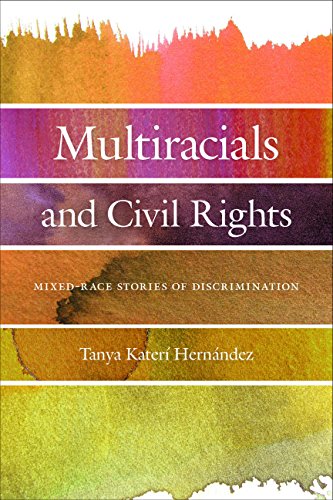
  • Tanya Katerí Hernández’s “Multiracials and Civil Rights”

    2018-08-25

    Tanya Katerí Hernández’s “Multiracials and Civil Rights”

    The Page 99 Test
    2018-08-08
    Marshal Zeringue

    Tanya Katerí Hernández is the Archibald R. Murray Professor of Law at Fordham University School of Law, where she co-directs the Center on Race, Law & Justice as its Head of Global and Comparative Law Programs and Initiatives.

    She applied the “Page 99 Test” to her new book, Multiracials and Civil Rights: Mixed-Race Stories of Discrimination, and reported the following:

    The Page 99 Test is like some numerical sorcery from a Jorge Luis Borges story, mythical and unfathomable yet accurate all at the same time. On page 99 of Multiracials and Civil Rights: Mixed-Race Stories of Discrimination, I describe how the U.S. government refused to add a “multiracial” category to its list of racial categories on the decennial census form in 1997, and instead started permitting respondents to select as many racial categories apply to their racial identity. The page then notes that the most zealous of multiracial category proponents were not satisfied by this government method of enumerating the population of racially mixed residents “because multiple box checking does not directly promote a distinct multiracial identity.” Page 99’s insight into the entire book though is revealed in the assessment that the significance of the census racial category debate:

    extends beyond the actual decision of how mixed-race persons should be counted. What is most salient is how the struggles over the census racial categories have fostered a discourse of exalting personal racial identity and characterizing any incursions on expressions of personal identity as a civil rights issue in of itself absent any mixed-race specific material inequality.

    Read the entire article here.

  • “A Part, and Apart”: Passing and Belonging as a Multiracial Person

    2018-08-24

    “A Part, and Apart”: Passing and Belonging as a Multiracial Person

    Psychology Today
    2018-08-21

    Tiffany McLain, LMFT
    San Francisco, California

    Here’s how to navigate passing and belonging as a multiracial person.

    Tiffany note: For the past few months, I have been writing about the experience of white mothers of biracial children. For the next set of articles in this series, I will be sharing the stories of white fathers of biracial children. The following article is a brief interlude that invites us to consider the experience of the biracial person who has been raised by a white mother, despite being multiethnic.

    The following article is written by Bay Area psychotherapist, Deva Segal, MFT. In it, she describes the experience of being a light-skinned biracial person in a society that desires a clear binary when it comes to racial identifications…

    …Over the course of my life, I have identified myself in many ways: half Indian-half White; just White; Other; South Asian; Desi; multiethnic; biracial; multiracial; light-skinned Indian; light-brown-but-probably-needs-to-go-back-in-the-toaster-a-little-bit-longer. In recent years, I have identified a “publicly white person and privately a person of color” in efforts to acknowledge my privilege. Still, that doesn’t always fit. Half my story is gone. Owning my own experience as a woman of color without apology while still kinda passing for white is a delightful grab bag of identity crises…

    Read the entire article here.

  • Danzy Senna’s Life Isn’t Black and White

    2018-08-24

    Danzy Senna’s Life Isn’t Black and White

    Articulate
    2018-04-24

    Jim Cotter, Host & Managing Editor

    Author Danzy Senna’s heritage gives her a unique perspective on race in America.

    Watch the interview (00:06:40-00:16:40) and read the transcript here.

  • Being Proud of my Blasian Identity Didn’t Come Without Some Pain

    2018-08-24

    Being Proud of my Blasian Identity Didn’t Come Without Some Pain

    Wear Your Voice
    2018-05-30

    Latonya Pennington, Pop Culture Writer

    Despite the ongoing trauma I’ve experienced and the toxic things I’ve had to unlearn, I wouldn’t trade being Blasian for anything.

    Until recently, I thought that being a biracial Black and Asian person was no big deal. I look Black and was always closer to my African American dad than my Vietnamese mom, so I thought that nullified my biracial heritage somehow. However, certain experiences, new stories, and media have reminded me that no matter how Black I appear to be, I will always be Blasian.

    The very first time I became aware of how my ethnicity affected me was when I was asked what my race was on a form when I was in elementary school. Ten to twenty years ago, official documents didn’t give you the option to say that you were multiracial or choose more than one race. I remember being a little confused because I knew my skin was Black, but both my parents weren’t. In the end, I chose “Black” and sometimes I still just choose “Black” when I think my ethnicity is too complicated for others to understand…

    Read the entire article here.

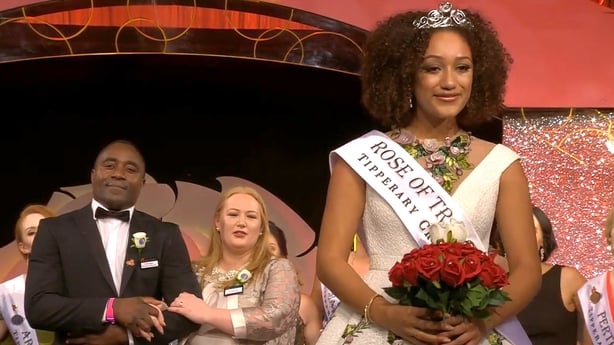
  • New Rose of Tralee calls on Ireland to embrace its diversity

    2018-08-24

    New Rose of Tralee calls on Ireland to embrace its diversity

    RTÉ
    2018-08-23


    The proud parents look on

    The new Rose of Tralee, Waterford Rose Kirsten Mate Maher, has called on Ireland to embrace its diversity, telling RTÉ Radio 1’s Morning Ireland that “there is no typical Irish woman”.

    The 21-year-old told presenter Bryan Dobson on Wednesday morning that being crowned the Rose of Tralee had yet to sink in, before going on to discuss the significance of her win…

    Read the entire article here.

  • Discussion on Race and Identity: One Year After Charlottesville

    2018-08-24

    Discussion on Race and Identity: One Year After Charlottesville

    C-SPAN
    Mississippi Book Festival
    Jackson, Mississippi
    2018-08-18

    Chris Goodwin, Introduction
    Programs and Communication Division
    Mississippi Department of Archives and History, Jackson, Mississippi

    W. Ralph Eubanks, Moderator and Visiting Professor of English & Southern Studies
    University of Mississippi

    Imani Perry, Hughes-Rogers Professor of African American Studies
    Princeton University, Princeton, New Jersey

    Sheryll Cashin, Carmack Waterhouse Professor of Law, Civil Rights and Social Justice
    Georgetown University, Washington, D.C.

    Jabari Asim, Associate Professor and Graduate Program Director for Creative Writing
    Emerson College, Boston, Massachusetts

    Authors Imani Perry, Sheryll Cashin, and Jabari Asim discuss race and identity.

    Watch the entire discussion (00:56:15) here.

  • “You Should’ve Seen My Grandmother; She Passed for White”: African American Women Writers, Genealogy, and the Passing Genre

    2018-08-22

    “You Should’ve Seen My Grandmother; She Passed for White”: African American Women Writers, Genealogy, and the Passing Genre

    University of Sheffield
    October 2015

    Janine Bradbury, Senior Lecturer in Literature; School Learning and Teaching Lead
    School of Humanities, Religion & Philosophy
    York St John University, York, United Kingdom

    Ph.D. Dissertation

    This thesis critiques the prevailing assumption that passing is passé in contemporary African American women’s literature.

    By re-examining the work of Toni Cade Bambara, Toni Morrison, Gloria Naylor, Dorothy West, Alice Walker, and Barbara Neely, I argue that these writers signify on canonical passing narratives – Brown’s Clotel (1853) and Clotelle (1867), Chesnutt’s The House Behind the Cedars (1900), Johnson’s The Autobiography of an Ex-Coloured Man (1912), Larsen’s Passing (1929), and Hurst’s Imitation of Life (1933) – in order to confront and redress both the historical roots and contemporary contexts of colourism.

    As well bridging this historiographic gap, I make a case for reading passing as a multivalent trope that facilitates this very process of cultural interrogation. Rather than focussing on literal episodes of passing, I consider moments of symbolic, textual, and narrative passing, as well as the genealogical and intertextual processes at play in each text which account for the spectral hauntings of the passing-for-white figure in post-civil rights literature.

    In Chapter 1, I examine the relationship between passing and embodiments of beauty in Morrison’s The Bluest Eye (1970), Bambara’s “Christmas Eve at Johnson’s Drugs N Goods” (1974) and Neely’s Blanche Among the Talented Tenth (1994).

    In Chapter 2, I discuss passing, class, and capital in Naylor’s Linden Hills (1985) and Dorothy West’s The Wedding (1995).

    In Chapter 3, I suggest that Walker and Morrison revisit Larsen’s Passing in their short stories “Source” (1982) and “Recitatif” (1983).

    Finally, I conclude this project with a discussion of Toni Morrison’s God Help the Child (2015) in order to demonstrate the continued centrality of the passing trope for authors interested in colourism, genealogy, and black women’s experiences.

    Embargoed here until October 2020.

  • The [passing] genre overlooks questions of colourism, treats racial identity as rigid and fixed, and the complexities of the mixed-race experience are ignored.

    2018-08-22

    The [passing] genre overlooks questions of colourism, treats racial identity as rigid and fixed, and the complexities of the mixed-race experience are ignored. And then there is the issue of optics. It is tricky for the passing character to move from page to screen. [John M.] Stahl’s selection of [Fredi] Washington for the role of Peola [in Imitation of Life (1934)] was hugely progressive for the 1930s. Not only did he give an actor who identified as black a significant role, but the film’s monochrome palette meant that Washington really looked white, which petrified southern segregationists.

    Janine Bradbury, “‘Passing for white’: how a taboo film genre is being revived to expose racial privilege,” The Guardian, August 20, 2018. https://www.theguardian.com/film/2018/aug/20/passing-film-rebecca-hall-black-white-us-rac.

  • “Why should we separate out based on this thing, this race thing? If we have grown them and they speak Lumbee the way we speak Lumbee, and they’ve gone to Lumbee schools and Lumbee churches and we’ve fed them and nourished them, they’re Lumbee.”

    2018-08-22

    Some Lumbees have red hair and freckles, others have tight blond curls, and others have sleek, dark hair and mocha skin. No one is kicked out of the tribe because of their skin tone — and that concept is hard for the BIA to accept, according to Mary Ann Jacobs, chair of the Department of American Indian Studies at UNC-Pembroke. “They don’t like the fact that we refuse to put people out who look too white or look too black. If they’re our people, we keep them.” Jacobs laughed, as if the idea of doing anything else were absurd. “We refuse to give them back. Why should we separate out based on this thing, this race thing? If we have grown them and they speak Lumbee the way we speak Lumbee, and they’ve gone to Lumbee schools and Lumbee churches and we’ve fed them and nourished them, they’re Lumbee.”

    Lisa Rab, “What Makes Someone Native American?” The Washington Post Magazine, August 20, 2018. https://www.washingtonpost.com/news/style/wp/2018/08/20/feature/what-makes-someone-native-american-one-tribes-long-struggle-for-full-recognition.

  • Brown Girl with Bubblegum

    2018-08-22

    Brown Girl with Bubblegum

    Longreads
    2018-08-17
    11 minutes (2,676 words)

    Lisa W. Rosenberg


    Illustration by Loveis Wise

    As a mixed-race kid with free-form hair, Lisa Rosenberg believed learning to blow bubblegum bubbles would be her ticket to an idealized (white) American girlhood.

    My fifth birthday was approaching, and I had one goal: to blow big, beautiful, pink bubbles out of real Bazooka bubble gum. I’d seen it done many times in person as well as captured in storybooks and on television. Bubble-blowing, I understood, was a critical marker of American girlhood — alongside hopscotch, Barbie dolls, and long hair with bangs you could flick out of your eyes with a toss of your head. I remember one image from a magazine: two girls riding bicycles up a tree-lined suburban street, their long, blond hair streaming out behind them in the wind, heads thrown back to relish the dappled sunlight. From the lips of each girl floated a pale pink bubble-gum bubble, half the size of her head. The girls were white, of course. In the ’70s, magazines didn’t show many little brown girls like me — with wild, free-form, biracial hair. I remember gazing and gazing at the picture, admiring those perfect girls with their flawless, pink bubbles. Somehow, someday, that would be me…

    Read the entire article here.

Previous Page
1 … 196 197 198 199 200 … 1,428
Next Page

Designed with WordPress