• Combating the Myth of Racial Democracy in Brazil

    Primary Source: The Indiana University Undergraduate Journal of History
    Volume IV: Issue I, Fall 2013
    Page 17-22

    Rebecca Pattillo

    While Brazil and the United States share a history of slavery, the changes to race relations in Brazil following emancipation differ greatly from the African American experience in the United States. The United States continuously enacted discriminatory laws against people of color such as Black Codes and Jim Crow Laws. From this emerged a society with government-institutionalized racism. In contrast, Brazil did not experience the same type of institutionalized racism and did not have overtly racist discriminatory laws. This is not to say that Afro-Brazilians did not struggle for social and racial equality following emancipation; rather, Brazil saw substantial differences in their racial social hierarchy due to their unique reasons for emancipation. Out of this emerged the opinion that racial prejudice and stratification existed more along the lines of wealth and class as opposed to the color of one’s skin. Sociologist Antonio Sérgio Alfredo Guimarães wrote in his essay “The Misadventures of Nonracialism in Brazil” that “in Brazil racism developed in a different way, present in social practice – a racism of attitudes – but unrecognized by the legal system and denied by the  nonracialist discourse of nationality.”1 Hence, a myth of racial democracy and inclusion emerged regarding Afro-Brazilians. Namely, this myth propagates that racism and inequality were not as prevalent in Brazil as they were in the United States and that blacks experienced little to no racial oppression…

    Read the entire article here.

  • Learning to Transgress: Law 10.639 and Teacher-Training Classrooms in São Paulo, Brazil

    Transforming Anthropology
    Volume 24, Issue 1, April 2016
    Pages 70–79
    DOI: 10.1111/traa.12058

    Reighan Gillam, Assistant Professor of Anthropology
    University of Southern California

    Signed in 2003, Law 10.639 makes teaching Afro-Brazilian history and culture compulsory in primary school lessons. Training programs to educate teachers on this material have proliferated in the state of São Paulo and elsewhere in Brazil. This paper illuminates non-elite Brazilians’ lived, personal engagements with ideas of racial inequality by way of these training programs. Participants in these classrooms did not express direct rejection or acceptance of these ideas but rather relied on personal experiences to negotiate their conceptions of racial identity and racial inequality that deviate from traditional ideas of racial democracy. As Brazil takes further steps to consider race when facilitating access to resources and confronting racial inequality directly, it is imperative that the everyday iterations of this shift are understood.

    As part of a series of training sessions1 to instruct teachers on how to integrate Afro-Brazilian history and culture into their curricula, trainer Flávia Gomes2 screened clips from the film Everyone’s Heroes (Heróis de Todo Mundo). This movie features prominent Afro-Brazilians and explains their role in national history. Flávia told the teachers that they could show this movie in their classrooms, or they could integrate the information from the movie into their lessons. Five female educators and I sat at our desks and quietly watched the clips that briefly recounted the lives and accomplishments of figures like Auta da Souza, an Afro-Brazilian writer, and Milton Santos, an Afro-Brazilian geographer. After showing the video, Flávia said a few words: “Violence is to whiten Black heroes. This silences the place of Blackness in the classroom. Machado de Assis, Lima Barreto. There is no way to silence this. (Não da para silenciar).” One of the participants raised her hand; Flávia called on her. She was a principal at an elementary school and participating in these classes to oversee the curricular changes at her school. Before saying anything, she began to sob, taking the entire class by surprise. “I feel so troubled because I didn’t know these people had been left out. I have heard of them but didn’t know they were Black. I liked reading the poems of Auta da Souza, but I always pictured her as White. The lack of information that we have…” Her comments trailed off as she wiped her tears. This response occurred toward the end of class, leaving Flávia with little time to initiate a conversation. Instead, she concluded class by adding a few words about using this video to educate children about the people presented in the movie before dismissing everyone for the day.

    This scene played out in a teacher-training program in its first year in Flor do Campo, Brazil, in the state of São Paulo. These teacher-training programs resulted from the passage of Law 10.639, which made Afro-Brazilian history and culture compulsory material for all Brazilian public primary schools. Since its passage, teacher-training programs have proliferated throughout the country to provide teachers with classroom material about Afro-Brazilian history and culture to satisfy the legal mandate of Law 10.639. The teacher-training classrooms in which I participated were dynamic spaces of conversation, interaction, and engagement where Brazilians, like the principal above, could encounter new ways of thinking about race2 that run contrary to the common belief that racism cannot naturally exist in a mixed-race society. This article aims to examine changing understandings of race in Brazil, not as it transforms larger social and political structures, but as it is continuously reframed on the micro-social or everyday level. I argue that the critical practice of learning about and responding to subjugated knowledge and alternative experiences have the potential to transgress boundaries of belonging and recognition of racial difference in Brazil.

    This article takes as a point of departure the issue of the personal in an era of changing conceptions of Brazilian race relations. This shift involves not only the macro changes of law and policy but also the personal, lived, everyday interactions of particular people as well. It uses the personal anecdotes, stories, and conversations of Brazilians offered during teacher-training sessions to examine how social change is a personal matter and how it plays out within everyday interactions. The “personal” broadly references the lived experiences of human beings. In several instances, the personal becomes the prism through which people perceive or react to macro-structural events and changing environments. I suggest that many Brazilians offer more personal responses to the shift from racial democracy based on their local and particular experiences as a way to account for the changes they are confronting in classroom education. While I would not say that these conversations were always successful at producing a shared understanding of the ways in which inequality can be tracked along racial lines, these teacher-training classrooms became sites and spaces of struggle over the limits and meanings of racial democracy and racial recognition, informed by the participants’ personal experiences of race that they frequently voiced….

    Read the entire article here.

  • February 20, 2018 – Lacey Schwartz & Mat Johnson

    The Opposition with Jordan Klepper
    Comedy Central
    2018-02-20

    Jordan Klepper, Host

    Jordan offers advice to civic-minded teens, talks the #NeverAgain movement with student activists, and chats with Lacey Schwartz and Mat Johnson of “The Loving Generation.”

    Watch the episode (00:21:15) here.

  • Book Talk: The Politics of Blackness: Racial Identity and Political Behavior in Contemporary Brazil

    Institute for the Study of Latin America and the Caribbean
    University of South Florida
    IBL Conference Room (FAO 296)
    4202 E. Fowler Avenue
    Tampa, Florida
    Thursday, 2018-03-01, 14:00 EDT

    Presenter

    Gladys L. Mitchell-Walthour, Assistant Professor of Public Policy and Political Economy
    Department of Africology (African Diaspora Studies)
    University of Wisconsin, Milwaukee

    Profess Mitchell-Walthour is the author of The Politics of Blackness: Racial Identity and Political Behavior in Contemporary Brazil.

    For more information, click here.

  • The Politics of Blackness: Racial Identity and Political Behavior in Contemporary Brazil

    Cambridge University Press
    December 2017
    260 pages
    Hardback ISBN: 9781107186101
    Paperback ISBN: 9781316637043

    Gladys L. Mitchell-Walthour, Assistant Professor of Public Policy and Political Economy
    Department of Africology (African Diaspora Studies)
    University of Wisconsin, Milwaukee

    This book uses an intersectional approach to analyze the impact of the experience of race on Afro-Brazilian political behavior in the cities of Salvador, São Paulo, and Rio de Janeiro. Using a theoretical framework that takes into account racial group attachment and the experience of racial discrimination, it seeks to explain Afro-Brazilian political behavior with a focus on affirmative action policy and Law 10.639 (requiring that African and Afro-Brazilian history be taught in schools). It fills an important gap in studies of Afro-Brazilian underrepresentation by using an intersectional framework to examine the perspectives of everyday citizens. The book will be an important reference for scholars and students interested in the issue of racial politics in Latin America and beyond.

    • Uses an intersectional approach that allows readers to understand how race, class, gender, and aesthetics shape Afro-Brazilian political behavior
    • Appeals to social scientists using quantitative and qualitative methods to study race, gender, group behavior, and politics
    • Develops a theory of racial spatiality that gives readers a bottom-up understanding of political representation and its reliance on everyday Afro-Brazilian citizens

    Table of Contents

    • Introduction
    • 1. Afro-Brazilian political underrepresentation
    • 2. Blackness and racial identification in contemporary Brazil
    • 3. Negro group attachment in Brazil
    • 4. Negro linked fate and racial policies
    • 5. Afro-descendant perceptions of discrimination and support for affirmative action
  • She’s Biracial, And It’s Not A Secret: Meet Duke Psychologist Sarah Gaither

    The State of Things
    WUNC, North Carolina Public Radio
    2018-02-19

    Amanda Magnus, Producer

    Frank Stasio, Host


    Sarah Gaither is an Assistant Professor of Psychology and Neuroscience at Duke, and a leading researcher in the field of biracial identity.
    Courtesy of Sarah Gaither

    Multiracial people are the fastest growing demographic group in the country. The U.S. Census Bureau projects the nation’s multiracial population will triple by 2060, but not much research has been done on this group. Sarah Gaither is hoping to change that. She’s an assistant professor of psychology and neuroscience at Duke University, and she is also a biracial woman.

    Listen to the interview (00:47:45) here.

  • Ancient DNA sheds light on what happened to the Taino, the native Caribbeans

    Ars Technica
    2018-02-19

    Kiona N. Smith


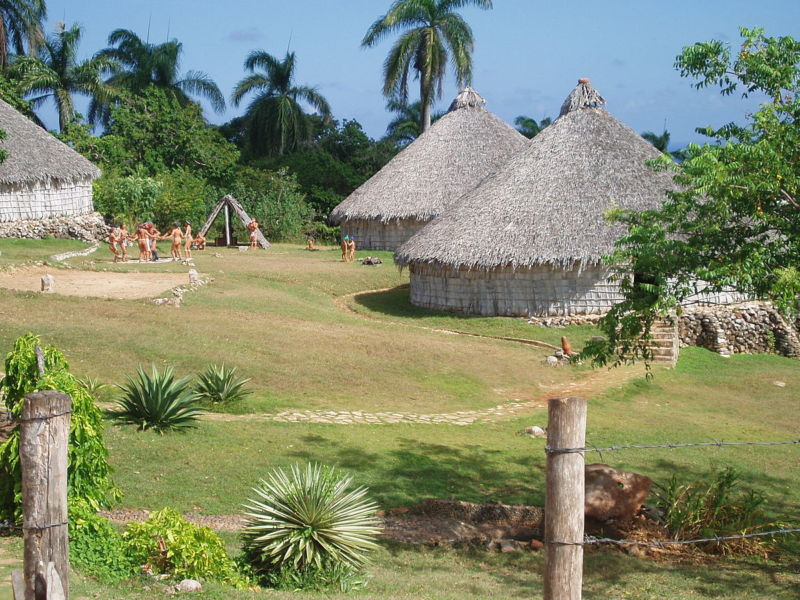
    Reconstruction of a Taino village in Cuba. Michal Zalewski

    A new DNA study explores where the Taino came from and where they went.

    The Caribbean was one of the last parts of the Americas to be settled by humans, although scientists don’t agree on when the first settlers arrived or where they came from. Some argue that people probably arrived from the Amazon Basin, where today’s Arawakan languages developed, while others suggest that the first people to settle the islands came from even farther west, in the Colombian Andes.

    “The differences in opinion illustrate the difficulty of tracing population movements based on a patchy archaeological record,” wrote archaeologist Hannes Schroeder of the University of Copenhagen, Denmark, and his colleagues. Schroeder’s research team has a new study on the genetics of the long-lost Taino people, which gives some clear indications of their origin and where they went after European colonization…

    Not vanished after all

    The recent work also shows that the vanished people of the Caribbean didn’t actually disappear without a trace. Modern inhabitants of the Caribbean islands mostly have a mixture of African and European ancestry, but some have a little indigenous DNA as well. That’s not entirely surprising; Spanish colonists reportedly married Taino wives, and other records say that Taino and escaped African slaves also intermarried and formed communities. Some people have made an effort to revive Taino culture and identity in the last century and a half or so, but it has never been clear how genetically related modern Caribbean residents are to the presumably vanished tribes…

    Read the entire article here.

  • “I think the generation after me was really the beginning of people openly embracing the idea of mixed identity. And today it’s to the point where when I walk into a place and people see or hear me, people assume I’m mixed because mixed identity exists. Because it didn’t exist in the public consciousness in the past, people would look at me like I was this wild, mutant creature.” —Mat Johnson

    Charles Pulliam-Moore, “Incognegro: Renaissance Author Mat Johnson Talks About Living a Black Life With Skin That Can Look White,” Gizmodo, February 12, 2018. https://io9.gizmodo.com/incognegro-renaissance-author-mat-johnson-talks-about-1822834011.

  • Frederick Douglass, Refugee

    The Atlantic
    2017-02-07

    David Blight, Class of 1954 Professor of American History; Professor of African-American and American Studies; Director, Gilder Lehrman Center
    Yale University


    J.C. Buttre / Wikimedia

    Throughout modern history, the millions forced to flee as refugees and beg for asylum have felt Douglass’s agony, and thought his thoughts.

    Frederick Douglass, author, orator, editor, and most important African American leader of the 19th century, was a dangerous illegal immigrant. Well, in 1838 he escaped a thoroughly legal system of enslavement to the tenuous condition of fugitive resident of a northern state that had outlawed slavery, but could only protect his “freedom” outside of the law.

    Douglass’s life and work serve as a striking symbol of one of the first major refugee crises in our history. From the 1830s through the 1850s, the many thousands of runaway slaves, like Douglass, who escaped into the North, into Canada, or Mexico put enormous pressure on those places’ political systems. The presence and contested status of fugitive slaves polarized voters in elections; they were the primary subject of major legislation such as the Fugitive Slave Act of 1850 as well as Supreme Court decisions such as Dred Scott v. Sanford in 1857. They were at the heart of a politics of fear in the 1850s that led to disunion. Among the many legacies of Douglass’s life and writings alive today, one of the most potent is his role as an illegal migrant and very public abolitionist orator and journalist posing as a free black citizen in slaveholding America.

    On February 1, 2017, President Donald J. Trump made some brief remarks on Black History Month. “Frederick Douglass,” he said, “is an example of somebody who’s done an amazing job, that is being recognized more and more, I notice.” That afternoon in one of the discussion sections of my lecture course at Yale on “The Civil War and Reconstruction Era,” my teaching fellow, Michael Hattem, reports that he read that quotation to the class. Students had just been assigned to read Douglass’s classic first autobiography, Narrative of the Life of Frederick Douglass. Michael says the class let out an audible collective groan, and one student declared: “My God, he doesn’t know who he was!”

    …Born Frederick Augustus Washington Bailey, his father likely his owner and his mother, Harriet, likely the owner’s slave, Douglass lived twenty years in bondage on Maryland’s eastern shore and in Baltimore. At age 18 he organized an escape plot with a small “band of brothers” among the slaves on a farm near St. Michaels, Maryland. Foiled and betrayed, he and his comrades were arrested, put in chains and marched several miles to the jail in Easton, the Talbot County seat. As great luck, Douglass’s owner, Thomas Auld, sent his slave back to Baltimore rather than selling him into obscurity in the deep South. Two years later, in a cunning and brave plot hatched with a few friends and with his intrepid fiancée, Anna Murray, Douglass escaped from slavery by train, steamer, and ferryboat to New York City, disguised as a sailor. His story is one of great drama and risk in the face of what he called a sense of “hopelessness” and “loneliness.” But in recollecting these events Douglass left the world an illegal refugee-immigrant’s language of fear and courage. His greatest power always resided in the written and spoken word…

    Read the entire article here.

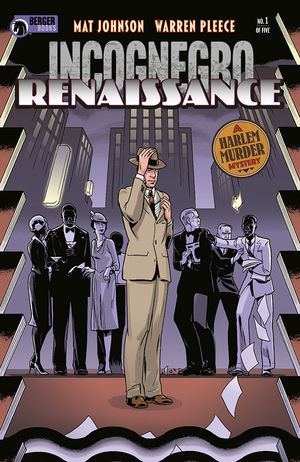
  • Incognegro: Renaissance #1

    Dark Horse Comics
    2018-02-07
    32 pages
    b&w, Miniseries
    UPC: 7 61568 00235 5 00111

    Writer: Mat Johnson
    Artist: Warren Pleece
    Editor: Karen Berger

    After a black writer is found dead at a scandalous interracial party in 1920s New York, Harlem’s cub reporter Zane Pinchback is the only one determined to solve the murder. Zane must go ”incognegro” for the first time–using his light appearance to pass as a white man–to find the true killer, in this prequel miniseries to the critically acclaimed Vertigo graphic novel, now available in a special new 10th Anniversary Edition.

    With a cryptic manuscript as his only clue, and a mysterious and beautiful woman as the murder’s only witness, Zane finds himself on the hunt through the dark and dangerous streets of ”roaring twenties” Harlem in search for justice.

    A page-turning thriller of racial divide, Incognegro: Renaissance explores segregation, secrets, and self-image as our race-bending protagonist penetrates a world where he feels stranger than ever before.