Mixed Race Studies

Scholarly perspectives on the mixed race experience.

    • About This Site
    • Bibliography
    • Contact Information
    • Date and Time Formats
    • Forthcoming… (Updated 2021-09-01)
    • Likely Asked Questions
    • List of Book Publishers
    • List of Definitions and Terms
    • My Favorite Articles and Papers
    • My Favorite Posts
    • My Recent Activities
    • Praise for Mixed Race Studies
    • Tag Listing
      • Tag Listing (Ordered by Count)
    • US Census Race Categories, 1790-2010
    • 1661: The First ‘Mixed-Race’ Milestone
    • 2010 U.S. Census – Some Thoughts

recent posts

  • The Routledge International Handbook of Interracial and Intercultural Relationships and Mental Health
  • Loving Across Racial and Cultural Boundaries: Interracial and Intercultural Relationships and Mental Health Conference
  • Call for Proposals: 2026 Critical Mixed Race Studies Conference at UCLA
  • Participants Needed for a Paid Research Study: Up to $100
  • You were either Black or white. To claim whiteness as a mixed child was to deny and hide Blackness. Our families understood that the world we were growing into would seek to denigrate this part of us and we would need a community that was made up, always and already, of all shades of Blackness.

about

  • Twitter
  • Facebook
  • Instagram
  • ‘Bleach bath’, clothes pins on the nose and ‘black monkey’: Study exposes racism in interracial families debunking one of Brazil’s greatest myths

    2017-06-29

    ‘Bleach bath’, clothes pins on the nose and ‘black monkey’: Study exposes racism in interracial families debunking one of Brazil’s greatest myths

    Black Women of Brazil
    2017-06-27

    Courtesy of Jornal Floripa

    What happens when there is racism in the home? In what way does it manifest? How can interracial marriages generate children who are segregated in their own home environment because of their color? Why do many white people deny the black race of their spouses – chosen by them – and even their children? Some answers to these questions appear in a study by the doctor in social psychology Lia Schucman, who researches racial relations in Brazil.

    For her postdoctoral work at USP (University of São Paulo), entitled Famílias Inter-Raciais: Tensões entre Cor e Amor (Inter-Racial Families: Tensions Between Color and Love), she interviewed 13 families who were willing to talk about the subject – often in conversations punctuated by tension and disagreement in relation to the races. In the end, the psychologist used reports from five families with different manifestations of what Lia called “racism of intimacy”…

    Read the entire article here.

  • Ngozi Onwurah: the forgotten pioneer of black British film

    2017-06-29

    Ngozi Onwurah: the forgotten pioneer of black British film

    gal-dem
    2017-06-20

    Varaidzo


    ‘The Body Beautiful‘ by Ngozi Onwurah. Image via BFI

    Ngozi Onwurah, despite being the director of the first independent black British feature film to be released, is not a household name. For a long time, her film Welcome II The Terrordome (1995), was the only film by a black woman to have a UK release. Like many black British women pioneers, her contributions to her craft have been pushed to the peripheries of British film history, yet revisiting her films reveals them to be prescient explorations of race that are just as relevant today.

    Onwurah was born to a white mother and a black father in 1960s Nigeria. She was raised in England by her mother, alongside her two other siblings (one of whom, Simon Onwurah, produced Welcome II The Terrordome). Her first work, Coffee Coloured Children (1988), uses Onwurah’s own personal narrative to look at the experiences of being a black mixed-race child in England. It begins gleefully with folk of all races gathered together, dancing, laughing, rejoicing, to the ever optimistic soundtrack of Blue Mink’s song ‘Melting Pot’. The tone of the film darkens almost instantly, its extended background monologue beginning with the question “our childhood memories are blurred, murky, why did the big boys throw dog shit on our front door?”. This is coupled with the visual of this particular act being reproduced for the viewer…

    Read the entire article here.

  • Princess Nokia Is Ready to Reign

    2017-06-29

    Princess Nokia Is Ready to Reign

    The Village Voice
    2017-03-29

    Ivie Ani


    ioulex

    I meet up with Destiny Frasqueri — the 24-year-old Nuyorican alternative hip-hop artist known variously as Princess Nokia, Wavy Spice, or simply Destiny — in the East Village. I’m running late; she’s even later, so I get to the Astor Place cube first. Fifteen minutes later she walks up, dressed, as she’d indicated in a text apologizing for being behind schedule, in a beige duster coat and sweats to match, carrying a cherry-print Louis V bag. She’s wearing oversize shades, no makeup, just a touch of mascara. Her dark hair blows in the breeze, caressing a diamond-studded choker.

    Frasqueri has appeared in Vogue, modeled for Calvin Klein, and had her song “Tomboy” used for an Alexander Wang runway show. But what makes her a figure of fascination for music aficionados in their teens and early twenties is the way she celebrates the beauty of imperfection, building a hero’s identity out of being a self-described “fucked-up kid.” She’s stunning yet still rough around the edges, rhyming about wearing dirty sneakers, smoking blunts in the stairwell, and proclaiming the power in her heritage. For her followers, her attractiveness lies in her contrasts. “Eczema so bad I’m bleeding,” she raps on “Bart Simpson,” the first track on 1992, the album she put up on SoundCloud last September. Sure enough, I look down and her irritated hands are bleeding slightly.

    “I’m just ghetto as hell,” she says once we’ve settled in at San Loco for some chicken nachos. “That’s the only way that I know how to just be myself.”…

    …Frasqueri’s mom passed by the time she was nine, and she grew up living in various homes across the Bronx, Harlem, and the Lower East Side. She experienced abusive foster care, life in the projects, and brief escapes to camp with wealthy kids from the Upper West Side. She’d skip class but bury herself in books, digging deep into the Black literary canon. (“I am Black Harlem Renaissance,” she says. “I am Walter Dean Myers and Langston Hughes, baby.”) She taught herself, studying Kemetic philosophy, practicing brujería and Santería, claiming her inheritance of Yoruba and Taíno cultures, and falling in love with New York City. Pissy project elevators and breezy summer barbecues in the street suffuse Frasqueri’s memories. She represents a specific kind of New York, what she describes as her own “urban realism.” “What makes life beautiful?” she muses at one point. “The ghetto makes life beautiful. Black people make life beautiful.”…

    …“I’m a Brown Afro-indigenous woman. That makes people uncomfortable as it is. The folks that have a problem with me and say, ‘You still live with privilege. You not fully Black.’ I can’t win and I can’t lose, so I’ma just keep going.” She smiles. “Yes, I’m mixed-race. There’s girls who look like me and glorify being exotic. I have a responsibility to my Blackness.”…

    Read the entire article here.
  • I Only Protested the Affordable Care Act Because the President Was Black. Please Don’t Take Away My Health Insurance

    2017-06-28

    I Only Protested the Affordable Care Act Because the President Was Black. Please Don’t Take Away My Health Insurance

    McSweeney’s Internet Tendency
    2017-06-27

    David Bradley Isenberg
    New York, New York

    Back in 2009, when the Patient Protection and Affordable Care Act was being debated in Congress, I was fuming with anger. How could I, a fiscal conservative, support a program that would drive down my insurance costs and cover my child’s preexisting condition? It clearly was a flawed bill that would ruin small businesses.

    I nearly boiled over for eight years, and rightly so. But now that President Obama has finally left office, and the Republicans want to take away my health insurance options and increase my premiums, I just want to be up front about something.

    It was never about the taxes. It was always about the president’s Blackness. It was super related to his race. Arguably, completely and wholly tied to race, alright? And now that the president is normal again, I’d be very grateful to be able to enjoy this health insurance and all these patient protections that have saved my small business and my child’s life. So please, don’t repeal the Affordable Care Act..

    Read (and enjoy) the entire article here.

  • The Afro-Latino Festival NYC Celebrates A Culture That’s Ready To Be Heard

    2017-06-28

    The Afro-Latino Festival NYC Celebrates A Culture That’s Ready To Be Heard

    The Village Voice
    2017-06-27

    Siddhartha Mitter


    Two revelers dance at last year’s festival Source: New Visual Collective

    At 26, Amara La Negra, the Dominican-American singer, has a string of energetic tropical-funk hits in Spanish, fierce dance moves, a fashion line, hundreds of thousands of social media followers, and rising star power in her hometown of Miami and back in the Dominican Republic. But Amara is also Afro-Latina — a visibly, unapologetically Black woman making her career in worlds where colorism still runs rampant, among them the D.R. with its social hierarchy and the international Latin entertainment industry. With her dark skin, exuberant Afro, and in-your-face “La Negra” stage name, Amara is making a point.

    “Change would be more Afro-Latinos in Hollywood, more on magazine covers,” Amara says. “It would be main roles in novelas, which we don’t yet have. They’ll cast you to be either a slave, a gangster, or a prostitute. They stereotype us.” Last year, a light-skinned beauty queen put on blackface and butt pads to parody Amara on Dominican TV. “We’re still a long way [from] seeing big change,” Amara says. “But we’re being more vocal.”…

    …In New York City, the flagship venue for the new cultural reassertion is the Afro-Latino Festival, which holds its fifth edition on July 7 and 8. A grassroots project led by Mai-Elka Prado Gil and Amilcar Priestley, a Panamanian couple in Brooklyn, it has ballooned since 2013 from an outdoor afternoon party to a two-day international summit gathering musicians, filmmakers, activists, scholars, and partygoers….

    Read the entire article here.

  • Angry in Omaha

    2017-06-28

    Angry in Omaha

    Captured and Exposed: Vintage Photography & True Crime Stories
    2017-06-08

    Shayne Davidson


    Minnie Bradley’s 1902 mugshot. Collection of the Nebraska State Historical Society.

    Minnie Bradley was arrested on the evening of December 11, 1902, and charged with “larceny from the person” or pickpocketing. Someone from the Midway Saloon, a well-known dance hall and whorehouse owned by several notorious Omaha crime bosses, offered to pay her $25 bond. Before she was released, W. H. Breiter showed up at the police station and identified Minnie as the person who had robbed him earlier that evening. Minnie offered Breiter $5 to drop the charge, but he refused, so she spent the night in jail…

    …Minnie returned to Omaha in 1904 and made two more appearances in police court before Judge Berka. The first, in March 1904, was as witness against a man named William Warwick, who was accused of assaulting her. The two had gotten into a heated argument when he bragged to her that, due to his light complexion, he often passed as a white man during his travels out west. He also mentioned that he had been in the company of two white women the previous evening. Minnie said William should show more respect for his race and reminded him that his mother was a black woman. His response was to punch her. Judge Berka sentenced him to 30 days in jail…

    Read the entire article here.

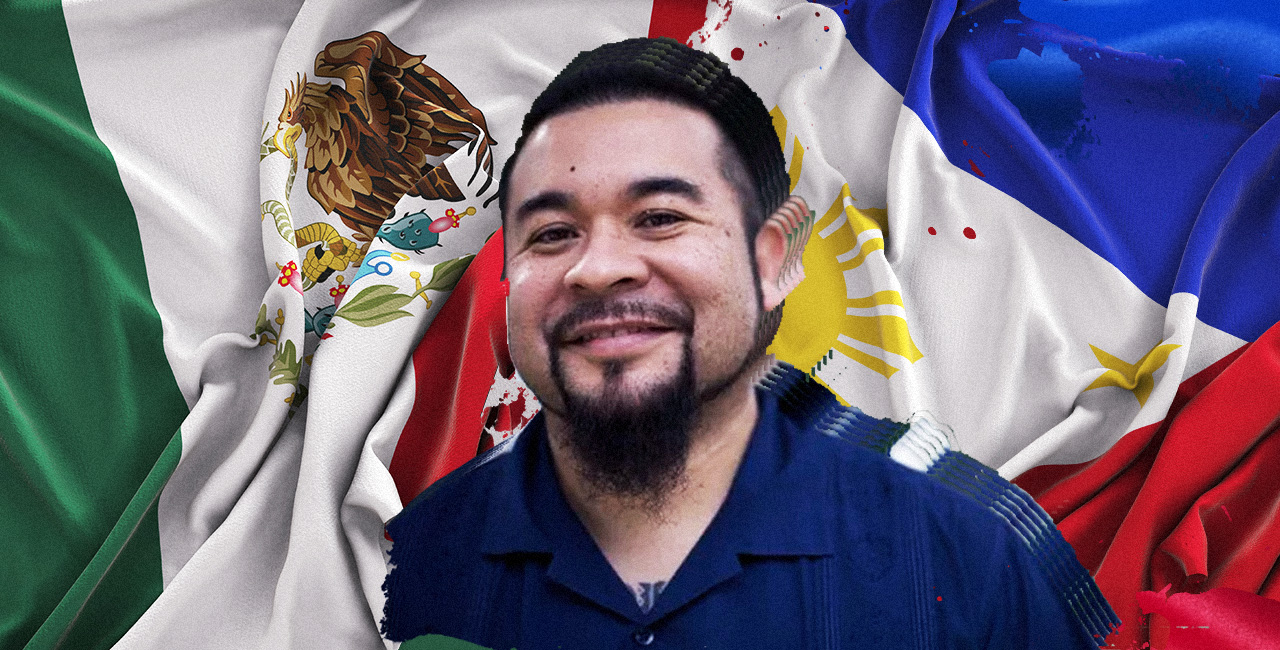
  • The Mexipino Experience: Growing Up Mexican and Filipino in San Diego

    2017-06-28

    The Mexipino Experience: Growing Up Mexican and Filipino in San Diego

    Remezcla
    2017-06-27

    Rudy P. Guevarra Jr., Associate Professor of Asian Pacific American Studies
    Arizona State University


    Author Rudy P. Guevarra Jr. Photo by Jimaya Gomez, Art by Alan López for Remezcla.

    Rudy P. Guevarra Jr. is the author of Becoming Mexipino: Multiethnic Identities and Communities in San Diego

    Growing up in San Diego, I remember watching my abuelito tend the guava tree he grew for my mother, while singing along to the Mexican rancheras that blared from his tiny radio in the backyard. When my mother called him in for lunch, he’d start whistling, as Linda Ronstadt’s Canciones de mi Padre echoed from the house. We both knew that we’d be eating caldo de res con arroz Mexicano. Once a month, my Filipino grandfather, or tata, would also pay us visits from San Francisco. I’d help him and my mother cook Filipino delicacies, like chicken adobo, pansit, and lumpia. He’d have us in tears, laughing at his jokes, while the smell of soy sauce and vinegar permeated the entire house.

    Many of our family functions centered on moments like these – eating Filipino food while listening to Mexican music, bathing ourselves in the experiences that were for me, the essence of being a Mexipino…

    Read the entire article here.

  • One possible antidote to the misappropriation of multiracial identity is for Loving Day celebrations to focus upon what was the ultimate civil rights objective of the Loving v. Virginia decision – the impermissible pursuit of what the Supreme Court there termed “White Supremacy.”

    2017-06-27

    One possible antidote to the misappropriation of multiracial identity is for Loving Day celebrations to focus upon what was the ultimate civil rights objective of the Loving v. Virginia decision – the impermissible pursuit of what the Supreme Court there termed “White Supremacy.” This is because interracial bans only prohibited interracial marriage involving white persons. Fifty years later, after the Loving v. Virginia decision, interracial marriage bans no longer exist, but White Supremacist violence and rhetoric still flourish. Whether or not Loving Day ever becomes an official federal holiday, it is to be hoped that its celebrations will specifically commemorate the decision’s fundamental civil rights concern with racial hierarchy.

    Tanya K. Hernández, “What the“Loving Day” 50th Anniversary Celebrations of the Loving v. Virginia Court Decision Really Need – A Challenge to Ongoing White Supremacy,” The Huffington Post, June 11, 2017. http://www.huffingtonpost.com/entry/593b4961e4b094fa859f1878.

  • One metric shows that race in America is about to experience a dramatic shift

    2017-06-27

    One metric shows that race in America is about to experience a dramatic shift

    Quartz
    2017-06-27

    Dan Kopf, Reporter
    San Francisco, California


    Feel the demographic change. (Reuters/Lucy Nicholson)

    The demographics of the United States are changing quickly, and there is no simpler way to understand that than to look at the most common age of each race and ethnic group.

    The US Census Bureau recently released its estimates of the US population as of July 2016. Besides an estimate of the total population (325 million), the census also includes estimates of the number of people of every age within each race and ethnicity. For example, the census estimates that, as of July 2016, there were 976,288 Hispanic 15-year-olds in the country.

    Jed Kolko, chief economist of jobs site Indeed, combed through this data and came away with a fascinating insight. He discovered huge variation in the most common age—more technically, the mode—between each major racial group in the US…

    Read the entire article here.

  • Navigating my way through mixed race identity

    2017-06-27

    Navigating my way through mixed race identity

    news.com.au
    Surry Hills, New South Wales, Australia
    2017-06-27

    Carolyn Cage


    Carolyn Cage pictured as a newborn with her dad Ray and her mum Doreen. Picture: Carolyn Cage

    IF THERE were an algorithm that could formulate a person’s most asked question, mine would be “what are you?” Society has a habit of labelling people like soup cans in a kitchen and for as long as I can remember, one of the first questions people ask during initial conversation is usually in relation to my racial ambiguity.

    Replying with “I am Australian” only ever leads to “but what are you really?” Learning how to tolerate ignorance and pass it off as curiosity, I take a deep breath and pull out the pie chart. I was born in Australia, but my mother originates from Malaysia and is of Chinese heritage. My father is of Anglo background, mixed with German and Belgium descent but was born in Sydney.

    The responses tend to be generic ranging from how exotic that is, how adorable mixed babies are or how I am the spitting image of their other mixed raced friend. Accepting that it is intended as a compliment, at the same time it is dehumanising and reduces my identity to some sort of novelty. Most of the time it leaves me unscathed, but the more I am asked “what am I”, the more of a hindrance it becomes…

    Read the entire article here.

Previous Page
1 … 273 274 275 276 277 … 1,428
Next Page

Designed with WordPress