• How U.S. Law Inspired the Nazis

    The Chronicle Review
    The Chronicle of Higher Education
    2017-03-19

    Marc Parry, Senior Reporter


    Asian immigrants in the late 1920s await processing in an internment center in San Francisco. AP Images

    It started with Mein Kampf. James Q. Whitman, a specialist in comparative law at Yale University, was researching a legal-history question when he pulled Adolf Hitler’s mid-1920s manifesto from the shelf. What jumped out at Whitman was the admiration that Hitler expressed for the United States, a nation that the future Führer lauded as “the one state” that had made progress toward establishing a healthy racial order. Digging deeper, Whitman discovered a neglected story about how the Nazis took inspiration from U.S. racial policies during the making of Germany’s Nuremberg Laws, the anti-Jewish legislation enacted in 1935. That history is the focus of Whitman’s new book, Hitler’s American Model (Princeton University Press). The interview that follows has been edited and condensed…

    You also write that some Nazis felt that the American legal example went too far. The Nazis were very interested in the way Americans classified members of the different races, defining who counted as black or Asian or whatever it might be. And there, in particular, the most far-reaching Nazi definition of who counted as a Jew was less than what you found in almost any American state. The most far-reaching Nazi definition, which dates to 1933, held that a Jew was anybody who had one Jewish grandparent. There were a few American states that made the same provision with regard to blacks. But most of them went much further than that. At the extreme, American states had what’s called the one-drop rule. That is, one drop of black blood makes you black…

    Read the entire interview here.
  • Rachel Dolezal struggling after racial-identity scandal in Spokane

    The Seattle Times
    2017-03-24

    Nicholas K. Geranios
    The Associated Press


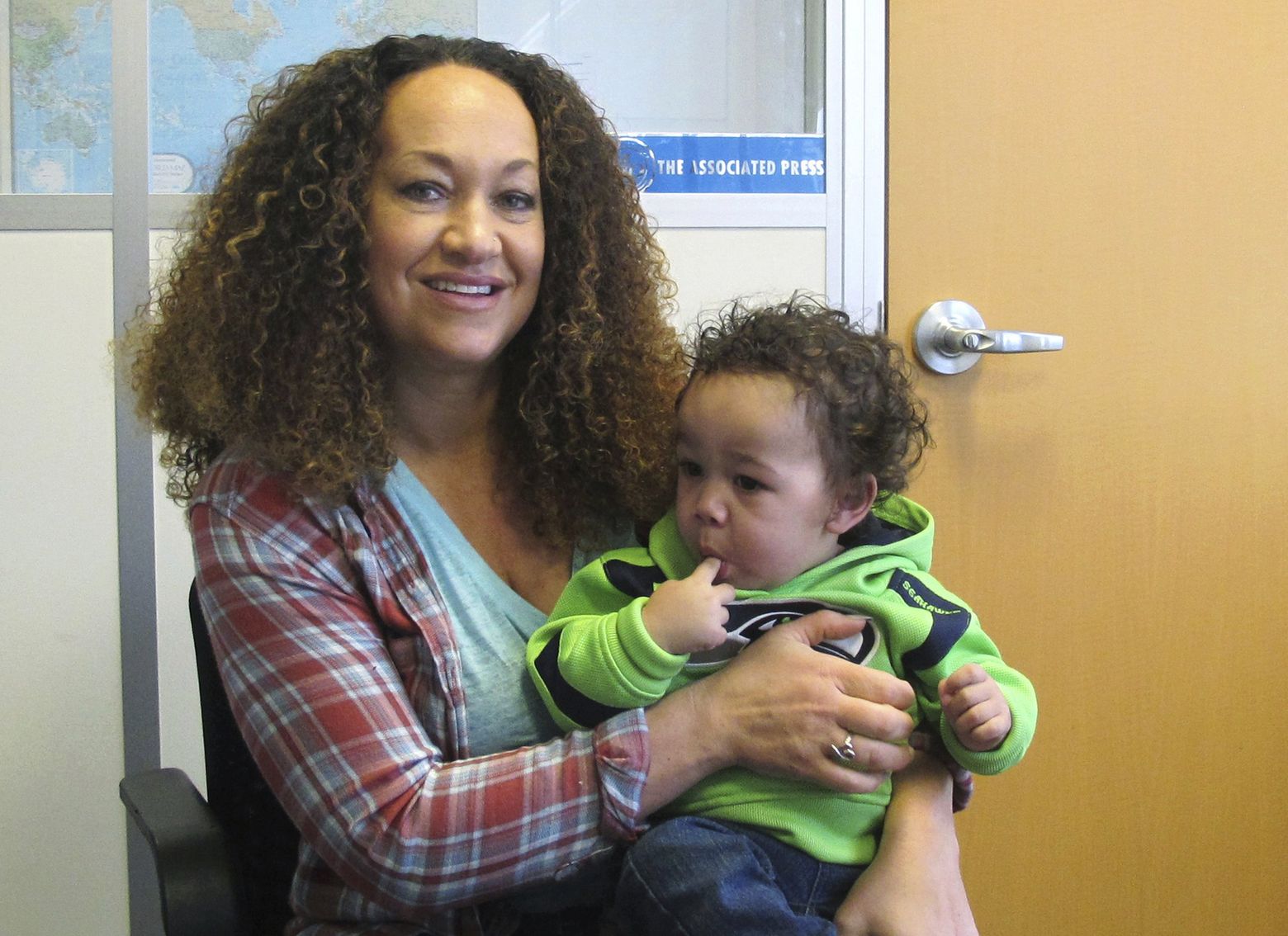
    In this March 20, 2017 photo, Rachel Dolezal poses for a photo with her son, Langston in the bureau of the Associated Press in Spokane, Wash. Dolezal, who has legally changed her name to Nkechi Amare Diallo, rose to prominence as a black civil rights leader, but then lost her job when her parents exposed her as being white and is now struggling to make a living. (AP Photo/Nicholas K. Geranios)

    “I was presented as a con and a fraud and a liar,” says Rachel Dolezal, who has been unable to find steady work since she was outed as a white woman in media reports. Dolezal had rose to prominence as a black civil-rights leader in Spokane.

    SPOKANE — A woman who rose to prominence as a black civil-rights leader then lost her job when her parents exposed her as white is struggling to make a living these days.

    Rachel Dolezal said she has been unable to find steady work in the nearly two years since she was outed as a white woman in media reports, and she is uncertain about her future.

    “I was presented as a con and a fraud and a liar,” Dolezal, 40, told The Associated Press this week. “I think some of the treatment was pretty cruel.”

    She still identifies as black, and looks black, despite being “Caucasian biologically.”

    “People didn’t seem able to consider that maybe both were true,” she said. “OK, I was born to white parents, but maybe I had an authentic black identity.”…

    …Dolezal has written a book about her ordeal titled “In Full Color.” It’s scheduled to be published next week.

    Last year, Dolezal legally changed her name to Nkechi Amare Diallo, a West African moniker that means “gift from the gods.” She made the change in part to give herself a better chance of landing work from employers who might not be interested in hiring Rachel Dolezal, a name she still intends to use as her public persona…

    Read the entire article here.

  • Acknowledging bi-racial women as black is not a threat to other black women

    Afropunk
    2017-03-23

    Erin White, Contributor
    Atlanta, Georgia

    There’s nothing wrong with wanting to marry a black-ass person and have black-ass kids. But pretending that this is the only way to lead an “authentically” black life and have “authentically” black children is a problematic mess.

    When we (the black community) talk about light skin privilege, many people want to simplify the conversation about colorism to “we’re all black”, “the police see you as black.” Isn’t this argument more true for non-white passing mixed blacks? When a person’s background and experiences in society are shaped by their blackness, why wouldn’t they “belong” to the black community?…

    Read the entire article here.

  • Why the Nazis Loved America

    TIME
    2017-03-21

    James Whitman, Ford Foundation Professor of Comparative and Foreign Law
    Yale Law School


    American Nazis parade on East 86th St. in New York City around 1939. Universal History Archive/UIG/Getty Images

    Whitman is the author most recently of Hitler’s American Model.

    To say America today is verging on Nazism feels like scaremongering. Yes, white nationalism lives in the White House. Yes, President Donald Trump leans authoritarian. Yes, the alt-right says many ugly things. But for all the economic pains of many Americans, there is no Great Depression gnawing away at democracy’s foundations. No paramilitary force is killing people in the streets. Fascism and Nazism have not arrived in the United States.

    But there is a different and instructive story to be told about America and the Nazis that raises unsettling questions about what is going on today — and what Nazism means to the U.S.

    When we picture a modern American Nazi, we imagine a fanatic who has imported an alien belief system from a far-away place. We also, not wrongly, picture captives in concentration camps and American soldiers fighting the Good War. But the past is more tangled than that. Nazism was a movement drawn in some ways on the American model — a prodigal son of the land of liberty and equality, without the remorse…

    Read the entire article here.

  • Denying your light skin privilege is harmful to the Black community as a whole

    Afropunk
    2017-03-22

    Erin White, Contributor
    Atlanta, Georgia


    Photo: PeopleImages / Getty

    “Stop dividing us!” “We’re all black at the end of the day.” “There is no #TeamLightSkin/#TeamDarkSkin!”

    Let’s cut the crap—nothing is as simple as “We’re all ______.” It’s nice to be reminded that we’re all in this together, human solidarity and back solidarity are beautiful things. They’re just not the only things. And when we don’t acknowledge the realities of the bad stuff, we let them fester and we leave others, the people we claim to be in solidarity with, more vulnerable.

    People of color can never fully separate themselves from their race and what it signifies to ‘others’, of course, but let’s not pretend that light skin blacks do not receive privileges that are at the expense of dark skin blacks. Every hip-hop reference, every magazine cover, the ease of crossover success for the ambiguously brown while darker skinned folks (especially women) somehow seem largely underrepresented, and subsequently under-valued.

    Society at large places a very high value on the perceived proximity to whiteness…

    Read the entire article here.

  • Race and Civil Rights Dramas in Hollywood

    Black Perspectives
    2017-03-24

    Justin Gomer, Assistant Professor of American Studies
    California State University, Long Beach


    Katharine Houghton and Sidney Poitier in “Guess Who’s Coming to Dinner.” Photo: Columbia Pictures.

    This year marks the fiftieth anniversary of Stanley Kramer’s Guess Who’s Coming to Dinner, starring the iconic Sidney Poitier. During the 1960s, when the film was released, Hollywood produced few movies about the political activism that comprised the civil rights movement. Instead, the movie industry turned to Sidney Poitier to offer representations of black middle-class respectability and colorblind racial discourse in hopes of changing the hearts and minds of whites across the country. Yet, Hollywood’s most celebrated civil rights drama debuted three years after the Civil Rights Act of 1964 and two years after the Voting Rights Act of 1965, amid a very different political climate. The film’s premiere in December 1967 was fourteen months after Huey Newton and Bobby Seale founded the Black Panther Party for Self Defense, and nearly eighteen months after Stokely Carmichael, director of the Student Nonviolent Coordinating Committee, began making calls for “Black Power.” James Baldwin, writing in July 1968, noted the contradiction between Hollywood’s images of black respectability vis-à-vis Poitier’s roles and the desires of the burgeoning Black Power movement, “white Americans appear to be under the compulsion to dream, whereas black Americans are under the compulsion to awaken.”

    The 2016 Hollywood year wrapped up a few Sundays ago with the Academy Awards. While the record six black actor nominations and the Best Picture Oscar for the black queer film Moonlight is reason to celebrate, Baldwin’s assessment of the movie industry endures. Indexing Hollywood’s “diversity problem” strictly to volume fails to fully comprehend the movie industry’s problematic relationship with black lives broadly, and with black history explicitly…

    Read the entire article here.

  • Hybridity and Miscegenation

    Chapter in The Wiley Blackwell Encyclopedia of Gender and Sexuality Studies
    Online ISBN: 9781118663219
    Published Online: 2016-04-21
    2 pages
    DOI: 10.1002/9781118663219.wbegss321

    Leigh H. Edwards, Associate Professor of English
    Florida State University

    Hybridity and miscegenation refer to race mixing. Both terms came into popular usage during the nineteenth century in the United States in the context of race slavery and scientific racism. Since the 1980s, hybridity has been used more broadly in postcolonial theory to refer to cultural mixture that can critique colonization.

    Read or purchase the chapter here.

  • Anti-Miscegenation Laws

    Chapter in The Wiley Blackwell Encyclopedia of Gender and Sexuality Studies
    Online ISBN: 9781118663219
    Published Online: 2016-04-21
    5 pages
    DOI: 10.1002/9781118663219.wbegss617

    Sally L. Kitch, Regents’ Professor, Women and Gender Studies
    Arizona State University

    Anti-miscegenation (racial mixing) laws have been enacted around the world throughout history. In mainland British colonies and the United States such laws regulated marriages between persons of different races, primarily between blacks and whites, from 1634 to 1967, when the Supreme Court declared them an unconstitutional mechanism for maintaining white supremacy in Loving v. Virginia. That decision exposed the faulty legal reasoning that exempted interracial marriages from the usual protections provided to marriage and citizenship on the grounds that miscegenation was illicit. British New World island colonies did not enact anti-miscegenation laws, but they did regulate the rights of mixed-race progeny. Often overlooked in discussions of these and other anti-miscegenation laws and policies are their inherent gender biases and their protection of white male prerogatives as a keystone of the doctrine of white supremacy.

    Read or purchase the chapter here.

  • The NFL has effectively blackballed Colin Kaepernick

    The Washington Post
    2017-03-23

    Kevin B. Blackistone, Visiting Professor
    Philip Merrill College of Journalism
    University of Maryland

    A week before Christmas 1996, Craig Hodges, who twice during his 10 NBA seasons was the league’s best three-point shooter, filed a federal lawsuit against the NBA. He charged that the league colluded to end his career four seasons earlier.

    Hodges contended the league was upset that he showed up at the White House with Michael Jordan and his other teammates from the 1991 NBA champion Bulls draped in a dashiki — a traditional West African tunic popularized here during the Black Power movement — and exercised utter audacity by presenting their host, President George H.W. Bush, with a two-page letter calling for the plight of people of color and the poor in this country to be prioritized in Bush’s domestic agenda.

    A week into 1998, the court dismissed Hodges’s complaint. His career effectively died when the Bulls waived him following their second championship in 1992.

    But Hodges’s story was revived with the advent of this NFL offseason’s free agency period. He’s been reincarnated in Colin Kaepernick. To be sure, Kaepernick managed the 17th-best quarterback rating last season among starters while coming back from injury. His touchdown percentage was 13th best, better than Washington’s Kirk Cousins, who wound up in the Pro Bowl and with a new franchise-tag contract worth $24 million next season. His interception percentage was sixth, just behind Aaron Rodgers and just ahead of MVP Matt Ryan

    Read the entire article here.

  • DW launches new multimedia project ‘Afro.Germany’

    Afro.Germany
    DW (Deutsche Welle)
    2017-03-10

    Gaby Reucher

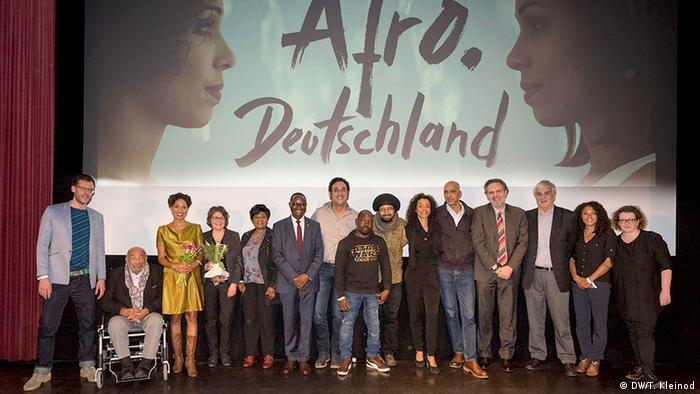
    What is it like to be a Black person living in Germany? What does it mean to be excluded from your own society? Prominent guests met to discuss these questions and more, underlining the launch the new project.

    I used to want to be white,” says Jana Pareigis, speaking with rapper Samy Deluxe.  She wanted to know if it was like that for him, as well. “As a child, yes,” he says. “But as a teen, I wanted to really be Black.”

    The dialogue is a scene from the movie “Afro.Germany,” in which TV host Jana Pareigis traveled throughout Germany visiting Black people and hearing their stories about what it’s like to be Black in Germany. They shared stories from their childhoods, and explained how they identified themselves and why they are proud of their skin color.

    Among those interviewed are prominent figures like football star Gerald Asamoahand artist Robin Rhode. Pareigis also spoke with refugee Issa Barra from Burkina Faso, as well as Indira Paarsch, who was given up for adoption by her white mother when she was a baby because she was “too black.”

    Pareigis also shares anecdotes from her own life – she herself was adopted by white parents. As a child in kindergarten, her dark skin attracted attention. Even until today, people touch her hair without asking…

    Read the entire article here.