• New World A-Coming: Black Religion and Racial Identity during the Great Migration

    New York University Press
    February 2017
    368 pages
    28 halftones
    Cloth ISBN: 9781479888801

    Judith Weisenfeld, Agate Brown and George L. Collord Professor of Religion
    Princeton University

    When Joseph Nathaniel Beckles registered for the draft in the 1942, he rejected the racial categories presented to him and persuaded the registrar to cross out the check mark she had placed next to Negro and substitute “Ethiopian Hebrew.”  “God did not make us Negroes,” declared religious leaders in black communities of the early twentieth-century urban North. They insisted that so-called Negroes are, in reality, Ethiopian Hebrews, Asiatic Muslims, or raceless children of God. Rejecting conventional American racial classification, many black southern migrants and immigrants from the Caribbean embraced these alternative visions of black history, racial identity, and collective future, thereby reshaping the black religious and racial landscape.

    Focusing on the Moorish Science Temple, the Nation of Islam, Father Divine’s Peace Mission Movement, and a number of congregations of Ethiopian Hebrews, Judith Weisenfeld argues that the appeal of these groups lay not only in the new religious opportunities membership provided, but also in the novel ways they formulated a religio-racial identity. Arguing that members of these groups understood their religious and racial identities as divinely-ordained and inseparable, the book examines how this sense of self shaped their conceptions of their bodies, families, religious and social communities, space and place, and political sensibilities.

    Weisenfeld draws on extensive archival research and incorporates a rich array of sources to highlight the experiences of average members. The book demonstrates that the efforts by members of these movements to contest conventional racial categorization contributed to broader discussions in black America about the nature of racial identity and the collective future of black people that still resonate today.

  • Thomas Jefferson, Sally Hemings, and the Question of Race: An Ongoing Debate

    Journal of American Studies
    Volume 37, Number 1 (April, 2003)
    pages 99-118
    DOI: 10.1017/S0021875803007023

    Peter Nicolaisen (1936-2013), Professor of English Emeritus
    University of Flensburg, Germany

    Not many private relationships in history have received as much press attention in recent years as that between Thomas Jefferson and his slave Sally Hemings. First alleged in 1802 by the journalist James Callender, who based his account on stories that had been current in Virginia for some years, the affair has since then been debated both in the scholarly community and by the general public to an unparalleled degree. The results of the DNA tests on male descendants of the Jefferson and Hemings families that were published in 1998 have added fuel to the debate. Meanwhile, its focus has shifted. The majority of those who have publicly expressed an opinion on the case, including the Thomas Jefferson Memorial Foundation which owns and administers Monticello, now seem to agree that a sexual relationship between Jefferson and Sally Hemings did exist, and that it resulted in a number of children. The questions addressed today primarily concern the implications of the affair. What does the liaison between Jefferson and Sally Hemings mean for our understanding of the man Thomas Jefferson, and how does it affect the accomplishments he has generally been credited with? Given the little we know about her, how do we view Sally Hemings’s role in the relationship, and how do we come to understand her as an individual living out her life in bondage? What, if any, are the consequences the affair has for an evaluation of interracial relationships as they existed in the late eighteenth and early nineteenth centuries?…

    Read the entire article here.

  • Hapa Japan Fest 2017

    University of Southern California
    Los Angeles, California
    2017-02-22 through 2017-02-26

    The Hapa Japan Festival celebrates mixed-race and mixed roots Japanese people and culture. Come join us at the Japanese American National Museum and the USC campus for film screenings documenting the story of mixed race Japanese people, rich conversations with Hapa cultural icons, jam sessions, and a gastoronomic experience to remember. Please also join us as we hear from lead thinkers of Hapa Japan (and critical mixed race) scholarship at the 3-day Critical Mixed Race Studies (CMRS) Conference which will be held in conjunction with the festival. This year’s conference explores issues in trans (gender, gressions, migrations, racial). For a full background on festival and conference participants, see our bios sections.

    For more information, click here.

  • I am a mixed-race person who remembers stumbling across the word “mulatto” in my history textbook, clinging to the first historical representation of myself despite the fact that it was rooted in the rape of slave women by their masters. Throughout the Obama presidency, I wondered about his first encounter with that word. I wondered how he might have coped with that feeling of being an unnamed outsider among white folks. I wondered how he might have negotiated his simultaneous proximity to whiteness and blackness as someone who did experience racism.

    Brianna Suslovic, “Mixed Like Obama,” Philadelphia Printworks, January 30, 2017. https://www.philadelphiaprintworks.com/blogs/news/mixed-like-obama.

  • Miscegenation and passing provide the primal scenes of American racial anxiety. In Boy, Snow, Bird they become more than themes: miscegenation and passing also drive the novel’s fundamental imagination and its modes of narration. The novel is replete with sly passing metaphors. One character describes another as “seventy percent all right and thirty percent pain in the neck” as if the deep logic of hypodescent—the discriminatory assignment of racialized identities based on a pseudoscientific calculus of “blood percentages”—has been displaced onto a casual personality assessment. Passing appears in other forms as well: Bird, the sister who does not pass racially, nonetheless possesses a gift for vocal mimicry that allows her to pass sonically; a woman named Boy desperately tries to perform motherhood; and extraordinary violence, such as pulling the eyes out of captured animals for no apparent reason, or simply punching your child in the kidneys as you walk by, passes as quotidian practice.

    Anne Anlin Cheng, “Passing Beauty,” Public Books, July 1, 2014. http://www.publicbooks.org/passing-beauty/.

  • A president’s past yields a modern parable

    The Berkshire Eagle
    Pittsfield, Massachusetts
    2017-01-24

    Jenn Smith


    A tree is planted and dedicated to the descendants of Thomas Jefferson and his slave, Sally Hemings, at Monticello’s Mulberry Row. Mulberry Row was the center of activity of Jefferson’s 5,000-acre agricultural enterprise. According to the Monticello website, it was populated by more than 20 dwellings, workshops, and storehouses between 1770 and the sale of Monticello in 1831.
    PHOTO PROVIDED BY JANE FELDMAN

    Students learn about black history in Thomas Jefferson’s family

    PITTSFIELD — History can play a crucial role in our futures, if we listen to it.

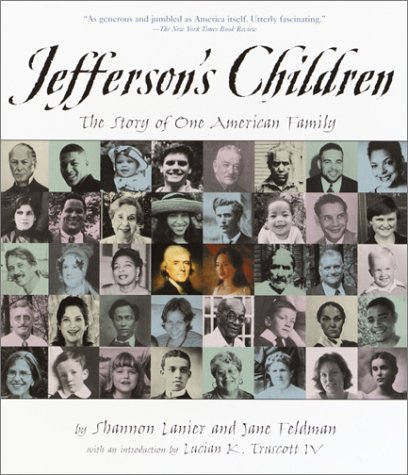
    In 2002, photographer, Jane Feldman, who shares her time between the Berkshires and New York City, and Shannon Lanier, the sixth great-grandson of U.S. President Thomas Jefferson, worked together to publish through Random House, “Jefferson’s Children: The Story of One American Family.”

    The book details, in family album and portrait style, Lanier’s trip across the country to retrace the footsteps of his maternal ancestor, Madison Hemings, the son of Thomas Jefferson and Sally Hemings. Hemings was Jefferson’s African-American slave.

    With increasing discussions and divides developing across the nation regarding race and rights, Lanier and Feldman have decided to revive a series of tours and talks — originally conducted after the book’s release — about the book and its themes of identity, family and the varying perspectives of American history and culture.

    “We believe that one of the things that will help us all navigate through this complicated time in our history is the ability to understand where we’ve come from and where we are going as individuals and as a nation,” Feldman said…

    …The co-authors also noted how people aren’t always as they seem; for example how many light-skinned members of the Jefferson-Hemings lineage would go on to “pass” in society, that is, take advantage of the social statuses that came with looking like a white person, including freedom from slavery.

    But the side effect of passing, is some future generations grew unaware of their black heritage, some even becoming racist, without knowing their own black blood lines…

    Read the entire article here.

  • Jefferson’s Children: The Story of One American Family

    Random House
    December 2002
    160 pages
    Hardcover ISBN: 978-0195031720
    Trade Paperback ISBN: 978-0-375-82168-4

    Shannon Lanier and Jane Feldman

    Personal testimonies from descendants of Thomas Jefferson and Sally Hemings pose important questions about equality, freedom, and family.

    On October 31, 1998, the Associated Press broke the news that there was finally scientific proof for what many people already knew was true, but others would not believe: Thomas Jefferson had a relationship with his slave Sally Hemings after the death of his wife. This DNA link was proven through the Eston Hemings line.

    Jefferson’s Children is the story of the Jefferson and Hemings families, and their efforts to be recognized and united as proud descendants of this great American genius. Some discovered their heritage through written family records, and others have based their beliefs on oral histories. Regardless of their sources, many descendants of Thomas Jefferson and Sally Hemings want the world to know that skin color isn’t what makes a family.

    Thomas Jefferson wrote about equality. He believed in freedom. Yet, he owned slaves. This contradiction in character raises many questions among historians and descendants as they unravel the “truth” about this complex man. Did he indeed father children with his slave, Sally Hemings? How would he view the issues of racism among his ancestors today?

  • Passing Beauty

    Public Books
    2014-07-01

    Anne Anlin Cheng, Professor of English; Professor of African American Studies
    Princeton University

    How do you break a spell? How do you get over the grief of racial, gendered, and childhood injuries? Helen Oyeyemi’s novel Boy, Snow, Bird is not a black-and-white parable but a black-and-blue story. A bruising tale about miscegenation, passing, and beauty, this novel brings to life the idealization and wounding that haunt the American racial psyche, and suggests that the price we pay for this history is nothing less than our own reflection.

    Imagine a collision (or a collusion) between Anne Sexton’s Transformations, Nella Larsen’s Passing, and Elizabeth Taylor’s striking and stricken face in the 1957 film Raintree County. The tortured hybrid that would result might resemble Helen Oyeyemi’s new novel Boy, Snow, Bird. What brings these three unlikely predecessors to mind is not simply Oyeyemi’s haunting fusion of passing narratives and fairy tales but also the way this Nigerian-born British novelist harnesses the sonic, the textual, and the cinematic to produce an uncanny world in which the quotidian tips effortlessly into the surreal and vice versa.

    In Oyeyemi’s version, Snow is the beloved, glowing, blonde girl-child of a jewelry maker named Arturo Whitman, and Bird is her dark-skinned half sister, whose birth exposes the Whitmans as light-skinned African Americans who have been passing as white. The wicked queen is the young bride and new mother named Boy who marries into the Whitman family without knowing their secret and who herself is the victim of a horrendously abusive childhood. The narrative voice shifts between Boy, whose first-person narration opens and closes the book, and her biological daughter Bird, who offers us her point of view in the middle section of the book and who in a sense speaks for her missing sibling, as Snow’s voice comes to us through a series of letters between the half sisters recorded by Bird…

    Read the entire review here.

  • @X: Making America White 200 Years Ago

    Public Books
    2017-02-17

    Brandon R. Byrd, Assistant Professor of History
    Vanderbilt University, Nashville, Tennessee

    In the latest edition of our anniversaries series, Brandon Byrd examines resistance to the American Colonization Society’s attempts to remove free blacks from the US.

    In January 1817, more than three thousand African Americans gathered in Mother Bethel African Methodist Episcopal (AME) Church in Philadelphia, PA. Skilled artisans, domestic workers, and underpaid manual laborers filled the pews. So did black elites including Richard Allen, the founder and first bishop of the AME Church; Absalom Jones, Allen’s friend and cofounder of the Free African Society, the leading black mutual aid society in Philadelphia; and James Forten, a wealthy sailmaker and outspoken abolitionist. As historian Benjamin Quarles noted, there was only one cause that could bring together a gathering of that size and diversity. Weeks earlier, some of the most influential white men in the United States had formed the American Colonization Society (ACS), an organization whose official title—the Society for the Colonization of Free People of Color of America—made clearer its goal of removing free blacks from the United States. Now, as the ACS began its work, black Philadelphians gathered to respond as one to the proposition that their futures lay not in what was for many their country of birth but in Africa.

    Standing behind a platform at the front of the church, Forten brought the meeting to order. The well-to-do businessman, born free in Philadelphia, first called for all in favor of colonization to respond with an “aye.” Nobody said a word. He then asked for those who opposed colonization to respond with a “no.” The response was thunderous. Unambiguous. Unanimous. In fact, Forten later wrote that it seemed as if the outcry “would bring down the walls of the building.”1

    One year later, the ACS gathered in the chamber of the US House of Representatives for its first annual meeting. Participating members included Francis Scott Key, the slaveholding author of what became known as “The Star-Spangled Banner” and a prominent Washington, DC–based attorney who later demanded in court that his fellow white men not “abandon your country; to permit it to be taken from you by the Abolitionist, according to whose taste it is to associate and amalgamate with the Negro.”2 Henry Clay was there too. The US congressman who would bring about the Missouri Compromise was also a Kentucky slaveowner who believed that “amalgamation”—interracial socializing or sex—was “impossible” because the “God of nature by the difference of color & of physical constitution, has decreed against it.”3 He was, put simply, a man who admired the racial thought of Thomas Jefferson, the exalted Founding Father whose antislavery views coexisted with his slaveholding and his “suspicion . . . that the blacks, whether originally a distinct race, or made distinct by time and circumstances, are inferior to the whites in the endowments both of body and mind.” He, too, wanted them removed from his country.4

    Read the entire article here.

  • The True Story of Pocahontas: Historical Myths Versus Sad Reality

    Indian Country Media Network
    2017-02-16

    Vincent Schilling


    AP Images
    A portrait of Pocahontas saving the life of John Smith with Father Wahunsenaca. Oral history from the descendants of Pocahontas dictate such a thing could never have happened.

    Pocahontas had a Native Husband and Native Child; Never Married John Smith

    Despite what many people believe due to longstanding and inaccurate accounts in history books and movies such as Disney’s Pocahontas, the true story of Pocahontas is not one of a young Native Powhatan woman with a raccoon friend who dove off of mountain-like cliffs off the coasts of Virginia. (Note: there are no cliffs on the coast of Virginia.)

    The true story of Pocahontas is a tale of tragedy and heartbreak.

    It is time to bust up the misconceptions perpetuated over 400 years regarding the young daughter of Powhatan chief Wahunsenaca. The truth—gathered from years of extensive research of the historical record, books, and oral histories from self-identified descendants of Pocahontas and tribal peoples of Virginia —is not for the faint of heart…

    Read the entire article here.