• Tracing Your “Routes”

    TEDx Talks: TEDxSBUWomen
    Stony Brook University, State University of New York
    2015-07-10

    Zebulon Miletsky, Professor of Africana Studies
    Stony Brook University, State University of New York

    “He’s gonna have a hard time proving he’s a brother.”

    Dr. Zebulon Miletsky discusses his journey through the multiple worlds of race and identity as he shares his experiences with researching his own family genealogy, the various “routes” this process led him to and how “tracing your routes” can lead to more than just knowledge about your background–it’s about how we treat one another along those “routes”.

    Dr. Zebulon Miletsky teaches African-American History at Stony Brook University where he is an Assistant Professor of Africana Studies. He is the author of numerous articles, essays and most recently a book chapter that appeared in the anthology “Obama and the Biracial Factor: The Battle for a New American Majority” which traces the contested meanings throughout history of terminology for multiracial people and the role that this historical legacy of “naming” plays into how President Obama is read as African American, but still asserts a strategic biracial identity through the use of language, symbols, and interactions with the media. Miletsky who is half-Jewish (white) and African-American/Afro-Caribbean, has done a great deal of genealogical research for a book manuscript in progress and is in the process of researching his own family tree. He lives in Brooklyn.
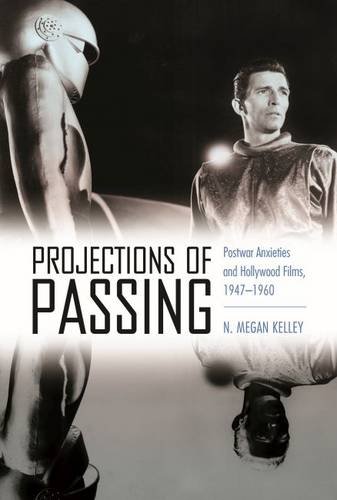

  • Projections of Passing: Postwar Anxieties and Hollywood Films, 1947-1960

    University Press of Mississippi
    2016-04-04
    284 pages
    40 b/w illustrations, filmography, bibliography, index
    6 x 9 inches
    Hardback ISBN: 9781496806277

    N. Megan Kelley

    How the cinematic act of passing embodied, exacerbated, and sometimes alleviated American fears

    A key concern in postwar America was “who’s passing for whom?” Analyzing representations of passing in Hollywood films reveals changing cultural ideas about authenticity and identity in a country reeling from a hot war and moving towards a cold one. After World War II, passing became an important theme in Hollywood movies, one that lasted throughout the long 1950s, as it became a metaphor to express postwar anxiety.

    The potent, imagined fear of passing linked the language and anxieties of identity to other postwar concerns, including cultural obsessions about threats from within. Passing created an epistemological conundrum that threatened to destabilize all forms of identity, not just the long-standing American color line separating white and black. In the imaginative fears of postwar America, identity was under siege on all fronts. Not only were there blacks passing as whites, but women were passing as men, gays passing as straight, communists passing as good Americans, Jews passing as gentiles, and even aliens passing as humans (and vice versa).

    Fears about communist infiltration, invasion by aliens, collapsing gender and sexual categories, racial ambiguity, and miscegenation made their way into films that featured narratives about passing. N. Megan Kelley shows that these films transcend genre, discussing Gentleman’s Agreement, Home of the Brave, Pinky, Island in the Sun, My Son John, Invasion of the Body-Snatchers, I Married a Monster from Outer Space, Rebel without a Cause, Vertigo, All about Eve, and Johnny Guitar, among others.

    Representations of passing enabled Americans to express anxieties about who they were and who they imagined their neighbors to be. By showing how pervasive the anxiety about passing was, and how it extended to virtually every facet of identity, Projections of Passing broadens the literature on passing in a fundamental way. It also opens up important counternarratives about postwar America and how the language of identity developed in this critical period of American history.

  • What Growing Up Mixed-Race Taught Me About Food

    Spoon University
    2016-09-13

    Susanna Mostaghim
    Virginia Tech

    And why we’re the ultimate foodies.

    Weird things come with being mixed-race. These include, but are not limited to: no one ever guessing your heritage correctly, random stereotypes you wouldn’t expect, a fusion of your parents’ cultures, and questions of “Wait, where did your parents meet?”

    Being mixed-race, I commonly get mistaken for being of Hispanic origin, which is a laugh as neither of my parents are from the same continents as any Hispanic country. It’s my favorite bar game to have people guess my heritage when they ask, “But where are you really from?” (cue my desire to act like this).

    It’s kind of like that Parks and Rec[creation] scene where Leslie asks Tom where he’s from, and it ends with him saying his mom’s uterus.

    But what most people don’t realize is that the best part of being mixed-race isn’t that you don’t look like any certain race or anything physical. It’s the fusion of the different food styles your parents and community bring to the table…

    Read the entire article here.

  • ‘We were the unspoken story of Ireland’

    BBC News
    2016-10-13

    The #IamIrish exhibition in north London explores what it means to be mixed race and Irish.

    Watch the video (00:02:21) here.

  • An interview with hip hop artist Akala

    Vlad TV
    2016-06-10

    Vladimir Lyubovny (DJ Vlad), Host

    U.K. artist Akala stopped by the Vlad Couch to discuss a plethora of topics surrounding the history of the impact of slavery throughout the world, Black culture, hip hop’s influence across the world, and what it means to be mixed-race in today’s society.

    Akala starts the conversation discussing the difference between racism in America versus the United Kingdom. Then delves into police brutality and the gun laws in Britain. Then the rapper gives a brief history lesson on Britain’s involvement in the slave trade, and how they’ve maintained a very “white” history. Akala explained there is nowhere in the U.K where there are only Black people. “You know if you go to the south side of the Chicago, or you go to certain parts of the Bronx, I’ve visited family up there, and literally everyone [was Black.]”

    In breaking down the presence of hip-hop in the UK, Akala talks about his Black Shakespeare theory, and how he believes that centuries from now, someone like Nas or Lauryn Hill will be the Shakespeare of their time. He also explains why he feels Damian Marley out-rapped Nas on ‘Distant Relatives,’ after explaining why as a Black man he chooses not to use the N-word anymore.

    Listen to the educational and entertaining interview above.

  • Being “Dual Heritage” In Modern Britain

    HC At Exeter Cornwall
    2016-10-11

    Stacey Harris, 2nd year Environmental Science Student
    Solihull, West Midlands

    As many of you may be aware, October is Black History Month, which acts as a platform for education, reflection and a celebration of the trials and triumphs of African and Caribbean communities throughout history. It provides a vital means to raise the voices of minorities whose history is often sorely overlooked.  Every year a different thought-provoking theme is selected for the month, with this year’s being “tackling conscious and unconscious bias”. As a person of dual heritage, this got me thinking about my own intentional and unintentional bias towards my own ethnic background.

    After spending 19 years of my life with a very vague understanding of my own family history – merely using the provided census classification of “white black Caribbean” – I suddenly had a bit of an identity crisis, and decided I needed to know more about my heritage in order to solve this. This, in tandem with my impulsive spending habits, led to me undertaking a 23andMe DNA test. The process involved sending away a saliva sample, and then an agonising two month wait until my results were sent back and revealed. I found the whole thing strangely more emotive than I was expecting when I first saw the detailed breakdown of my ancestry, as so much of my history was presented before me in just a few words and numbers…

    Read the enitre article here.

  • Paisley Rekdal Wins the 2016 AWP Award for Creative Nonfiction

    University of Georgia Press
    2016-10-05


    Paisley Rekdal (photo credit: Austen Diamond)

    Congratulations to Paisley Rekdal for winning this year’s Association of Writers & Writing Programs Award for Creative Nonfiction with her work The Broken Country: On Trauma, a Crime, and the Continuing Legacy of Vietnam. Rekdal is an essayist, photographer, and poet. She is the author of The Night My Mother Met Bruce Lee, a book of essays; a photo-text memoir called Intimate; and five books of poetry: A Crash of Rhinos, Six Girls without Pants, The Invention of the Kaleidoscope, Imaginary Vessels, and Animal Eye. She has received numerous awards and fellowships for her work. She currently holds the position of managing editor at Mapping Salt Lake City, a community-written web atlas of Salt Lake City of which she is creator. She is a professor of English at the University of Utah in Salt Lake City and holds a Master of Arts from the University of Toronto and a Master of Fine Arts from the University of Michigan, Ann Arbor.

    Paisley Rekdal’s The Broken Country will be published by the University of Georgia Press in the fall of 2017…

    Read the entire press release here.

  • ‘I shouldn’t have to defend my Irishness’ – tackling the identity struggles faced by mixed race Irish

    The Irish Post
    2016-10-10

    Erica Doyle Higgins, Digital Reporter


    The above image of Lorraine Maher Faissal as a child is the main image of the #IAmIrish Project. (Picture: Lorraine Maher Faissal)

    FOR the first time a photography exhibition celebrating mixed race Irish has gone on display in the London Irish Centre

    #IAmIrish is a project founded by Lorraine Maher Faissal is running during Black History Month and features 25 photographs of mixed race Irish people.

    Ms Maher Faissal says she hopes this exhibition becomes a way to celebrate diversity, and opening the dialogue on being mixed race and Irish.

    “I hope this project is part of the solution in opening up dialogue in understanding and to dispel the idea that if you are from a non-white community, you are automatically an immigrant,” she said.

    “ The project is a creative conversation mapping the roots, the lives and experiences of Irish people who happen to be mixed race,” Ms Maher Faissal added.

    “October is Black History Month so what better time to celebrate as an Irish woman of colour than here at the London Irish Centre?” creator Lorraine Maher Faissal told The Irish Post…

    Read the entire article here.

  • I Loved My Bigoted Uncle, and He Loved Us

    The Daily Beast
    2016-10-09

    Goldie Taylor, Editor-at-Large

    My late Uncle Buster, a barrel-chested white man raised in the woody bowels of Louisiana and a self-professed bigot, opened his life, his home and his heart to me. Wendell “Buster” Carson was ours by marriage but, even as he rests in his grave, our bond remains as indelible as the etchings on his marble tombstone.

    Buster never hid his views on race from me or anybody else. He saw it as an anathema born of economic tension at our nation’s founding. But, it was my uncle who taught me about the strictures of race, gender and class. Over plates of skillet-fried venison backstrap, smothered in flour gravy made with the grease drippings, he altered the way I saw myself and the world.

    A plainspoken man, who had raised my now former husband as his own and who I met for the first time nearly three years into our marriage, Buster taught me that water is sometimes thicker than blood and that, despite the complexities of ethnic heritage, deeply rooted family ties grow and strengthen where you least expect them…

    Read the entire article here.

  • The way ahead

    The Economist
    2016-10-08

    Barack Obama, President of The United States

    America’s president writes for us about four crucial areas of unfinished business in economic policy that his successor will have to tackle

    WHEREVER I go these days, at home or abroad, people ask me the same question: what is happening in the American political system? How has a country that has benefited—perhaps more than any other—from immigration, trade and technological innovation suddenly developed a strain of anti-immigrant, anti-innovation protectionism? Why have some on the far left and even more on the far right embraced a crude populism that promises a return to a past that is not possible to restore—and that, for most Americans, never existed at all?

    It’s true that a certain anxiety over the forces of globalisation, immigration, technology, even change itself, has taken hold in America. It’s not new, nor is it dissimilar to a discontent spreading throughout the world, often manifested in scepticism towards international institutions, trade agreements and immigration. It can be seen in Britain’s recent vote to leave the European Union and the rise of populist parties around the world.

    Much of this discontent is driven by fears that are not fundamentally economic. The anti-immigrant, anti-Mexican, anti-Muslim and anti-refugee sentiment expressed by some Americans today echoes nativist lurches of the past—the Alien and Sedition Acts of 1798, the Know-Nothings of the mid-1800s, the anti-Asian sentiment in the late 19th and early 20th centuries, and any number of eras in which Americans were told they could restore past glory if they just got some group or idea that was threatening America under control. We overcame those fears and we will again…

    Read the entire article here.