• Same Family, Different Colors: Confronting Colorism in America’s Diverse Families

    Beacon Press
    2016-10-04
    216 pages
    Cloth ISBN: 978-080707678-1

    Lori L. Tharps, Assistant Professor of Journalism
    Temple University, Philadelphia, Pennsylvania

    Weaving together personal stories, history, and analysis, Same Family, Different Colors explores the myriad ways skin-color politics affect family dynamics in the United States.

    Colorism and color bias—the preference for or presumed superiority of people based on the lighter color of their skin—is a pervasive but rarely openly discussed phenomenon, one that is centuries old and continues today. In Same Family, Different Colors, journalist Lori Tharps, the mother of three mixed-race children with three distinct skin colors, uses her own family as a starting point to explore how skin-color difference is dealt with in African American, Latino, Asian American, and mixed-race families and communities. Along with intimate and revealing stories and anecdotes from dozens of diverse people from across the United States, Tharps adds a historical overview and a contemporary cultural critique. Same Family, Different Colors is a solution-seeking journey to the heart of identity politics, so this more subtle “cousin to racism,” in the author’s words, will be acknowledged, understood, and debated.

  • GONS-FA16.03 | Transcending Race

    GONS – Gonson Society Lecture Series
    The Cambridge Center for Adult Education
    42 Brattle Street
    Cambridge, Massachusetts 02138
    2016-10-12, 11:00 EDT (Local Time)

    Carlos Hoyt

    Based on Carlos Hoyt’s recently published book, The Arc of a Bad Idea: Understanding and Transcending Race, will provide a penetrating, provocative, and promising analysis and alternative to the hegemonic racial world-view. How race came about, how it evolved into a natural-seeming aspect of human identity, and how racialization, as a habit of the mind, can be broken is presented through the unique and corrective framing of race as a time-bound (versus eternal) concept, the lifespan of which is traceable and the demise of which is predictable.

    For more information, click here.

  • Inequality and African-American Health: How Racial Disparities Create Sickness

    Policy Press
    2016-10-05
    224 pages
    6¾ x 9½
    Cloth ISBN-13: 978-1-4473-2281-8
    Paper ISBN-13: 978-1-4473-2282-5

    Shirley A. Hill, Professor of Sociology
    Univeristy of Kansas

    This book shows how living in a highly racialized society affects health through multiple social contexts, including neighborhoods, personal and family relationships, and the medical system.

    Black-white disparities in health, illness, and mortality have been widely documented, but most research has focused on single factors that produce and perpetuate those disparities, such as individual health behaviors and access to medical care.

    This is the first book to offer a comprehensive perspective on health and sickness among African Americans, starting with an examination of how race has been historically constructed in the US and in the medical system and the resilience of racial ideologies and practices. Racial disparities in health reflect racial inequalities in living conditions, incarceration rates, family systems, and opportunities. These racial disparities often cut across social class boundaries and have gender-specific consequences.

    Bringing together data from existing quantitative and qualitative research with new archival and interview data, this book advances research in the fields of families, race-ethnicity, and medical sociology.

    Contents

    • Introduction
    • Part One: Theorizing Social Inequalities in Health
      • Race, Racism, and Sickness
      • Slavery and Freedom
    • Part Two: Health and Medicine
      • Health Behaviors in Social Context
      • Medical Care and Health Policy
    • Part Three: Health and Families
      • Economic Decline and Incarceration
      • Love, Sexuality and (Non)Marriage
      • Children’s Health
  • Who Are We, Really?

    View from Rue Saint-Georges
    The American Scholar
    2016-09-21

    Thomas Chatterton Williams


    Detail from The Redemption of Ham by Modesto Brocos y Gómez (1895)

    Lately, as I’ve been working on my second book, a meditation on the absurdity of sorting human beings into metaphorical color categories, I’ve been thinking a lot about the concept of passing. In his 1948 autobiography, A Man Called White, the pale-skinned, blond-haired, blue-eyed former NAACP leader, Walter White, observed, “Many Negroes are judged as whites. Every year approximately twelve-thousand white-skinned Negroes disappear—people whose absence cannot be explained by death or emigration.” Or as Henry Louis Gates Jr. has tabulated more recently, “How many ostensibly ‘white’ Americans walking around today would be classified as ‘black’ under the one-drop rule? Judging by the last U.S. Census, 7,872,702. To put that in context, that number is equal to roughly 20 percent, or a fifth, of the total number of people identified as African American in the same census count!”…

    Read the entire article here.

  • Both black and white Brazilians have long considered “whiteness” something that can be striven towards. In 1912 João Baptista de Lacerda, a medic and advocate of “whitening” Brazil by encouraging European immigration, predicted that by 2012 the country would be 80% white, 3% mixed and 17% Amerindian; there would be no blacks. As Luciana Alves, who has researched race at the University of São Paulo, explains, an individual could “whiten his soul” by working hard or getting rich. Tomás Santa Rosa, a successful mid-20th-century painter, consoled a dark-skinned peer griping about discrimination, saying that he too “used to be black”.

    Slavery’s legacies,” The Economist, September 10, 2016. http://www.economist.com/news/international/21706510-american-thinking-about-race-starting-influence-brazil-country-whose-population.

  • Racial awareness lacks “One Drop of Love”

    The Current
    St. Petersburg, Florida
    2016-10-06

    Mereysa Taylor, Co-Opinion Editor


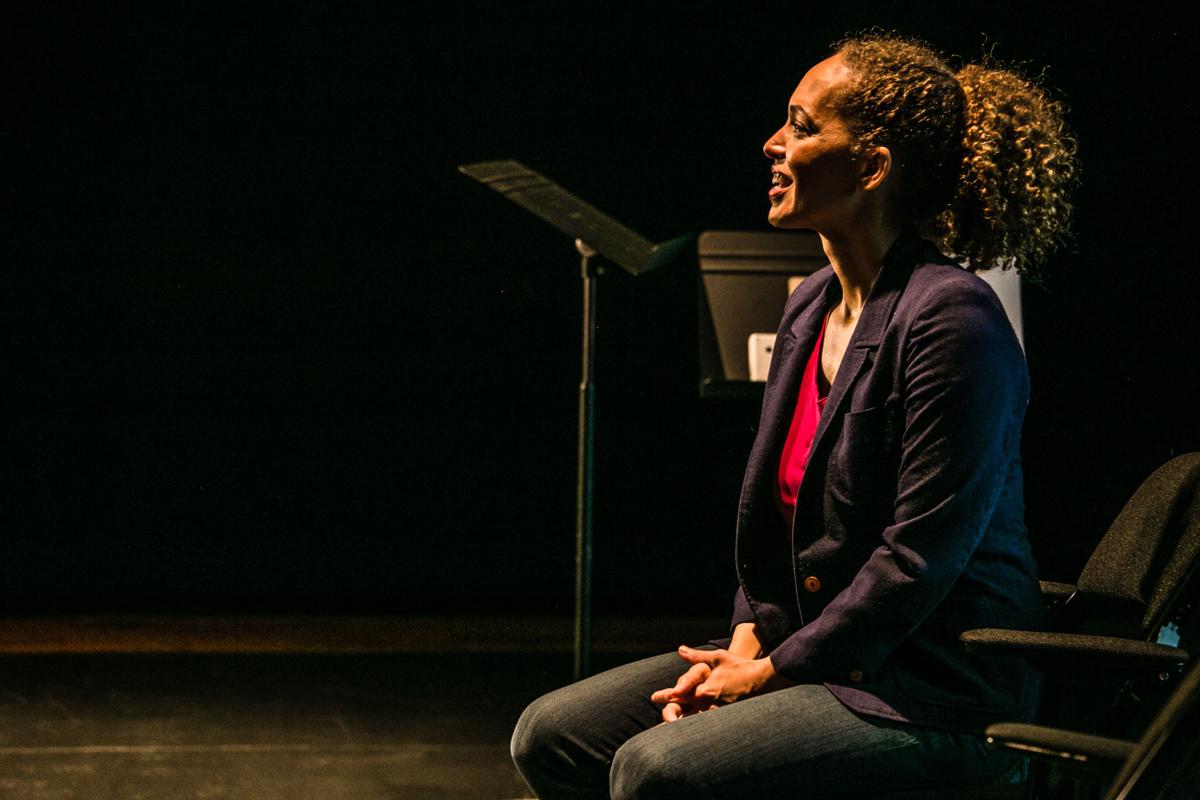
    Cox DiGiovanni artfully narrates her own education about being mixed race in America in efforts to start a larger national dialogue.
    photo by Jeff Lorch

    Fanshen Cox DiGiovanni graced Eckerd with her one-woman performance about how race was constructed in the U.S. and the ways in which it affects our most intimate relationships on Sept. 15.

    “People lived with the rule, that one drop of black blood, deemed you black in a national census,” she said, remarking on the history of our national census and the notorious “one drop rule.”

    Her performance, called “One Drop of Love,” barely filled Miller Auditorium; more senior citizens of the surrounding St. Petersburg area attended than Eckerd students did. Shame on us.

    Cox DiGiovanni tours around the country, performing her wildly entertaining, educational and autobiographical piece on race, justice, truth and love. A mixed race woman herself, she found her passion in acting and storytelling, and what began as a thesis project for her Master of Fine Arts (MFA) in 2013 bore an influential piece of performance art. She has since then used her platform and creative license to educate and empathize with the plight of racial minorities in this country, including those of mix race.

    At this school, this is a particular conversation that nobody really wants to have — it’s too awkward, too uncomfortable to face the fact that there may be something wrong with the way race is handled at Eckerd– whether that be in the classroom, on tours or with Eckerd brochures that like to depict a rainbow of color in our predominantly white student body…

    Read the entire article here.

  • Jackie Kay announces makar’s tour of all the Scottish islands

    The Guardian
    2016-10-07

    Libby Brooks, Scotland Correspondent

    The poet has revealed plans for ‘an odyssey’ that will take in overlooked parts of Scotland and form the basis of a long poem about the country

    As the UK lurches towards xenophobia, it is a writer’s responsibility to “tell the time”, says Scotland’s national poet Jackie Kay.

    Kay, whose complex relationship with her Scottish identity provides inspiration for much of her work, warned that poets should not shy away from addressing current and acute political divisions…

    Read the entire article here.

  • Meritocracy in Obama’s Gilded Age

    The Chronicle of Higher Education
    2016-09-25

    Aziz Rana, Professor of Law
    Cornell University, Ithaca, New York

    The Obama administration’s vision of social mobility in America is bound up with a story about higher education. According to this story, elite colleges and universities are engines of American opportunity. They select the most talented and hardworking people, from across all backgrounds, and provide them with the training to achieve even the most “impossibly big dreams,” as Michelle Obama would say. There is truth to this account. Indeed, Barack Obama’s lived experience speaks to the possibility of meritocratic achievement. He is the multiracial child of a single mother from a middle-class background, who through skill and determination made it to top universities and eventually rose to the highest echelon of political power.

    But this familiar story of higher education as a spur to social mobility blinds us to both what is pernicious and what is worth defending about the modern American university…

    Read the entire article here.

  • “So, What Are You?”

    Columbia Daily Spectator
    New York, New York
    2016-10-04

    Alexandra Peebles and Eliza Solomon


    Members of the Mixed Heritage Society at a club meeting. (Jared Orellana / Staff Photographer)

    “For me, personally, thinking of myself as defined by race has never really worked, because I don’t fit in with the Asians, [and] I don’t fit in with white people,” Zina Sockwell, a Columbia College senior, explains when asked about her identity as a mixed-heritage student.

    Sockwell is half Korean on her mother’s side and a quarter Native American on her father’s side, and she identifies as mixed heritage. Her entire “nuclear family” is Asian, white, and Native American. Growing up, Sockwell did not feel different or perplexed by her mixed background. “I didn’t realize for a long time that I was mixed race—I was just a person, in a family. I was a Sockwell; that’s what was normal,” she says matter-of-factly.

    But when Sockwell got to college, things were different. When the Mixed Heritage Society (previously known as the Mixed-Race Students Society) debuted on campus in the spring of 2015, it filled what some saw as a glaring cavity by providing an identity-based discussion space for students like Sockwell. These students don’t identify strictly with one race or ethnicity, and as a result must combat the pressure to define themselves as belonging to one specific culture. The club set out to meet a need for the students who wanted to share their often unique experiences with their fellow “mixed” classmates…

    Read the entire article here.

  • Where is the love: How tolerant is Canada of its interracial couples?

    The Globe and Mail
    2016-10-03

    Zosia Bielski


    Minelle Mahtani, an associate professor in human geography and journalism at the University of Toronto Scarborough, wrote the book Mixed Race Amnesia: Resisting the Romanticization of Multiraciality in Canada.
    (Jennifer Van Houten)

    Is love the last frontier of racial bigotry in Canada?

    It’s a question that intrigues Minelle Mahtani, who has dared to ask whether interracial couples and their families still test the limits of tolerance in this country.

    In her recent book Mixed Race Amnesia: Resisting the Romanticization of Multiraciality in Canada, Mahtani, an associate professor in human geography and journalism at the University of Toronto Scarborough, questions whether we’ve not just put rose-coloured glasses on our multiculturalism, especially where mixed-race families are concerned.

    While interracial relationships are on the rise in Canada (we had 360,000 mixed-race couples in 2011, more than double the total from 20 years earlier), the numbers remain slim. Just 5 per cent of all unions in Canada were between people of different ethnic origins, religions, languages and birthplaces in 2011, the last year Statistics Canada collected such data. That figure rises only marginally in urban areas: Just 8 per cent of couples were in mixed-race relationships in Toronto, 10 per cent in Vancouver.

    How do people in interracial relationships experience that multiculturalism on the ground, when they introduce their boyfriends and girlfriends to family, or hold hands on a date? How do mixed-race families and their children feel about it, in their communities and in their schools?

    Mahtani was the keynote speaker at last month’s Hapa-palooza, an annual festival celebrating mixed heritage in Vancouver, and she will present at the next Critical Mixed Race Studies Conference in California in February. She spoke with The Globe and Mail about the daily realities of mixed-race families…

    Read the entire interview here.