• Marvin Rees’s triumph as mayor defies Bristol’s racist past

    The Guardian
    2016-05-08

    Simon Woolley


    Source: Marvin Rees

    The descendant of enslaved Africans is now running a former slave city. His symbolic victory gives hope – and should not be forgotten

    While much has been said, rightly so, about a Muslim now leading London, we must not lose sight of the symbolism and enormous significance of Marvin Rees being elected mayor of Bristol this weekend.

    Rees, the working-class son of an English mother and Jamaican father, makes history as the first directly elected city mayor in Europe of African or Caribbean heritage.

    And that’s important, because the city of Bristol and its governance cannot effectively be understood without seeing it, in part, through the prism of race…

    Read the entire article here.

  • Dying to Be Black: White-to-Black Racial Passing in Chesnutt’s “Mars Jeems’s Nightmare,” Griffin’s Black Like Me, and Van Peebles’s Watermelon Man

    Prospects
    Volume 28 / October 2004
    pages 519-542
    DOI: 10.1017/S0361233300001599

    Baz Dreisinger, Associate Professor of English
    John Jay College of Criminal Justice, City University of New York

    Is racial passing passé? Not according to contemporary book sales. The theme remains central to at least three recent best sellers: Danzy Senna’s Caucasia, Colson Whitehead’s The Intuitionist, and Philip Roth’s The Human Stain. Roth’s novel made it to the big screen this fall, just as Devil in a Blues Dress, the adaptation of Walter Mosley’s novel starring Denzel Washington, did in 1995. Renewed academic attention is being paid, of late, to “classic” passing narratives; once-ignored ones, including Charles Chesnutt’s The House Behind the Cedars, are being revived; and still others being reread in the context of passing.

    Read or purchase the article here.

  • Long Time Passing

    Sunday Book Review
    The New York Times
    2009-01-23

    Amy Finnerty

    Baz Dreisinger, Near Black: White-to-Black Passing in American Culture (Amherst: University of Massachusetts Press, 2008).

    How black is Eminem? How white is our president? We can’t help asking these awkward questions as we digest “Near Black,” by Baz Dreisinger. A freelance journalist and an assistant professor of English at John Jay College of Criminal Justice, she explores cases of “reverse racial passing” — as distinct from the more conventional, black-as-white “passing,” for so long a feature of our tortured society. Presenting “narratives about white people who either envision themselves or are envisioned by others as being or becoming black,” and drawing on examples ranging from Twain’sPudd’nhead Wilson” to the sophomoric genre film “Soul Man,” she argues that the appropriation of black identity by whites — both literally and metaphorically — has been a potent strain in American culture for centuries.

    The term “white passing” is broadly defined here. A white journalist with dyed skin infiltrating black precincts and writing about it is passing. So is a “jive-slanging” white D.J. A white immigrant sold into slavery in the early 19th century (a case of “coerced passing”) also has a place in Dreisinger’s compendium of racial mix-ups, satires and cautionary tales…

    Read the entire review here.

  • The Experiences of Mixed-Race Students In An Urban Area

    University of Nebraska, Lincoln
    2012
    189 pages
    ISBN: 9781267282132

    Germaine W. Huber
    University of Nebraska, Lincoln

    Mixed-race children are the fastest growing segment of the U.S. population, and it is essential that educators are aware of the unique experiences of this student population. The purpose of this phenomenological research study was to examine the experiences of mixed-race students in relation to their racial identity formation, their social emotional development, and their academic experiences within urban public schools Educators who have a better understanding of the life experiences of these students have a greater ability to create positive relationships, a caring environment, and effective teaching strategies for the classroom that can lead to greater academic success for these students. Twenty mixed-race participants between the ages of 19–36 years were interviewed. Themes that emerged from the analysis of the interview transcripts included: Identity Factors; Adversity; Rewards; Family Relationships and Support; School Interactions; Peers, and Suggested Academic Supports. Participants shared childhood and teen experiences with families, peers and in the school environment that influenced their identity and social development. They identified numerous challenges and strengths related to their mixed-race identity and offered strategies educators can use to assist mixed-race students. Their responses provide an inside look of the unique realities experienced by this student population during their elementary and secondary school years.

    Order the dissertation here.

  • ‘Ladivine,’ by Marie NDiaye

    Book Review
    The New York Times
    2016-05-05

    Patrick McGrath

    LADIVINE
    By Marie NDiaye
    Translated by Jordan Stump
    276 pp. Alfred A. Knopf. $26.95.

    Marie NDiaye is the author of more than a dozen plays and works of fiction. Currently living in Berlin, having left France in 2009, by her own account in disgust at Nicolas Sarkozy’s election to the presidency, she is the daughter of a French mother and a Senegalese father. As yet, she is little known in this country, although at least four of her previous books — including “Three Strong Women,” which won France’s prestigious Prix Goncourt, and “Rosie Carpe,” winner of the Prix Femina — have been translated into English.

    NDiaye’s new novel, “Ladivine,” has been elegantly translated by Jordan Stump. It is a work of immense power and mystery, an account of four generations of women, the first of whom, Ladivine Sylla, immigrates from a tropical third-world country to France, where she works as a house cleaner. Her daughter, Malinka, is ashamed of her. As a teenager, Malinka heightens the natural pallor of her face with makeup in order to pass for white, and later she reinvents herself as Clarisse, finding a French husband and taking his name, becoming Clarisse Rivière. She visits her mother in secret, allowing no contact with either her husband or her daughter. This ambivalent relationship is one she both sustains and repudiates…

    Read the entire review here.

  • This desire to own all aspects of a hyphenated identity at once was probably the most pronounced unifying theme for the conference participants, who spanned the gamut of skin tones and religious observance levels. We shared the experience of feeling like outsiders, and many shared an overlapping constellation of marginalized identities like non-whiteness, queerness and far-left politics (although it soon became clear that not everyone had the same political views on Israel and Palestine). Presented by the Jewish Multiracial Network and by Jews for Racial & Economic Justice, the event included African Americans and Latinos and Asians alongside Sephardic and Mizrahi Jews.

    Sigal Samuel, “Jews of Color Get Personal and Political at First-Ever National Gathering,” Forward, May 4, 2016. http://forward.com/opinion/340018/jews-of-color-get-personal-and-political-at-first-ever-national-gathering/.

  • Jump at de Sun

    The Nation
    2003-01-30

    Kristal Brent Zook

    Anthropologist, novelist, folklorist, essayist and luminary of the Harlem Renaissance, Zora Neale Hurston dazzled her peers and patrons almost immediately upon her arrival in New York City in 1925, when she made a show-stopping grand entrance at a formal literary affair, flinging a red scarf around her neck and stopping all conversation with her animated storytelling and antics. “I would like to know her,” declared Langston Hughes. She had a “blazing zest for life,” opined celebrity writer Fannie Hurst. Annie Nathan Meyer, a founder of Barnard College, did them one better: She promptly offered Hurston entrance into Columbia University’s sister college, making her the first black student to attend Barnard.

    Over the course of her life, Hurston would publish several dozen essays, short stories and poems, and seven books, including her notoriously deceptive (some would say ingeniously “dissembling”) autobiography Dust Tracks on a Road. Nine more books–essays, folklore, short stories and a play–would appear in print posthumously, following Alice Walker’s “rediscovery” of Hurston in the 1970s. According to Carla Kaplan, editor of Zora Neale Hurston: A Life in Letters and a professor at the University of Southern California, this resurrection of the long-forgotten writer has yielded over 800 more books (including sixteen for children), articles, chapters, dissertations, reference guides and biographical essays about Hurston over the past three decades. That some 2,000 spectators showed up at Central Park last summer for a reading of her work is further evidence that Zora mania continues to be in full swing….

    …On the other hand (and herein lies the rub), Hurston also believed that “all clumps of people turn out to be individuals on close inspection,” and that “black skunks are just as natural as white ones.” And she had absolutely no tolerance for the suffering protest narratives such as those offered up by novelist (and nemesis) Richard Wright. But “can the black poet sing a song to the morning?” she demanded in a 1938 essay. No, she laments, answering her own question. “The one subject for a Negro is the Race and its sufferings and so the song of the morning must be chocked back. I will write of a lynching instead.”

    And there are other troubling inconsistencies. Those of us of racially mixed parentage, for example, might wonder whether we would have qualified for Hurston’s affection as “authentic” black folk. That she placed a premium on “pure” Negroness was apparent in her attacks on colorist prejudice among the light-skinned black elite (W.E.B. Du Bois was not well-loved by Hurston for his championing of the talented tenth); her disparaging remarks about “a crowd of white Negroes” on their way to Russia to make a movie about black America who had never been “south of the Mason-Dixon line”; and her “color-conscious casting” of an “authentic” Negro concert with “no mulattoes at all.” (Godmother Mason was also pleased by this banning of the “diluted ones.”)

    She was a black nationalist, say some. Indeed, her complicated opposition to Brown v. Board of Education flew in the face of everything the “race leaders” of her time fought and died for. Though she was not a segregationist, Hurston found the assumption of Negro inferiority deeply insulting, according to both Boyd and Kaplan. “It is a contradiction,” as Hurston put it, “to scream race pride and equality while…spurning Negro teachers and self-association.”…

    Read the entire article here.

  • Charleston Syllabus: Readings on Race, Racism, and Racial Violence

    University of Georgia Press
    May 2016
    336 pages
    Trim size: 6 x 9
    Hardcover ISBN: 978-0-8203-4956-5
    Paper ISBN: 978-0-8203-4957-2
    Author Website

    Edited by:

    Chad Williams, Associate Professor of African & Afro-American Studies
    Brandeis University, Waltham, Massachusetts

    Kidada E. Williams, Associate Professor of History
    Wayne State University, Detroit, Michgan

    Keisha N. Blain, Assistant Professor of History
    University of Iowa

    On June 17, 2015, a white supremacist entered Emanuel AME Church in Charleston, South Carolina, and sat with some of its parishioners during a Wednesday night Bible study session. An hour later, he began expressing his hatred for African Americans, and soon after, he shot nine church members dead, the church’s pastor and South Carolina state senator, Rev. Clementa C. Pinckney, among them. The ensuing manhunt for the shooter and investigation of his motives revealed his beliefs in white supremacy and reopened debates about racial conflict, southern identity, systemic racism, civil rights, and the African American church as an institution.

    In the aftermath of the massacre, Professors Chad Williams, Kidada Williams, and Keisha N. Blain sought a way to put the murder—and the subsequent debates about it in the media—in the context of America’s tumultuous history of race relations and racial violence on a global scale. They created the Charleston Syllabus on June 19, starting it as a hashtag on Twitter linking to scholarly works on the myriad of issues related to the murder. The syllabus’s popularity exploded and is already being used as a key resource in discussions of the event.

    Charleston Syllabus is a reader—a collection of new essays and columns published in the wake of the massacre, along with selected excerpts from key existing scholarly books and general-interest articles. The collection draws from a variety of disciplines—history, sociology, urban studies, law, critical race theory—and includes a selected and annotated bibliography for further reading, drawing from such texts as the Confederate constitution, South Carolina’s secession declaration, songs, poetry, slave narratives, and literacy texts. As timely as it is necessary, the book will be a valuable resource for understanding the roots of American systemic racism, white privilege, the uses and abuses of the Confederate flag and its ideals, the black church as a foundation for civil rights activity and state violence against such activity, and critical whiteness studies.

  • Atlantic Africa and the Spanish Caribbean, 1570-1640

    University of North Carolina Press
    May 2016
    352 pages
    6.125 x 9.25, 15 halftones
    Cloth ISBN: 978-1-4696-2341-2

    David Wheat, Assistant Professor of History
    Michigan State University

    This work resituates the Spanish Caribbean as an extension of the Luso-African Atlantic world from the late sixteenth to the mid-seventeenth century, when the union of the Spanish and Portuguese crowns facilitated a surge in the transatlantic slave trade. After the catastrophic decline of Amerindian populations on the islands, two major African provenance zones, first Upper Guinea and then Angola, contributed forced migrant populations with distinct experiences to the Caribbean. They played a dynamic role in the social formation of early Spanish colonial society in the fortified port cities of Cartagena de Indias, Havana, Santo Domingo, and Panama City and their semirural hinterlands.

    David Wheat is the first scholar to establish this early phase of the “Africanization” of the Spanish Caribbean two centuries before the rise of large-scale sugar plantations. With African migrants and their descendants comprising demographic majorities in core areas of Spanish settlement, Luso-Africans, Afro-Iberians, Latinized Africans, and free people of color acted more as colonists or settlers than as plantation slaves. These ethnically mixed and economically diversified societies constituted a region of overlapping Iberian and African worlds, while they made possible Spain’s colonization of the Caribbean.

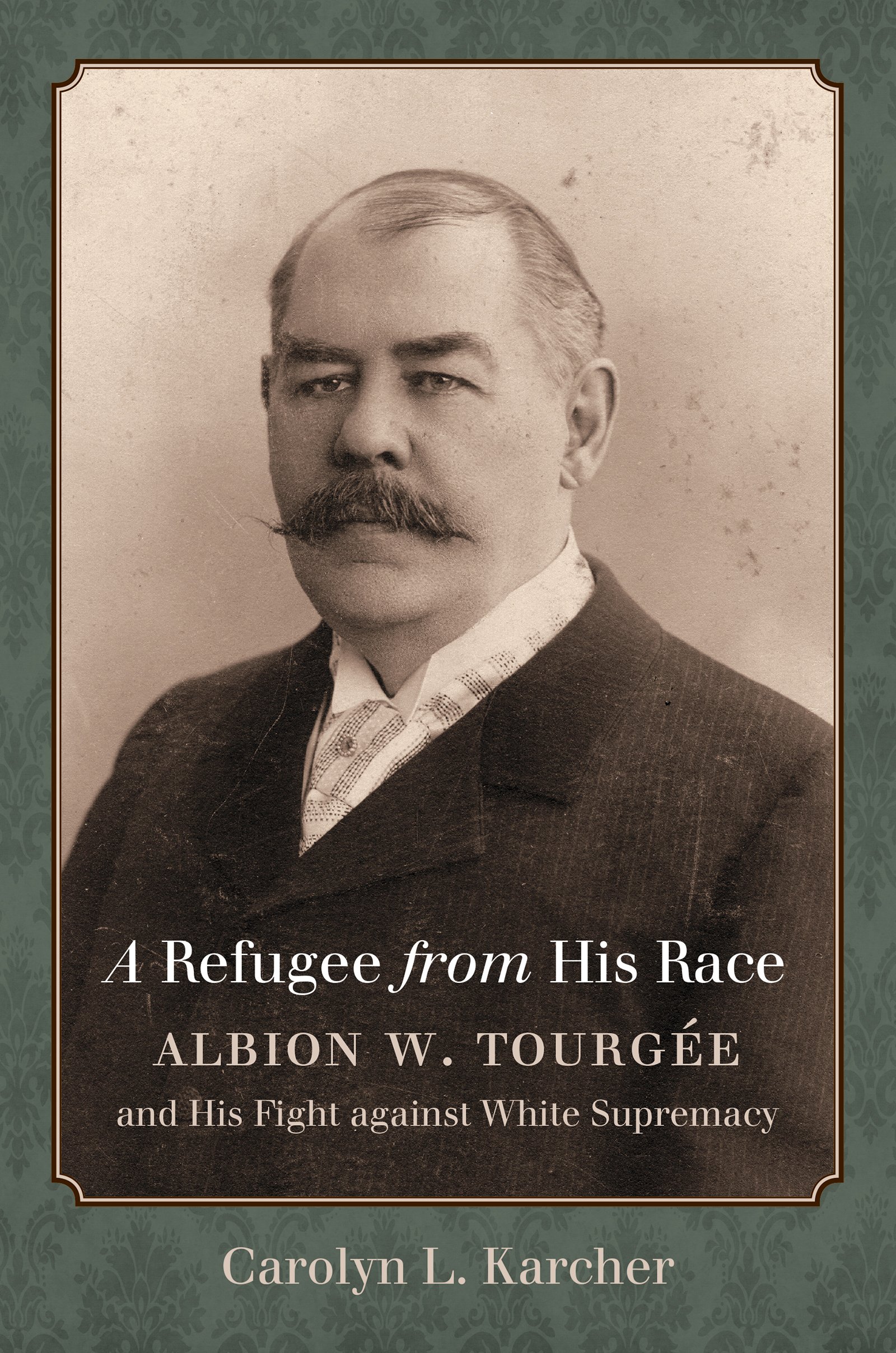
  • A Refugee from His Race: Albion W. Tourgée and His Fight against White Supremacy

    University of North Carolina Press
    2016-05-02
    464 pages
    9 halftones, notes, bibl., index
    6.125 x 9.25
    Paper ISBN: 978-1-4696-2795-3

    Carolyn L. Karcher

    During one of the darkest periods of U.S. history, when white supremacy was entrenching itself throughout the nation, the white writer-jurist-activist Albion W. Tourgée (1838-1905) forged an extraordinary alliance with African Americans. Acclaimed by blacks as “one of the best friends of the Afro-American people this country has ever produced” and reviled by white Southerners as a race traitor, Tourgée offers an ideal lens through which to reexamine the often caricatured relations between progressive whites and African Americans. He collaborated closely with African Americans in founding an interracial civil rights organization eighteen years before the inception of the NAACP, in campaigning against lynching alongside Ida B. Wells and Cleveland Gazette editor Harry C. Smith, and in challenging the ideology of segregation as lead counsel for people of color in the 1896 Plessy v. Ferguson case. Here, Carolyn L. Karcher provides the first in-depth account of this collaboration. Drawing on Tourgée’s vast correspondence with African American intellectuals, activists, and ordinary folk, on African American newspapers and on his newspaper column, “A Bystander’s Notes,” in which he quoted and replied to letters from his correspondents, the book also captures the lively dialogue about race that Tourgée and his contemporaries carried on.