Mixed Race Studies

Scholarly perspectives on the mixed race experience.

    • About This Site
    • Bibliography
    • Contact Information
    • Date and Time Formats
    • Forthcoming… (Updated 2021-09-01)
    • Likely Asked Questions
    • List of Book Publishers
    • List of Definitions and Terms
    • My Favorite Articles and Papers
    • My Favorite Posts
    • My Recent Activities
    • Praise for Mixed Race Studies
    • Tag Listing
      • Tag Listing (Ordered by Count)
    • US Census Race Categories, 1790-2010
    • 1661: The First ‘Mixed-Race’ Milestone
    • 2010 U.S. Census – Some Thoughts

recent posts

  • The Routledge International Handbook of Interracial and Intercultural Relationships and Mental Health
  • Loving Across Racial and Cultural Boundaries: Interracial and Intercultural Relationships and Mental Health Conference
  • Call for Proposals: 2026 Critical Mixed Race Studies Conference at UCLA
  • Participants Needed for a Paid Research Study: Up to $100
  • You were either Black or white. To claim whiteness as a mixed child was to deny and hide Blackness. Our families understood that the world we were growing into would seek to denigrate this part of us and we would need a community that was made up, always and already, of all shades of Blackness.

about

  • Twitter
  • Facebook
  • Instagram
  • BBC releases first-look images of My Name Is Leon

    2021-10-29

    BBC releases first-look images of My Name Is Leon

    Royal Television Society
    2021-10-28

    Caitlin Danaher

    Cole Martin as Leon (credit: BBC)

    The BBC has released images for the upcoming adaptation of Kit de Waal’s award-winning novel, My Name Is Leon.

    Adapted into a screenplay by Shola Amoo (The Last Tree) and directed by Lynette Linton, the series will star Sir Lenny Henry CBE, Malachi Kirby (Small Axe), Monica Dolan (A Very English Scandal), Olivia Williams (Counterpart), Christopher Eccleston (The A Word), Poppy Lee Friar (In My Skin), Shobna Gulati (Everybody’s Talking About Jamie) and Cole Martin, who will play the lead, Leon, in his first TV role.

    Set in 1980s Birmingham, the feature film tells the uplifting and poignant tale of nine-year-old Leon, a mixed-race boy separated from his blue-eyed baby brother as he was taken into care, who is on a quest to reunite his family…

    Read the entire article here.

  • The politics of identity: The unexpected role of political orientation on racial categorizations of Kamala Harris

    2021-10-29

    The politics of identity: The unexpected role of political orientation on racial categorizations of Kamala Harris

    Analysis of Social Issues and Public Policy
    22 pages
    First published 2021-06-29
    DOI: 10.1111/asap.12257

    Debbie S. Ma, Professor of Psychology
    California State University, Northridge

    Danita Hohl
    Department of Psychology
    California State University, Northridge

    Justin Kantner, Assistant Professor of Psychology
    California State University, Northridge

    The 2020 US Presidential election was historic in that it featured the first woman of color, Kamala Harris, on a major-party ticket. Although Harris identifies as Black, her racial identity was widely scrutinized throughout the election, due to her mixed-race ancestry. Moreover, media coverage of Harris’s racial identity appeared to vary based on that news outlet’s political leaning and sometimes had prejudicial undertones. The current research investigated racial categorization of Harris and the role that political orientation and anti-Black prejudice might play in shaping these categorizations. Studies 1 and 2 tested the possibility that conservatives and liberals might mentally represent Harris differently, which we hypothesized would lead the two groups to differ in how they categorized her race. Contrary to our prediction, conservatives, and liberals mentally represented Harris similarly. Also surprising were the explicit racial categorization data. Conservatives labeled Harris as White more than liberals, who tended to categorize Harris as multiracial. This pattern was explained by anti-Black prejudice. Study 3 examined a potential political motivation that might explain this finding. We found that conservatives, more than liberals, judge having a non-White candidate on a Democratic ballot as an asset, which may lead conservatives to deny non-White candidates these identities.

    Read the entire article in HTML or PDF format.

  • Using black and white also allowed Hall to cast Black actresses in the roles. She’s not trying to “fool” anyone into thinking that Negga or Thompson is white, she’s simply trying to turn the film’s deeply metaphorical ideas into a practical experience.

    2021-10-29

    Using black and white [media] also allowed [Rebecca] Hall to cast Black actresses in the roles. She’s not trying to “fool” anyone into thinking that Negga or Thompson is white, she’s simply trying to turn the film’s deeply metaphorical ideas into a practical experience. The audience will have “very fixed ideas about Tessa Thompson and Ruth Negga’s racial identity,” Hall said, “which gives me a position from which to destabilize those ideas and point out the limits of just reducing them to that one definition.”

    Kate Erbland, “‘Passing’: Rebecca Hall Made One of the Year’s Best Debuts, but for Years Nobody Would Fund It,” IndieWire, October 28, 2021. https://www.indiewire.com/2021/10/passing-rebecca-hall-interview-1234674475/.

  • Stony Brook professor’s biracial heritage has lessons for life, classroom

    2021-10-29

    Stony Brook professor’s biracial heritage has lessons for life, classroom

    Newsday
    2020-02-26

    Joe Dziemianowicz, Special to Newsday

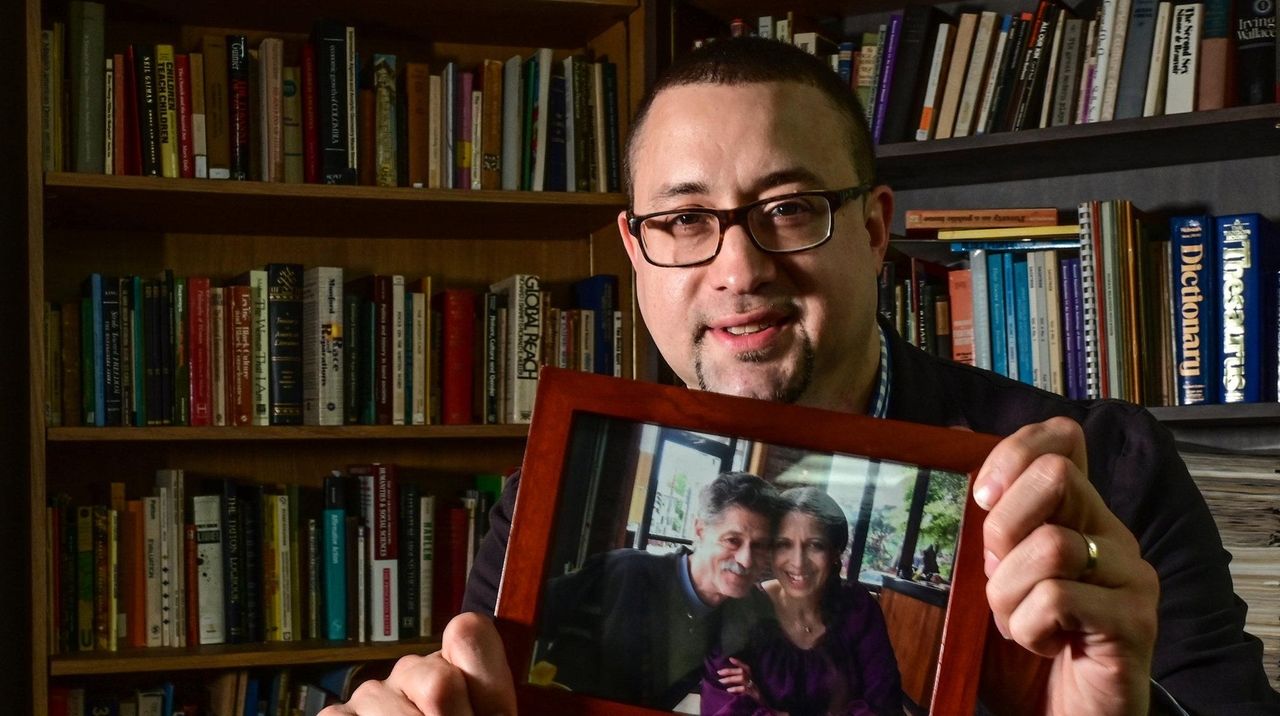
    Stony Brook University Assistant Professor Zebulon Miletsky holds a photo of his parents, Marc and Veronica Miletsky. Miletsky draws on his own biracial past to delve into conversations about race in America. Newsday/Thomas A. Ferrara

    A week and a half ago, Zebulon Vance Miletsky, who will be leading a talk on African Americans and the right to vote on Feb. 27 at the Brentwood Public Library, was zipping through a PowerPoint presentation in his “Themes in the Black Experience” class at Stony Brook University.

    He got to a slide with bullet points on the renowned black historian and activist W.E.B. Du Bois. Miletsky, an assistant professor in Africana Studies and History, went off-script. He shared an anecdote with his students about the time a young Du Bois offered a white girl a valentine and she turned him down flat. Because he was black. It left a mark.

    Du Bois went on to become the first African American to earn a Ph.D. at Harvard. “Childhood things shape you,” the professor added.

    Miletsky, 45, speaks from experience…

    Read the entire article here.

  • ‘Passing’: Rebecca Hall Made One of the Year’s Best Debuts, but for Years Nobody Would Fund It

    2021-10-29

    ‘Passing’: Rebecca Hall Made One of the Year’s Best Debuts, but for Years Nobody Would Fund It

    IndieWire
    2021-10-28

    Kate Erbland

    Behind the scenes of “Passing”
    Netflix

    For nearly a decade, the actress-turned-filmmaker tried to get her ambitious Nella Larsen adaptation made. As she tells IndieWire, she knew there was only one way to make it happen.

    Every word that first-time feature filmmaker Rebecca Hall uses to describe the genesis of her “Passing” vibrates with intensity. Her first experience reading the Nella Larsen novella she eventually adapted for the black-and-white period piece was like “being in a fever,” the pages flipping by as if she was “slightly possessed.”

    More than 13 years after first reading Larsen’s book, Hall has kept up that same passion for the material, enough to propel her through years of denials from Hollywood brass and the distinct possibility that the film would never get made the way she saw it.

    Much has been made of Hall’s personal connection to the material — the film, like Larsen’s seminal work, follows the fraught reunion of a pair of friends (Tessa Thompson and Ruth Negga), both of whom are Black, though one of them has crossed the color line and lived her life “passing” as a white woman (Negga as Clare). Hall herself is of mixed racial heritage and her own maternal grandfather “passed” for the majority of his life. But for the long-time actress, Larsen’s slim book spoke even more deeply about much larger ideas…

    Read the entire article here.

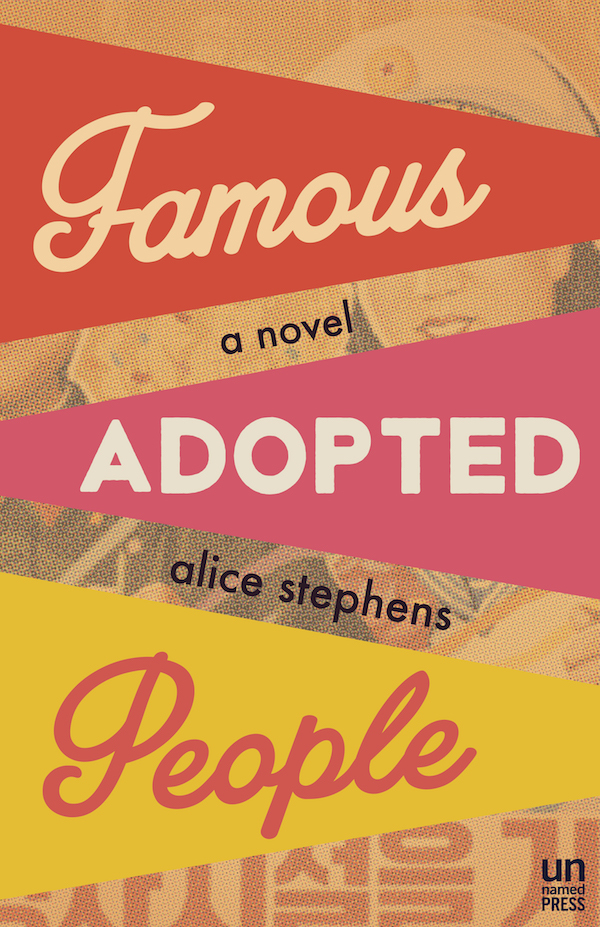
  • Famous Adopted People

    2021-10-28

    Famous Adopted People

    Unnamed Press
    2018-10-16
    331 pages
    5.5 x 1.1 x 8.4 inches
    12 ounces
    Paperback ISBN: 9781944700744

    Alice Stephens

    Debut novelist Alice Stephens combines dark humor and a keen wit to examine the profound implications of not knowing where you come from; and how our perceptions of an unknown world reflect deeper truths about our own.

    Lisa Pearl is an American teaching English in Japan and the situation there—thanks mostly to her spontaneous, hard-partying ways—has become problematic. Now she’s in Seoul, South Korea, with her childhood best-friend Mindy. The young women share a special bond: they are both Korean-born adoptees into white American families. Mindy is in Seoul to track down her birth mom, and wants Lisa to do the same. Trouble is, Lisa isn’t convinced she needs to know about her past, much less meet her biological mother.

    She’d much rather spend time with Harrison, an almost supernaturally handsome local who works for the Motherfinder’s agency. When Lisa wakes up inside a palatial mountain compound, the captive of a glamorous, surgically-enhanced blonde named Honey, she soon realizes she is going to learn about her past whether she likes it or not. What happens next only could in one place: North Korea.

  • Surviving the White Gaze: A Memoir

    2021-10-28

    Surviving the White Gaze: A Memoir

    Washington Independent Review of Books
    2021-02-05

    Alice Stephens
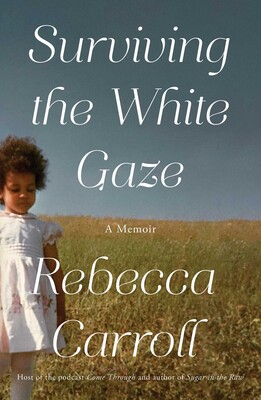
    A transracial adoptee reveals her struggle to build a Black identity in a world of white privilege.

    Rebecca Carroll, Surviving the White Gaze, A Memoir (New York: Simon & Schuster, 2021)

    In 1972, the National Association of Black Social Workers (NABSW) issued a position statement that took a “vehement stand against the placement of Black children in white homes for any reason.” The document eloquently and forcefully explains this stance as crucial to the child’s healthy formation of identity in a society intent on the erasure of Blackness.

    Around that time, David and Laurette Carroll formally adopt Rebecca, whom they had been raising since infancy. Rebecca is the mixed-race child of Tess, a white high school student of David’s. Uninterested in Black life and culture, the Carrolls were likely unaware of NABSW’s stance. As Rebecca Carroll vividly reveals in her searing memoir, Surviving the White Gaze, her adoptive parents were woefully unprepared to raise a Black child, clueless to the challenges she faced as the only Black resident of their rural New Hampshire town.

    Like many progressive people of that era who adopted outside of their race, the Carrolls, who already had two biological children of their own, “believed in Zero Population Growth, and so…didn’t want to bring another child into the world.”

    They first thought of adopting a Native American child, no doubt influenced by the Indian Adoption Project, a federal program that was heralded as a beacon of enlightened adoption practices for placing brown babies with white families. But then, 16-year-old Tess offers the Carrolls the opportunity to adopt her baby, fathered by a Black man. As Tess is a friend of the family, the adoption is open…

    Read the entire review here.

  • Ruth Negga on her latest role – as a black woman passing as white

    2021-10-28

    Ruth Negga on her latest role – as a black woman passing as white

    BBC News
    2021-10-27

    Ruth Negga stars in Passing, a film which follows two black women living in 1920s New York.

    One of them, Clare Kendry played by Negga, “passes” for white and has a white husband who doesn’t know she’s black.

    Based on the 1929 book by Nella Larsen, the film received rave reviews at the Sundance Film Festival.

    The film’s director Rebecca Hall and star Ruth Negga, tell BBC News why their film feels so relevant for today’s audiences.

  • Rebecca Hall on race, regret and her personal history: ‘In any family with a legacy of passing, it’s very tricky’

    2021-10-28

    Rebecca Hall on race, regret and her personal history: ‘In any family with a legacy of passing, it’s very tricky’

    The Guardian
    2021-10-27

    Ellen E. Jones

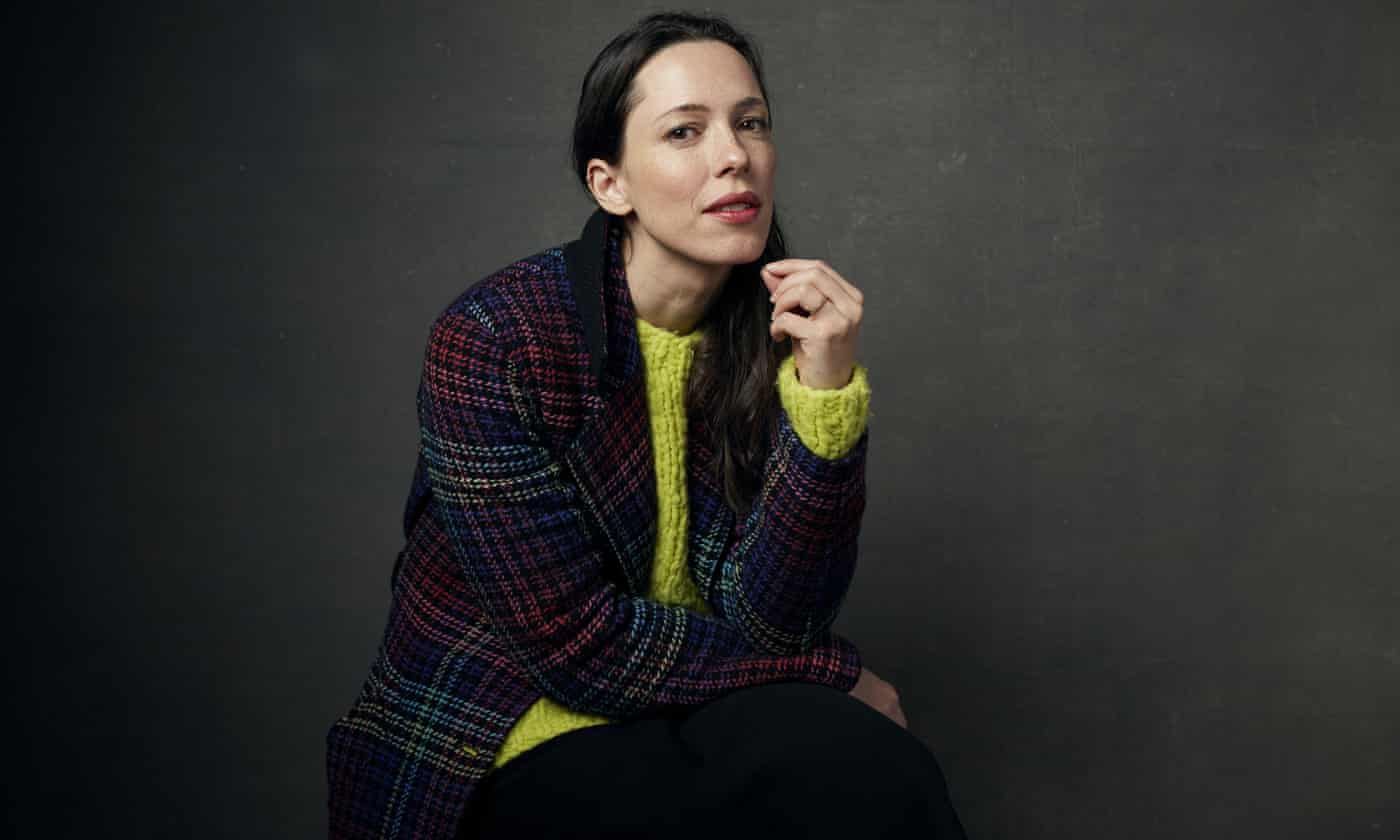
    Rebecca Hall: ‘In any family that has a legacy of passing, you inherit all of the shame and none of the pride.’ Photograph: Taylor Jewell/Invision/AP

    The actor has just directed her first film, an adaptation of Nella Larsen’s 1929 novel Passing. She discusses the family story that inspired her, cultural appropriation and class in Hollywood

    It would be easy to assume that Rebecca Hall has never had to fight for anything in her life. Now 39, she made her screen debut at the age of 10 in The Camomile Lawn, the 1992 TV series directed by her father, the British theatre grandee Sir Peter Hall. Her stage debut came a decade later, in his production of Mrs Warren’s Profession. There followed 15 hugely successful years as an actor, working with Steven Spielberg (The BFG), Christopher Nolan (The Prestige), Woody Allen (Vicky Cristina Barcelona) and many more. But for more than a decade she has been struggling to build a second career, as the director of a movie that some would say she has no right to make.

    That movie is Passing, which Hall has adapted herself from the 1929 novel by the Harlem Renaissance writer Nella Larsen. It is an emotionally resonant study of racial identity, seen through the eyes of two Black women, Irene (played by Tessa Thompson) and Clare (Ruth Negga), both of whom, to varying extents, “pass” as white. Hall remembers first encountering the book in her early 20s and feeling a rush of inspiration: “I was sat there reading and I could just suddenly start seeing it: their two faces, seeing each other in that tea room, and I had that idea of looking from Irene’s perspective and panning through someone staring at you and then coming back. That was really there, and very potent, in black and white in my head.”

    The phenomenon of “passing” is, in many ways, historically specific. It made sense only in a time and place when the oppression and segregation of American “negroes” (defined, according to the “one-drop rule”, as anyone with any African ancestry) coincided with the severing of community ties, making it both possible and desirable for people of European appearance to “cross the colour line” into white society. And yet, what Larsen’s book revealed – and Hall’s film further elucidates – is the universality of the passing experience. Nobody fits entirely comfortably into the identity categories assigned them by society; every human is more complex than any label can account for…

    Read the entire article here.

  • Women and Mixed Race Representation in Film: Eight Star Profiles

    2021-10-27

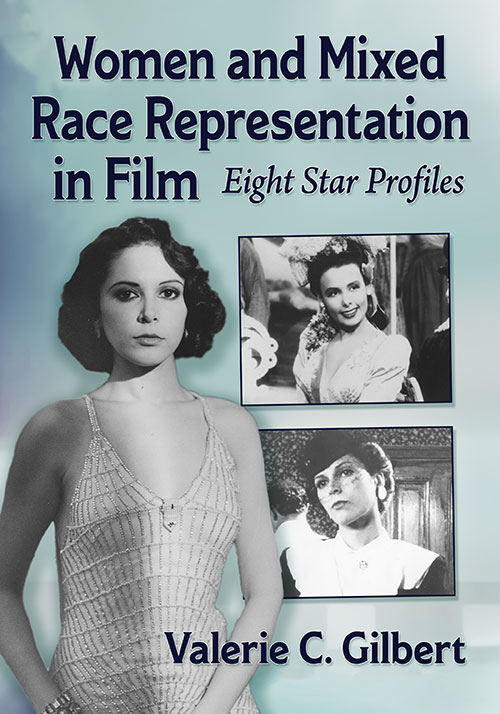
    Women and Mixed Race Representation in Film: Eight Star Profiles

    McFarland
    2021-09-10
    302 pages
    54 photos, notes, bibliography, index
    7 x 10
    Softcover ISBN: 978-1-4766-6338-8
    eBook ISBN: 978-1-4766-4473-8

    Valerie C. Gilbert
    Seattle, Washington

    This book uses a black/white interracial lens to examine the lives and careers of eight prominent American-born actresses from the silent age through the studio era, New Hollywood, and into the present century: Josephine Baker, Nina Mae McKinney, Fredi Washington, Lena Horne, Dorothy Dandridge, Lonette McKee, Jennifer Beals and Halle Berry. Combining biography with detailed film readings, the author fleshes out the tragic mulatto stereotype, while at the same time exploring concepts and themes such as racial identity, the one-drop rule, passing, skin color, transracial adoption, interracial romance, and more. With a wealth of background information, this study also places these actresses in historical context, providing insight into the construction of race, both onscreen and off.

    Table of Contents

    • Preface
    • Introduction
    • 1. Josephine Baker: From Exotic Savage to Creole Queen
    • 2. Nina Mae McKinney: Dichotomy of a Hollywood Black Woman
    • 3. Fredi Washington: Paradox of Black Identity
    • 4. Lena Horne: Separate and Unequalled
    • 5. Dorothy Dandridge: ­Star-Crossed Crossover Star
    • 6. Lonette McKee: Mixed Race Heroine Remix
    • 7. Jennifer Beals: White But Not Quite
    • 8. Halle Berry: Imitation of Dorothy Dandridge
    • Chapter Notes
    • Bibliography
    • Screen Title Index
    • Subject Index
Previous Page
1 … 59 60 61 62 63 … 1,428
Next Page

Designed with WordPress