• Where the Dead Pause, and the Japanese Say Goodbye: A Journey

    W. W. Norton & Company, Inc.
    January 2015
    336 pages
    Hardcover ISBN: 978-0-393-06301-1
    6.6 × 9.6 in

    Marie Mutsuki Mockett

    How does one cope with overwhelming grief?

    Marie Mutsuki Mockett’s family owns a Buddhist temple 25 miles from the Fukushima Daiichi nuclear power plant. In March 2011, after the earthquake and tsunami, radiation levels prohibited the burial of her Japanese grandfather’s bones. As Japan mourned thousands of people lost in the disaster, Mockett also grieved for her American father, who had died unexpectedly.

    Seeking consolation, Mockett is guided by a colorful cast of Zen priests and ordinary Japanese who perform rituals that disturb, haunt, and finally uplift her. Her journey leads her into the radiation zone in an intricate white hazmat suit; to Eiheiji, a school for Zen Buddhist monks; on a visit to a Crab Lady and Fuzzy-Headed Priest’s temple on Mount Doom; and into the “thick dark” of the subterranean labyrinth under Kiyomizu temple, among other twists and turns. From the ecstasy of a cherry blossom festival in the radiation zone to the ghosts inhabiting chopsticks, Mockett writes of both the earthly and the sublime with extraordinary sensitivity. Her unpretentious and engaging voice makes her the kind of companion a reader wants to stay with wherever she goes, even into the heart of grief itself.

  • Aboriginal Identity: Who is ‘Aboriginal’?

    Creative Spirits
    2014-12-23

    Jens Korff

    • People who identify themselves as ‘Aboriginal’ range from dark-skinned, broad-nosed to blonde-haired, blue-eyed people.
    • Aboriginal people define Aboriginality not by skin colour but by relationships.
    • Light-skinned Aboriginal people often face challenges on their Aboriginal identity because of stereotyping.

    Ever since white people mixed with Aboriginal people they have struggled to define who is ‘Aboriginal’.

    Racist definitions of Aboriginal identity

    • ‘full-blood’ as a person who had no white blood,
    • ‘half-caste’ as someone with one white parent,
    • ‘quadroon’ or ‘quarter-caste’ as someone with an Aboriginal grandfather or grandmother,
    • ‘octoroon’ as someone whose great-grandfather or great-grandmother was Aboriginal.


    Caste categories in an identity card used in the 1940s [4].

    These “one-dimensional models of Aboriginality” [41] pervaded literature of that time. Today these words are considered offensive and racist. In fact, racism lies just beneath the surface and it “bubbles out” when Aboriginal identity is discussed [40]…

    …Is there genetic proof of Aboriginality?

    Proposals of genetic testing as a means of proving one’s Aboriginality have been dismissed on the grounds that ‘race’ and ‘ethnicity’ are social, cultural and political constructs [2] which cannot be tested objectively.

    Cheri Yavu-Kama-Harathunian has a story to tell about genetic proof [48]: “I have a brother (by association, and my own recognition), who has sought ‘recognition’ of his Torres Strait/Aboriginal heritage for the last five years. “This dear man comes and sits with me to tell me of the joys of his discoveries and the sorrows of hearing, ‘This is not enough.’

    “His last attempt [was] back to an Aboriginal organisation in the town of his birth was met with, ‘You might have to get DNA proof’ DNA proof! I rang the Chairperson, and asked what this DNA stuff was about. I heard the phone being placed back and the line go dead.

    “This man lived in this town all of his life, is known by the Chairperson, and the organisation… and only moved later in life. He is in his fifties now, and he, his wife and I have been trawling through historical documents, court documents, government documents for this ‘proof’.”…

    …Most people still believe that Aboriginal people are poor, uneducated and live in the desert. But only 25% of Aboriginal people live in remote areas.

    While the vibrant life of urban Aboriginal communities goes mostly unnoticed, the national eyes turn willingly to reports of violence, criminal activities or antisocial behaviour (such as drinking) which then shape the perception of urban Aboriginal identity.

    Aboriginal writer Anita Heiss, author of “Am I Black Enough For You?”, describes herself as “a concrete Koori with Westfield dreaming” [43]. She is urban, educated, glamorous and cheeky, hates camping and cannot tell the time by the sun [44]…

    Read the entire article here.

  • Adopting The Asian in ‘Caucasian’: Korean Adoptees and White Privilege

    Hyphen: Asian America Unabridged
    2015-01-20

    Nicky Sa-eun Schildkraut

    My father remembers that when I first arrived, he’d wake up to me calling out “Abojee! Abojee!” in the middle of the night, the Korean word for father. As a little girl, those nights in my new home in America were filled with angst that if I fell asleep at night, I might wake up utterly alone. I fought against the tide of sleep until I was secure in the knowledge that one of my parents was still at my side. I remember my mother would often sing me to sleep with Christmas carols, after running out of lullabies.

    I was around two years old when I was adopted. I say ‘around’ because my date of birth and name on my official adoption documents were most likely fabricated by social workers at the White Lily orphanage in Daegu, South Korea in 1979. On those papers, it says that I was “abandoned,” without explanation nor names of my biological parents; for many Korean adoptees, this is the norm. Many of us will never know our real stories because those early erasures of our original families were not only commonplace but were created to make us into social orphans, a profitable industry. Many of us were the children of unwed mothers who faced the stigma of raising us alone and unsupported by the state. Caught in precarious social and economic circumstances, their only option was to relinquish their children to wealthy, white and European parents who could provide “a better life” with the promise of a home, education, and cultural capital.

    I feel compelled to return to this giant chimera of adoption because it continues to haunt me. Equivalent to the giant elephant in the room, the chimera represents everything that is unspeakable and messy and ambivalent. Like many Korean adoptees, I grew up in a liberal, white family, in a predominantly white town, and came of age during the years of neoliberal multiculturalism in the 1980s to 1990s. I didn’t realize it then, but my discomfort as a hypervisible minority in my family was the direct result of being raised in a climate of colorblind attitudes when international adoption was part of a continuing trend of the white American savior complex. I was taught to believe race wasn’t important, when the real reason was that nobody knew how to discuss racism and micro aggressions, especially the social workers at adoption agencies…

    Read the entire article here.

  • TCK TALENT: Gene Bell-Villada, literary critic, Latin Americanist, novelist, translator and TCK memoirist

    The Displaced Nation: A home for international creatives
    2015-01-21

    Elizabeth (Lisa) Liang


    Professor Gene Bell-Villada (own photo)

    Elizabeth (Lisa) Liang is here with her first column of 2015. For those who haven’t been following: she is building up quite a collection of stories about Adult Third Culture Kids (ATCKs) who work in creative fields. Lisa herself is a prime example. A Guatemalan-American of Chinese-Spanish-Irish-French-German-English descent, she has developed her own one-woman show about growing up as a TCK, which is receiving rave reviews wherever it goes.

    —ML Awanohara

    Happy New Year, readers! Today I’m honored to be interviewing Gene Bell-Villada, author of the Third Culture Kid memoir Overseas American: Growing Up Gringo in the Tropics and co-editor of my first published essay in the TCK/global-nomad anthology: Writing Out of Limbo. Gene grew up in Latin America and “repatriated” to the USA for college and beyond; he is a Professor of Romance Languages (Spanish), Latin American Literature, and Modernism at Williams College in Williamstown, Massachusetts. He is also a published writer of fiction and nonfiction.

    Welcome to The Displaced Nation, Gene. Like me, you’re an Adult Third Culture Kid of mixed heritage. Since you were born in Haiti and grew up in Puerto Rico, Cuba, and Venezuela as the son of an Asian-Polynesian mother from Hawaii and a WASP father from Kansas, your identity development was complex and nuanced, as you make clear in your memoir. Can you tell us how you identify yourself these days?

    Like the title of my memoir, I identify myself as an Overseas American, of mixed WASP and Chinese-Filipino-Hawaiian ethnicity, with a Caribbean-Hispanic upbringing. I wrote my memoir in great measure to disentangle and explain that background—for myself and others! More broadly, in my middle 20s, it dawned on me that, by default, I happened to be a cosmopolitan, and that I couldn’t feel “local” even if I wished to. And so, I set out to make the best of that cosmopolitanism and build on it…

    Read the entire interview here.

  • Md. Gov. Larry Hogan and his Korean-born wife, Yumi, are a historic first couple

    The Washington Post
    2015-01-23

    Michael S. Rosenwald, Staff Writer

    She was a painter displaying her abstract landscapes, a single mother of three daughters who’d grown up on a chicken farm in South Korea. He was a wealthy bachelor with more interest in politics than art who had stopped by the show in suburban Maryland on a whim.

    His eyes didn’t gravitate to the paintings.

    “I was more interested in the artist than the art,” he said.

    He gave her his phone number, but she never called. Still, he didn’t give up. They eventually met again, fell in love and married several years later, in 2004.

    They made history this week, moving into the Maryland governor’s mansion as a mixed-race couple in an increasingly diverse state — and as novices in wielding political power. Larry Hogan, a Republican in an overwhelmingly Democratic state, had never held elected office before he won a stunning upset in November…

    Read the entire article here.

  • Mixed Race Identities: Written by Peter J. Aspinall and Miri Song

    The Kelvingrove Review
    Issue 13: Dialogue Across Decades (2014-05-27)
    5 pages

    Mengxi Pang
    Centre on Dynamics of Ethnicity
    University of Glasgow, United Kingdom

    Aspinall, Peter J. and Miri Song, Mixed Race Identities (Basingstoke, Hampshire: Palgrave Macmillan, 2013), 218 pp.

    As the fastest growing population in Britain, the mixed race group has received increasing attention from academics in social sciences disciplines. The book Mixed Race Identities is one of the latest sociological contributions to mixed race studies, engaging in the ongoing debate on ‘race’, ethnicity and identities. This book succeeds in bringing attention to the British context of mixed race studies, a field that has been long dominated by research in the US. The two authors, Peter Aspinall and Miri Song, are leading researchers of mixed race studies in the UK, who published extensively on identities and identity politics of mixed race populations. Based on their ESRC-funded project ‘The ethnic options of mixed race people in Britain’, this book presents the analytical results derived from questionnaire surveys and follow-up, in-depth interviews with over three hundred mixed race participants from higher education institutions in England. The results depict the unique identity dilemmas faced by mixed race youths. Findings specifically identify how different types of mixed race people understand and articulate their identifications, and eventually question the salience of ‘race’ in shaping individuals’ lived experiences…

    Read the entire review here.

  • Social representations of ‘mixed-race’ in early twenty-first-century Britain: content, limitations, and counter-narratives

    Ethnic and Racial Studies
    Published online: 2015-01-23
    19 pages
    DOI: 10.1080/01419870.2014.992924

    Peter J. Aspinall, Emeritus Reader in Public Health
    Centre for Health Services Studies (CHSS)
    University of Kent, United Kingdom

    Over the last two decades, lay and professional interest in Britain’s ‘mixed-race’ population has markedly increased, following dramatic growth in mixing and mixedness. As is often the case with new phenomena, agencies in the sphere of popular culture have stepped in to offer the wider public interpretative representations of this ‘new’ group. Drawing on challenging concepts, like demographic growth rates and projections, the family ‘norm’, the ostensible benefits of heterozygosity, and the drawbacks of claimed ‘in-betweenness’, they have offered us a picture of the ‘mixed-race’ population that is sometimes at variance with lived experiences or the harder image of statistical reality. Social representation theory is used to explore the limitations of these representations and to offer a number of counter-narratives that are grounded in the evidence base.

    Read or purchase the article here.

  • More Than a Knapsack: The White Supremacy Flower as a New Model for Teaching Racism

    Sociology of Race and Ethnicity
    Volume 1, Number 1
    pages 192-197
    DOI: 10.1177/2332649214561660

    Hephzibah V. Strmic-Pawl, Assistant Professor of Sociology and Anthropology
    Manhattanville College, Purchase, New York

    This article suggests that White supremacy versus White privilege provides a clearer and more accurate conceptual understanding of how racism operates, evolves, and sustains itself. This article suggests a specific model for teaching White supremacy, the White supremacy flower, and describes the application and benefits of the model.

    Teaching race and racism, particularly to undergraduate students who are often learning this type of information for the first time, can be especially trying for professors (Jakubowski 2001; Lucal 1996; Moulder 1997). This difficulty has spawned many teaching articles that address race but relatively few that provide instruction on teaching racism (Khanna and Harris 2009; Kwenda 2012; Sharp and Wade 2011). Furthermore, while the articles that do suggest strategies for teaching racism are insightful, most center on the concepts of “White privilege” or “advantage” as the guides for conversation (Gillespie, Ashbaugh, and Defiore 2010; Pence and Fields 1999; Wooddell and Henry 2005). Thus, some scholarship is attentive to teaching race but neglects racism while others focus on White privilege at the expense of White supremacy. This article addresses both of these concerns by teaching racism using a particular model of White supremacy.

    In this article, I first review how and why White privilege and White supremacy should not be conflated. Second, I argue that White supremacy should replace White privilege as the primary concept to teach racism. Third, I propose a specific model for teaching White supremacy, the White supremacy flower model…


    Figure 1. The White supremacy flower model.

    Read the entire article here.

  • From an Intimate Distance: A Mixed Perspective on Embracing Gratitude

    Mixed Roots Stories
    2015-01-08

    Kaily Heitz, Guest Blog Coordinator

    “The problem is not that we all have these different view of things, it is that we each consider our views the only reality. We forget that life is truly a matter of perspective.” –angel Williams, Being Black [: Zen and the Art of Living With Fearlessness and Grace]

    I was on the phone with my friend, Lily, the other night, delving into one of our many uniquely personal and academic discussions, when she says, “Forget hallucinogens. If you want to go on a real trip, try becoming a woman.” As a biracial cis-woman, I am unable to comprehend what this transition must be like, but I laugh, recognizing that at the root of her comment is a shared an experience of mixed marginality—of being able to see the ugly truth about race and sex in this country from both sides of the binary.

    When I met Lily, she was still coming to terms with her gender identity and has only recently come out as a trans-woman. In our discussions about her transition and some of the challenges she now faces, we found in one another a new commonality of perspective unique to those who find themselves an outlier, a categorical anomaly, within the strictures of our black/white, male/female binary system. “Sometimes I’m read as male, sometimes female, “ or, often, she describes simply being stared at as people try to figure out what she is. While I understand that there are quite a few significant differences between trans and mixed people’s experiences, there are also a striking number of similarities that exist as a result of being cast into a liminal identity. Being stared at, fetishized or ostracized for being something outside the realm of puritanical gender categories is something that I, as a mixed black/white woman, can certainly relate to. Often, we mixed folk bemoan the weight of expectation people unfamiliar with our unusual, unidentifiable looks place upon us. Certainly we have every right to complain about being asked again and again what we are instead of being recognized for the people we know ourselves to be. This is part of our experience. But with our liminal perspectives, also comes a grace and maturity of wisdom that deserves equal attention and celebration. What Lily expressed to me that night as she discussed her experiences of living once as a man and now sometimes read as a woman, was her unique ability to really see and understand how being a man or woman in this society affects your quality of life. And isn’t this similar to many interracial families and mixed people’s understanding of how deeply one’s perceived race truly affects one’s life?

    As incredibly difficult a journey Lily is on, I deeply respect her ability to find cause to celebrate, or at least appreciate, her unique perspective on gender. This, I think, is something that we in the mixed community can also draw from. The “Tragic Mulatto” trope has been used to dissuade people from entering interracial relationships by conveying mixed children as perpetually lonely and confused outsiders. To be mixed, then, is seen as a weakness. But after having attended the Critical Mixed Race Studies (CMRS) Conference in Chicago, I, along with the 600+ other attendees, would probably have to disagree. We are clearly not alone and if we are outsiders, we are only outsiders to a structure that has historically been used to perpetrate structural inequity and oppression….

    Read the entire article here.

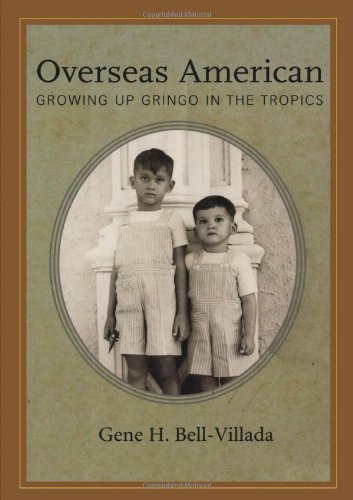
  • Overseas American: Growing Up Gringo in the Tropics

    University Press of Mississippi
    March 2005
    240 pages
    Cloth ISBN: 978-1-57806-720-6
    Ebook ISBN: 978-1-61703-222-6

    Gene H. Bell-Villada, Professor of Romance Languages
    Williams College, Williamstown, Pennsylvania

    Born in 1941 of a Hawaiian mother and a white father, Gene H. Bell-Villada, grew up an overseas American citizen. An outsider wherever he landed, he never had a ready answer to the innocuous question “Where are you from?”

    By the time Bell-Villada was a teenager, he had lived in Puerto Rico, Venezuela, and Cuba. Though English was his first language, his claim on U.S. citizenship was a hollow one. All he knew of his purported “homeland” was gleaned from imported comic books and movies. He spoke Spanish fluently, but he never fully fit into the culture of the Latin American countries where he grew up.

    In childhood, he attended an American Catholic school for Puerto Ricans in San Juan, longing all the while to convert from Episcopalianism so that he could better fit in. Later at a Cuban military school during the height of the Batista dictatorship, he witnessed fervent political debates among the cadets about Fidel Castro’s nascent revolution and U.S. foreign policy. His times at the American School in Caracas, Venezuela, are tinged with reminiscences of oil booms and fights between U.S. and Venezuelan teen gangs.

    When Bell-Villada finally comes to the United States to stay, he finds himself just as rootless as before, moving from New Mexico to Arizona to California to Massachusetts in quick succession. His accounts of life on the campuses of Berkeley and Harvard during the tumultuous 1960s reveal much about the country’s climate during the Cold War era.

    Eventually the “Gringo” comes home, finding the stability in his marriage and career that allows him to work through and proudly claim his identity as a “global nomad.”