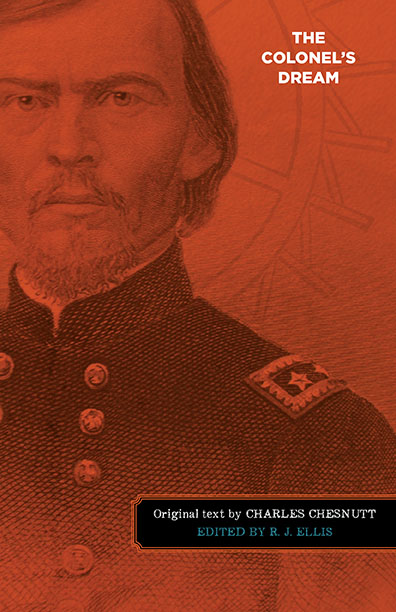
• The Colonel’s Dream

    West Virginia University Press
    October 2014 (originally published in 1905)
    352 pages
    Paperback ISBN: 978-1-935978-91-6
    Cloth ISBN: 978-1-940425-23-8
    ePub ISBN: 978-1-935978-93-0
    PDF ISBN: 978-1-935978-92-3

    Charles W. Chesnutt

    Edited by:

    R. J. Ellis, Professor of American Studies
    University of Birmingham, United Kingdom
    Charles Waddell Chesnutt (1858-1932) was an African American writer, essayist, Civil Rights activist, legal-stenography businessman, and lawyer whose novels and short stories explore race, racism, and the problematic contours of African Americans’ social and cultural identities in post-Civil War South. He was the first African American to be published by a major American publishing house and served as a beacon-point for future African American writers.

    The Colonel’s Dream, written in 1905, is a compelling tale of the post-Civil War South’s degeneration into a region awash with virulent racist practices against African Americans: segregation, lynchings, disenfranchisement, convict-labor exploitation, and endemic violent repression. The events in this novel are powerfully depicted from the point of view of a philanthropic but unreliable southern white colonel. Upon his return to the South, the colonel learns to abhor this southern world, as a tale of vicious racism unfolds. Throughout this narrative, Chesnutt confronts the deteriorating position of African Americans in an increasingly hostile South. Upon its publication The Colonel’s Dream was considered too controversial and unpalatable because of its bitter criticisms of southern white prejudice and northern indifference, and so this groundbreaking story failed to gain public attention and acclaim.

    This is the first scholarly edition of The Colonel’s Dream. It includes an introduction and notes by R. J. Ellis and works to reestablish this great novel’s reputation.

  • Notes from a Colored Girl: The Civil War Pocket Diaries of Emilie Frances Davis

    University of South Carolina Press
    May 2014
    280 pages
    9 b&w illus.
    6 x 9
    Hardcover ISBN: 978-1-61117-352-9
    eBook ISBN: 978-1-61117-353-6

    Karsonya Wise Whitehead, Assistant Professor of Communication and African and African American Studies
    Loyola University Maryland, Baltimore

    A rare glimpse into the thoughts and experiences of a free black American woman in the nineteenth century

    In Notes from a Colored Girl, Karsonya Wise Whitehead examines the life and experiences of Emilie Frances Davis, a freeborn twenty-one-year-old mulatto woman, through a close reading of three pocket diaries she kept from 1863 to 1865. Whitehead explores Davis’s worldviews and politics, her perceptions of both public and private events, her personal relationships, and her place in Philadelphia’s free black community in the nineteenth century.

    Although Davis’s daily entries are sparse, brief snapshots of her life, Whitehead interprets them in ways that situate Davis in historical and literary contexts that illuminate nineteenth-century black American women’s experiences. Whitehead’s contribution of edited text and original narrative fills a void in scholarly documentation of women who dwelled in spaces between white elites, black entrepreneurs, and urban dwellers of every race and class.

    Notes from a Colored Girl is a unique offering to the fields of history and documentary editing as the book includes both a six-chapter historical reconstruction of Davis’s life and a full, heavily annotated edition of her Civil War–era pocket diaries. Drawing on scholarly traditions from history, literature, feminist studies, and sociolinguistics, Whitehead investigates Davis’s diary both as a complete literary artifact and in terms of her specific daily entries.

    From a historical perspective, Whitehead re-creates the narrative of Davis’s life for those three years and analyzes the black community where she lived and worked. From a literary perspective, Whitehead examines Davis’s diary as a socially, racially, and gendered nonfiction text. From a feminist studies perspective, she examines Davis’s agency and identity, grounded in theories elaborated by black feminist scholars. And, from linguistic and rhetorical perspectives, she studies Davis’s discourse about her interpersonal relationships, her work, and external events in her life in an effort to understand how she used language to construct her social, racial, and gendered identities.

    Since there are few primary sources written by black women during this time in history, Davis’s diary—though ordinary in its content—is rendered extraordinary simply because it has survived to be included in this very small class of resources. Whitehead’s extensive analysis illuminates the lives of many through the simple words of one.

  • The Post-Racial Mystique: Media and Race in the Twenty-First Century

    New York University Press
    April 2014
    256 pages
    9 halftones and 7 tables
    Cloth ISBN: 9780814762899
    Paper ISBN: 9780814770603

    Catherine R. Squires, Associate Professor of Communication Studies
    University of Minnesota

    Despite claims from pundits and politicians that we now live in a post-racial America, people seem to keep finding ways to talk about race—from celebrations of the inauguration of the first Black president to resurgent debates about police profiling, race and racism remain salient features of our world. When faced with fervent anti-immigration sentiments, record incarceration rates of Blacks and Latinos, and deepening socio-economic disparities, a new question has erupted in the last decade: What does being post-racial mean?

    The Post-Racial Mystique explores how a variety of media—the news, network television, and online, independent media—debate, define and deploy the term “post-racial” in their representations of American politics and society. Using examples from both mainstream and niche media—from prime-time television series to specialty Christian media and audience interactions on social media—Catherine Squires draws upon a variety of disciplines including communication studies, sociology, political science, and cultural studies in order to understand emergent strategies for framing post-racial America. She reveals the ways in which media texts cast U.S. history, re-imagine interpersonal relationships, employ statistics, and inventively redeploy other identity categories in a quest to formulate different ways of responding to race.

  • Historically Black: Imagining Community in a Black Historic District

    New York University Press
    July 2014
    208 pages
    10 halftones
    Cloth ISBN: 9780814762882
    Paper ISBN: 9780814763483

    Mieka Brand Polanco, Assistant Professor of Anthropology
    James Madison University, Harrisonburg, Virginia

    In Historically Black, Mieka Brand Polanco examines the concept of community in the United States: how communities are experienced and understood, the complex relationship between human beings and their social and physical landscapes—and how the term “community” is sometimes conjured to feign a cohesiveness that may not actually exist. Drawing on ethnographic and historical materials from Union, Virginia, Historically Black offers a nuanced and sensitive portrait of a federally recognized Historic District under the category “Ethnic Heritage—Black.” Since Union has been home to a racially mixed population since at least the late 19th century, calling it “historically black” poses some curious existential questions to the black residents who currently live there. Union’s identity as a “historically black community” encourages a perception of the town as a monochromatic and monohistoric landscape, effectively erasing both old-timer white residents and newcomer black residents while allowing newer white residents to take on a proud role as preservers of history. Gestures to “community” gloss an oversimplified perspective of race, history and space that conceals much of the richness (and contention) of lived reality in Union, as well as in the larger United States. They allow Americans to avoid important conversations about the complex and unfolding nature by which groups of people and social/physical landscapes are conceptualized as a single unified whole. This multi-layered, multi-textured ethnography explores a key concept, inviting public conversation about the dynamic ways in which race, space, and history inform our experiences and understanding of community.

  • Race, Sex, and the Freedom to Marry: Loving v. Virginia

    University Press of Kansas
    November 2014
    296 pages
    5-1/2 x 8-1/2
    Cloth ISBN 978-0-7006-1999-3, $39.95(s)
    Paper ISBN 978-0-7006-2000-5, $19.95(s)
    Ebook ISBN 978-0-7006-2048-7

    Peter Wallenstein, Professor of History
    Virginia Polytechnic Institute and State University

    In 1958 Mildred Jeter and Richard Loving, two young lovers from Caroline County, Virginia, got married. Soon they were hauled out of their bedroom in the middle of the night and taken to jail. Their crime? Loving was white, Jeter was not, and in Virginia—as in twenty-three other states then—interracial marriage was illegal. Their experience reflected that of countless couples across America since colonial times. And in challenging the laws against their marriage, the Lovings closed the book on that very long chapter in the nation’s history. Race, Sex, and the Freedom to Marry tells the story of this couple and the case that forever changed the law of race and marriage in America.

    The story of the Lovings and the case they took to the Supreme Court involved a community, an extended family, and in particular five main characters—the couple, two young attorneys, and a crusty local judge who twice presided over their case—as well as such key dimensions of political and cultural life as race, gender, religion, law, identity, and family. In Race, Sex, and the Freedom to Marry, Peter Wallenstein brings these characters and their legal travails to life, and situates them within the wider context—even at the center—of American history. Along the way, he untangles the arbitrary distinctions that long sorted out Americans by racial identity—distinctions that changed over time, varied across space, and could extend the reach of criminal law into the most remote community. In light of the related legal arguments and historical development, moreover, Wallenstein compares interracial and same-sex marriage.

    A fair amount is known about the saga of the Lovings and the historic court decision that permitted them to be married and remain free. And some of what is known, Wallenstein tells us, is actually true. A detailed, in-depth account of the case, as compelling for its legal and historical insights as for its human drama, this book at long last clarifies the events and the personalities that reconfigured race, marriage, and law in America.

  • Pigmentocracies: Ethnicity, Race, and Color in Latin America

    University of North Carolina Press
    October 2014
    320 pages
    59 figs., 4 maps, 23 tables, notes, bibl., index
    6.125 x 9.25
    Paper ISBN: 978-1-4696-1783-1

    Edward E. Telles, Professor of Sociology
    Princeton University

    and

    The Project on Ethnicity and Race in Latin America (PERLA)
    Princeton University

    Pigmentocracies—the fruit of the multiyear Project on Ethnicity and Race in Latin America (PERLA)—is a richly revealing analysis of contemporary attitudes toward ethnicity and race in Brazil, Colombia, Mexico, and Peru, four of Latin America’s most populous nations. Based on extensive, original sociological and anthropological data generated by PERLA, this landmark study analyzes ethnoracial classification, inequality, and discrimination, as well as public opinion about Afro-descended and indigenous social movements and policies that foster greater social inclusiveness, all set within an ethnoracial history of each country. A once-in-a-generation examination of contemporary ethnicity, this book promises to contribute in significant ways to policymaking and public opinion in Latin America.

    Edward Telles, PERLA’s principal investigator, explains that profound historical and political forces, including multiculturalism, have helped to shape the formation of ethnic identities and the nature of social relations within and across nations. One of Pigmentocracies’s many important conclusions is that unequal social and economic status is at least as much a function of skin color as of ethnoracial identification. Investigators also found high rates of discrimination by color and ethnicity widely reported by both targets and witnesses. Still, substantial support across countries was found for multicultural-affirmative policies—a notable result given that in much of modern Latin America race and ethnicity have been downplayed or ignored as key factors despite their importance for earlier nation-building.

    Contents

    • Acknowledgments
    • 1. The Project on Ethnicity and Race in Latin America (PERLA): Hard Data and What Is at Stake
    • 2. The Different Faces of Mestizaje: Ethnicity and Race in Mexico
    • 3. From Whitened Miscegenation to Triethnic Multiculturalism: Race and Ethnicity in Columbia
    • 4. ¿El pals de todas las sangres? Race and Ethnicity in Contemporary Peru
    • 5. Mixed and Unequal: New Perspectives on Brazilian Ethnoracial Relations
    • 6. A Comparative Analysis of Ethnicity, Race, and Color Based on PERLA Findings
    • Notes
    • References
    • About the Authors
    • Index
  • One Drop of Love at the Straz Center

    Straz Center for the Performing Arts
    Jaeb Theater
    1010 N. W.C. MacInnes Place
    Tampa, Florida 33602
    Saturday, 2014-11-08, 19:30 EST (Local Time)

    Produced by Ben Affleck and Matt Damon, this extraordinary one-woman show by Fanshen Cox DiGiovanni incorporates filmed images, photographs and animation to tell the story of how the notion of ‘race’ came to be in the United States and how it affected her relationship with her father. This show is a moving memoir that takes audiences from the 1600s to the present, to cities all over the U.S. and West and East Africa, where both father and daughter spent time in search of their ‘racial’ roots. Funny and provocative, One Drop of Love is a spellbinding and honest journey into the heart of finding one’s place in the world and in the complicated microcosm of one’s family.

    For more information, click here.

  • ‘A Chosen Exile,’ by Allyson Hobbs: review

    San Francisco Chronicle
    2014-11-01

    Imani Perry, Professor, Center for African American Studies
    Princeton University

    Allyson Hobbs, A Chosen Exile: History of Racial Passing in American Life (Cambridge: Harvard University Press, 2014)

    Family across the color line: It is now a popular enough theme that it qualifies as a subgenre of memoir. This contemporary motif has a companion in American literary history. Fiction writers beginning in the 19th century took up the phenomenon of black people so light-skinned that they chose to cross over into whiteness permanently. Passing narratives are what such stories are called. In those works, it was an almost universally tragic choice, marking an essential loss of identity.

    Stanford historian Allyson Hobbs’ book “A Chosen Exile” lies between those two genres and yet is something else altogether. It is a book that is at once literary, cultural, archival and social, crossing the borders of various approaches to the study of history in order to create a collage of a fascinating yet elusive phenomenon. Intrigued by the story of a distant relative who crosses the color line, Hobbs has followed this interest to explore the practice of passing with detail and rigor. Her writing is elegant, bubbling with curiosity even as it is authoritative and revelatory.

    In order to cover this subject, Hobbs had to be innovative. It’s impossible to know how many African Americans passed for white, and how many crossed back over. A creative intellectual, she uses unpublished family histories, anthropological projects, sociological journals, personal papers, correspondence, court cases, newspapers, literature and film to reveal an important set of stories caught in the thicket of race in the United States…

    Read the entire review here.

  • Marni Soupcoff: A law that bans ‘mixed race’ couples? Yes. In 2014. In Canada

    National Post
    Toronto, Ontario, Canada
    2014-11-06

    Marni Soupcoff, Deputy Comment Editor

    A Canadian woman falls in love and joins her life with that of a man of a different race. As a direct result of this union, she is harassed, receives notice of eviction, and is told she must leave her home.

    What century are we talking about? This one, I’m afraid; and the culprit is not some errant racist landlord trying to throw one tenant out of a building. It’s the Kahnawake Mohawk council, which has a law that bans all “mixed race” couples from living anywhere in its Montreal-area territory.

    Waneek Horn-Miller is half of one of those “mixed race” couples who has been told to get out. Horn-Miller may be a Mohawk, but because her common-law husband (and the father or her two children) is white, the aboriginal activist and former Olympian is no longer welcome or permitted to live on Kahnawake territory.

    This is happening in 2014. Which, to put things in context, is 47 years after the United States Supreme Court ruled anti-miscegenation (or race-mixing) laws unconstitutional in that country

    Read the entire article here.

  • ‘The abuse we suffered due to our skin colour is being airbrushed from Irish history’

    TheJournal.ie
    Dublin, Ireland
    2014-10-22

    Nicky Ryan, Staff Reporter


    Members of Mixed Race Irish before the committee today. Source: Oireachtas.ie

    Mixed Race Irish is asking for the Government to recognise the abuse they suffered in State-run institutions.

    IN A EMOTIONAL appearance before an Oireachtas committee, mixed race survivors of institutional abuse in Ireland have called on the Government to recognise the suffering they endured.

    The group, Mixed Race Irish, believe the alleged racist abuse they experienced in these institutions is being “airbrushed from Irish history”. They say that few, if any, records exist of mixed race Irish in any State institutions.

    “Our research suggests this racism was endemic throughout all the institutions attended by our community,” co-founder Rosemary Adaser told the Justice Committee.

    “The nuns showed us films of missionaries going to tame the ‘savages’, and we were told, ‘look at that, they are savages, that’s what you are’,” she said.

    Co-founder Carole Brennan said that parish priests “would single out mixed race children and abuse them.”

    “We believe we were treated differently, resulting in inequality, in these systems due to one simple fact – the colour of our skin,” she said…

    Read the entire article here.