• Matthew McConaughey & Gary Ross Mount Civil War Saga; Bob Simonds’ STX In Talks To Finance

    Deadline Hollywood
    2014-11-05

    Mike Fleming Jr., Film Editor

    Anita Busch, Film Editor

    EXCLUSIVE: Matthew McConaughey and writer-director Gary Ross are the catalysts for a project called Free State Of Jones, which is getting some serious attention from STX Entertainment, the new mini-studio founded by investors TPG Growth, Gigi Pritzker, Hony and Robert Simonds. We hear that company reps, financial partner IM Global (who is handling foreign), and the filmmakers are heading to AFM this afternoon to discuss pre-sales. This is one of many projects STX is considering pushing through as part of its first slate. They are looking to go before the cameras in the first quarter of 2015.

    Free State Of Jones is based on the untold and extraordinary story of Newton Knight, the leader of one of the greatest rebellions in Civil War history, and we hear that STX may finance (up to $20M) for the $65M-budgeted story of one of the most controversial men from the that era. McConaughey is in talks to play the Mississippian, who defected from the Confederate Army, banded together with a group of like-minded soldiers, and set out to form their own State known as the Free State Of Jones.

    Knight would later have a common-law marriage to a former slave, one of the first outwardly mixed racial unions in the South — unheard of at the time. The rebellious Knight actually fought against the Confederates from within the state and after the war freed children still enslaved after a daring raid…

    Note from Steven F. Riley: For more about the Knight family, please read Victoria E. Bynum’s superb monograph, The Free State of Jones: Mississippi’s Longest Civil War.

    Read the entire article here.

  • ‘One Drop of Love’ star Fanshen Cox DiGiovanni talks race, family and more

    The Tampa Bay Times
    St. Petersburg, Florida
    2014-11-05

    Robbyn Mitchell, Times Staff Writer


    Fanshen Cox DiGiovanni: “Race is like a religion to us.”

    It’s been an interesting year in race relations for America. In just over 10 months, there have been communities violently protesting loss of due process, NBA owners losing their teams over racist remarks and anti-immigration zealots blockading school buses full of brown children because they were presumed to be foreign.

    It’s a climate — not of change, as was promised by the election of President Barack Obama, but of an overwhelming dedication to fight change.

    “People believe in race so strongly they’re faithful to it. Race is like a religion to us,” said Fanshen Cox DiGiovanni, writer and performer of One Drop of Love, a one-woman multimedia show coming to the Straz Center for the Performing Arts Saturday night.

    As a woman with parents who identify themselves as different races — her father is black and her mother is white — Cox DiGiovanni says she has the had the privilege to move between two different spheres of American society and decide for herself how she would be defined.

    “The way I identify myself is as a culturally mixed woman searching for racial answers,” she said. “I care about justice and that’s more important than racial identity.”…

    Read the entire article here.

  • What ‘White Privilege’ Really Means

    The New York Times
    2014-11-05

    George Yancy, Professor of Philosophy
    Duquesne University, Pittsburgh, Pennsylvania

    Naomi Zack, Professor of Philosophy
    University of Oregon

    This is the first in a series of interviews with philosophers on race that I am conducting for The Stone. This week’s conversation is with Naomi Zack, a professor of philosophy at the University of Oregon and the author of “The Ethics and Mores of Race: Equality After the History of Philosophy.”  The interview was conducted by email and edited. — George Yancy

    George Yancy: What motivates you to work as a philosopher in the area of race?

    Naomi Zack:  I am mainly motivated by a great need to work and not to be bored, and I have a critical bent. I think there is a lot of work to be done concerning race in the United States, and a lot of ignorance and unfairness that still needs to be uncovered and corrected. I received my doctorate in philosophy from Columbia University in 1970 and then became absent from academia until 1990. When I returned it had become possible to write about real issues and apply analytic skills to social ills and other practical forms of injustice. My first book, “Race and Mixed Race” (1991) was an analysis of the incoherence of U.S. black/white racial categories in their failure to allow for mixed race. In “Philosophy of Science and Race,” I examined the lack of a scientific foundation for biological notions of human races, and in “The Ethics and Mores of Race,” I turned to the absence of ideas of universal human equality in the Western philosophical tradition…

    G.Y.: We can safely assume white parents don’t need to have this talk with their children. Do you think white privilege is at work in this context?

    N.Z.: The term “white privilege” is misleading. A privilege is special treatment that goes beyond a right. It’s not so much that being white confers privilege but that not being white means being without rights in many cases. Not fearing that the police will kill your child for no reason isn’t a privilege. It’s a right.  But I think that is what “white privilege” is meant to convey, that whites don’t have many of the worries nonwhites, especially blacks, do. I was talking to a white friend of mine earlier today. He has always lived in the New York City area. He couldn’t see how the Michael Brown case had anything to do with him. I guess that would be an example of white privilege.

    Other examples of white privilege include all of the ways that whites are unlikely to end up in prison for some of the same things blacks do, not having to worry about skin-color bias, not having to worry about being pulled over by the police while driving or stopped and frisked while walking in predominantly white neighborhoods, having more family wealth because your parents and other forebears were not subject to Jim Crow and slavery. Probably all of the ways in which whites are better off than blacks in our society are forms of white privilege. In the normal course of events, in the fullness of time, these differences will even out. But the sudden killings of innocent, unarmed youth bring it all to a head…

    Read the entire interview here.

  • BEING a mixed-race black person…

    Max News: ‘View from the Bottom’ Magazine of Kevin Maxwell
    London, United Kingdom
    2014-11-05

    Kevin Maxwell

    I was talking with a black woman earlier, and we happened to get on to the subject of race – something close to my skin, literally.

    She said that a lot of mixed-race people only identified as black, when they had experienced racism. I thought, how true.

    Prior to my own challenges against racism within the police, I’m unsure how I described myself. I mean, the Government gave me labels on forms like mixed-race because I have a white mother and black father – but, I was just me.

    It was the Metropolitan Police which ironically got me to look closer under my skin, at my race and identity.

    I wrote in The Nubian Times for the recent Black History Month that, in my challenges against discrimination within Scotland Yard the Met said I wasn’t black (enough) to be discriminated against.

    I was like, this is just stupid.

    The first thing people see when they meet me is my black skin, and it’s how I identify anyhow too – which, is what is important…

    Read the entire article here.

  • Philosophy of Science and Race

    Routledge
    2002-09-20
    152 pages
    Paperback ISBN: 978-0-415-94164-8
    Hardback ISBN: 978-0-415-94163-1

    Naomi Zack, Professor of Philosophy
    University of Oregon

    Contents

    • Preface and Acknowledgments
    • Introduction: Reason and Method
    • 1. Philosophical Racial Essentialism: Hume and Kant
    • 2. Geography and Ideas of Race
    • 3. Phenotypes and Ideas of Race
    • 4. Transmisson Genetics and Ideas of Race
    • 5. Genealogy and Ideas of Race
    • 6. Race and Contemporary Anthropology
    • 7. Philishophical and Social Implications
    • Notes
    • Select Bibliography
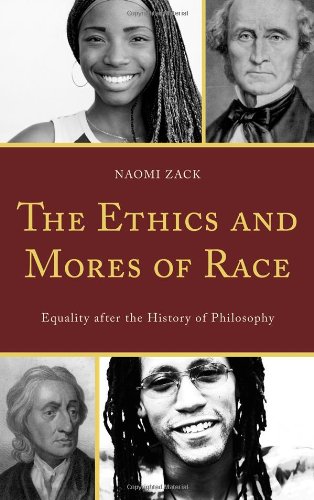
  • The Ethics and Mores of Race: Equality after the History of Philosophy

    Rowman & Littlefield
    July 2011
    216 pages
    Size: 6 3/4 x 9 1/2
    Hardback ISBN: 978-1-4422-1125-4
    eBook ISBN: 978-1-4422-1127-8

    Naomi Zack, Professor of Philosophy
    University of Oregon

    Preeminent philosopher, Naomi Zack, brings us an indispensable work in the ethics of race through an inquiry into the history of moral philosophy. Beginning with Plato and a philosophical tradition that has largely ignored race, The Ethics and Mores of Race: Equality After the History of Philosophy enters into a web of ideas, ethics, and morals that untangle our evolving ideas of racial equality straight into the twenty-first century. The dichotomy between ethics and mores has long aided the separation of what is right with ideas of equality. Zack tackles the co-existence of slavery with the classic moral systems and continues to show how our society has evolved and our mores with it. An ethics of race my not exist yet, but this book gives us twelve discerning requirements to establish it.

    Table of Contents

    • Acknowledgments
    • Introduction: Ethics, Mores, and Race
    • Chapter 1: Plato and Aristotle’s Invention of Race
    • Chapter 2: Cosmopolitan Contributions to an Ethics of Race
    • Chapter 3: Natural Law and Inequality
    • Chapter 4: Moral Law and Slavery
    • Chapter 5: Christian Metaphysics and Inequality
    • Chapter 6: Social Contract Theory and the Sovereign Nation State
    • Chapter 7: Deontology, Utilitarianism, and Rights
    • Conclusion: Egalitarian Humanism and Requirements for an Ethics of Race
    • Select Bibliography
    • About the Author
  • Am I ‘black enough’?

    Cable News Network (CNN)
    2014-10-27

    Gene Seymour

    Editor’s note: Gene Seymour is a film critic who has written about music, movies and culture for The New York Times, Newsday, Entertainment Weekly and The Washington Post. The opinions expressed in this commentary are solely those of the writer.

    (CNN) — I am black, though for most of my life, I’ve heard from various people that I wasn’t.

    From children with skin the same color as mine saying that my normal speaking voice was somehow faked and that I spoke and therefore acted “like a white man”; from a black woman who berated me for listening to the Beatles in my car because, in her words, their music “wasn’t yours”; from strangers and would-be acquaintances of varied races over several decades who openly wondered if I was something other than African-American because of an eclectic range of interests (Jewish novelists, New Wave French movies, Wallace Stevens’ poetry, etc.) that didn’t quite jibe with whatever was expected from African-Americans.

    There was even a liberal white teacher in my high school who suggested to me, straight-faced and with the very best of intentions, that if I was feeling out of place among my fellow black students I should just spend more time around what was then called “the ghetto” and learn how to speak as they would prefer; maybe even to adopt their speech as my own, so as to ….I don’t remember the exact words, but I’m guessing it was to better embody whatever her idea of legitimate blackness was back in the mid-60s.

    If you came of age in mid- to late-20th century America when the civil rights movement gave way to growing consciousness of, and pride in being of African descent, the charge from within the black community that you were Not Black Enough was almost as wounding, even debilitating, as a racial epithet from a white person.

    Apparently, you can’t even win a Super Bowl as a black quarterback without somebody slurring your authenticity. There were reports swirling around the Internet last week that Russell Wilson, signal caller for the defending NFL champion Seattle Seahawks, was being accused by some of his black teammates of being Not Black Enough. “I don’t even know what that means,” Wilson, who has mixed-race parentage, told a press conference yesterday after his team rallied from a two-week losing streak to beat the Carolina Panthers

    …This fall, what was once a mostly insular discourse among black folks has gone even more public through two cozily familiar entertainment genres: the family sitcom and the campus comedy.

    The latter, “Dear White People” is writer-director Justin Simien’s Sundance Film Festival sensation about culture clashes between white and black students (and among black students themselves) at a mythical Ivy League college. There’s a black Big Man On Campus named (what else) Troy, who besides being the son of the dean of students is dating the daughter of the white university president. There’s also a gay nerd-outcast named Lionel, who wears a retrograde Afro hairstyle so big as to be compared to a weather system, listens to Mumford & Sons, loves Robert Altman movies and, as he puts it, “isn’t black enough” for either the black or the white students.

    The most radical character is a mixed-race young woman named Sam White, a rabble-rousing radio jock and aspiring filmmaker whose acerbically funny barbs aimed at genteel racial stereotyping at mythical Winchester University sets off a nationalist insurgency among the black students. Yet, as with Lionel, she carries a portfolio of seeming contradictions, such as a white lover and a preference for Ingmar Bergman’s movies over Spike Lee’s

    Read the entire article here.

  • My Children and the Limits of White Privilege

    Nursing Clio: Because the Personal is Historical
    2013-08-28

    Danielle J. Swiontek, Assistant Professor of History
    Santa Barbara City College, Santa Barbara, California

    Nursing Clio is honored to have Danielle J. Swiontek as our guest author today. Danielle is an Assistant Professor of History at Santa Barbara City College. She received her Ph.D. in History from the University of California, Santa Barbara. Her dissertation, entitled “With Ballots and Pocketbooks: Women, Labor, and Reform in Progressive California” examines California women’s campaign for, and subsequent use of, the vote in the 1910s and 1920s.

    The community in which I live held a march in memory of Trayvon Martin two weeks ago. It seemed so dated, in a way. In this 24-hour news cycle that we live in, it feels like forever ago since Trayvon Martin was shot and killed on February 26, 2012. It seems like ages since the jury found George Zimmerman not guilty of his death this past July. Yet the killing of Trayvon Martin continues to haunt me, as it probably does the people who joined the march. The news cycle has moved on, but the issues that Trayvon Martin’s death brought to the forefront have not. When I first heard about Trayvon Martin’s death, it made me fear for my son. That fear has not gone away in the last two months. It will probably never go away.

    In a very specific, concrete way, I worry that my almost three-year-old boy will someday be shot by an overly zealous neighborhood watcher, by a police officer, or by someone who simply feels threatened by him, because of his size and the color of his skin. This is not a fear I would have if my son were white. I know this in my bones.

    When President Obama offered his thoughts on Trayvon Martin and the experience of race in the U.S., I was not surprised by the experiences that others have found so striking. He talked about how he had been followed in department stores, how people locked their car doors when he walked down the street, how women were visibly nervous when he got on the elevator with them.

    I am a middle-class white woman, but I believe I have some understanding of what those experiences feel like. I come to this conversation about race from a position of racial and class privilege. I was raised in a white, middle-class neighborhood by parents who lived out an archetypical American narrative of rising from working-class roots to a comfortable upper-middle class life…

    Read the entire article here.

  • Use of Race and Ethnicity in Public Health Surveillance: Summary of the CDC/ATSDR Workshop

    United States Department of Health and Human Services
    Centers for Disease Control and Prevention
    Morbidity and Mortality Weekly Report
    Volume 42, 1993-06-25, Number RR-10
    28 pages

    Preface

    This edition of MMWR Recommendations and Reports summarizes a workshop that addresses the role of race and ethnicity in public health surveillance. The importance of public health surveillance efforts in assuring the nation’s health objectives cannot be overstated. However, because of a lack of consensus when defining and measuring race and ethnicity, public health surveillance systems have been limited. If the Year 2000 Health Objectives are to be met, recognizing and addressing these limitations are essential.

    The issues addressed in this report highlight concepts, measures, and uses of race and ethnicity in public health surveillance. Representing the private sector, government and other public agencies, workshop participants assisted CDC and the Agency for Toxic Substances and Disease Registry (ATSDR) in describing, assessing, and improving the use of race and ethnicity in public health surveillance. The involvement of health professional organizations and minority health advocates ensured that relevant “real life” health concerns of racial and ethnic groups were addressed. This report includes summaries of plenary presentations by invited experts. The summaries do not necessarily represent the views or positions of CDC.

    The workshop focused on the limitations of the current use of race and ethnicity in public health surveillance, and the problems that persist because of these limitations. Although conceptual alternatives and practical strategies for improvement were recommended, further refinement is necessary. For example, while race may have some biological basis, its significance is mainly derived from social arrangements. Thus, race should be viewed within public health surveillance as a sociological phenomenon. Race and ethnicity are not risk factors — they are markers used to better understand risk factors. For instance, homicide disproportionately impacts African American communities; however, when income status is considered, the impact of homicide in African American communities is similiar to that in white communities. Finally, there should be further exploration of the full utility of the concept of ethnicity. This term generally has been limited to definers such as surname or language, while ignoring, for example, the importance of historical and sociological experiences.

    The recommendations generated from the workshop were developed for CDC/ATSDR and some of them may be used to improve surveillance systems at CDC/ATSDR and in other parts of the Public Health Service. In addition, some of these recommendations may be used to update the 1985 Report of the Secretary’s Task Force on Black and Minority Health, as well as in measuring progress in reaching theYear 2000 Health Objectives. These recommendations have been submitted to the Director of CDC for consideration. They are being published in this format to stimulate further discussion. Some of these recommendations may exceed the missions of CDC and ATSDR, may be in conflict with other recommendations, or may be in various stages of implementation. Any comments regarding these recommendations may be sent to me at: Centers for Disease Control and Prevention, Office of the Associate Director for Minority Health, 1600 Clifton Road, MS-D39, Atlanta, GA 30333.

    Rueben C. Warren, D.D.S., M.P.H., Dr.P.H.
    Associate Director for Minority Health…

    Read the entire report here.

  • ‘Dear White People’ or ‘Dear Bougie Black People’?

    The Boston Globe
    2014-11-04

    Farah Stockman

    THIS WEEKEND, I saw the new satirical film “Dear White People.” I was curious what it would tell me about how young people view race today.

    Each generation plays out the drama of race in the movies. Baby boomers flocked to“Guess Who’s Coming to Dinner,” which raised the question: Could a well-educated black man ever be good enough for a white family’s daughter? The jury was still out in 1967, the year my mom, who is black, saw that movie several times. Two years later, she married my dad, who is white.

    Then came my generation. Born in the ’70s, we grew up glued to depictions of black slavery and impoverishment, with the television miniseries “Roots” and the sitcom “Good Times.” We came of age with Spike Lee’sJungle Fever,” released in 1991, which asked the question: Will the gulf between black and white ever be bridged? Lee’s answer seemed to be: Don’t hold your breath. In 1992, I left my predominantly white high school for a predominantly white Ivy League college.

    Now we have the millennial generation, the most ethnically diverse, socially liberal cohort America has ever seen; kids who never wondered whether America could elect a black president. About 90 percent report being “fine” with a family member marrying outside the race. Yet, for much of this generation, the civil rights movement is ancient history, and systemic black poverty and incarceration take place on a separate planet. Millennials feel deeply ambivalent about acknowledging race, even for the purpose of righting wrongs: According to one poll, 70 percent feel it’s “never fair to give preferential treatment to one race over another, regardless of historical inequalities.” Nearly half of white young people today believe that discrimination against whites has become “as big a problem as discrimination against racial minority groups.” By comparison, only 27 percent of people of color share that belief…

    W. E. B. Du Bois famously defined a black man as anybody “who must ride ‘Jim Crow’ in Georgia,’ ” writes Stanford historian Allyson Hobbs in her new book, “A Chosen Exile.” That “raises the question, What would a black man be without Jim Crow in Georgia?”…

    Read the entire article here.