• Multiracial Experiences in Higher Education: Contesting Knowledge, Honoring Voice, and Innovating Practice

    Stylus Publishing
    2021-02-17
    Paperback ISBN: 9781642670691
    E-Book (ePub) ISBN: 9781642670714
    Hardback ISBN: 9781642670684
    Lib E-Book ISBN: 9781642670707

    Edited by:

    Marc P. Johnston-Guerrero, Associate Professor
    Department of Educational Studies
    Ohio State University

    Charmaine L. Wijeyesinghe, Ed.D., Consultant and Author in Organizational Development and Social Justice Education

    Foreword by:

    G. Reginald Daniel, Professor of Sociology
    University of California, Santa Barbara

    Recipient of the 2021 Innovation Award of The Multiracial Network (MRN)

    In the last Census, over 9 million people – nearly 3% of the population – identified themselves as of two or more races. The proportion of college students who identify as Multiracial is somewhat higher, and growing. Although increasing at a slightly slower rate, Multiracial faculty and staff are also teaching and working on campuses in greater numbers. Together, Multiracial people from diverse backgrounds and in various roles are influencing college and university culture, practices, and climate.

    This book centers the experiences of Multiracial people, those individuals claiming heritage and membership in two or more (mono)racial groups and/or identifies with a Multiracial term. These terms include the broader biracial, multiethnic, and mixed, or more specific terms like Blasian and Mexipino.

    In addressing the recurring experiences of inclusion, exclusion, affirmation, and challenges that they encounter, the contributors identify the multiple sites in higher education that affect personal perceptions of self, belonging, rejection, and resilience; describe strategies they utilized to support themselves or other Multiracial people at their institutions; and to advocate for greater awareness of Multiracial issues and a commitment to institutional change.

    In covering an array of Multiracial experiences, the book brings together a range of voices, social identities (including race), ages, perspectives, and approaches. The chapter authors present a multiplicity of views because, as the book exemplifies, multiracial people are not a monolithic group, nor are their issues and needs universal to all.

    The book opens by outlining the literature and theoretical frameworks that provide context and foundations for the chapters that follow. It then presents a range of first person narratives – reflecting the experiences of students, faculty, and staff – that highlight navigating to and through higher education from diverse standpoints and positionalities. The final section offers multiple strategies and applied methods that can be used to enhance Multiracial inclusion through research, curriculum, and practice. The editors conclude with recommendations for future scholarship and practice.

    This book invites Multiracial readers, their allies, and those people who interact with and influence the daily lives of Multiracial people to explore issues of identity and self-care, build coalitions on campus, and advocate for change. For administrators, student affairs personnel, and anyone concerned with diversity on campus, it opens a window on a growing population with whom they may be unfamiliar, mis-categorize, or overlook, and on the need to change systems and structures to address their full inclusion and unveil their full impact.

    Table of Contents

    • Foreword —G. Reginald Daniel
    • Preface
    • Acknowledgments
    • Part One: Framing Multiracial Experiences in Higher Education
      • 1) Insights on Multiracial Knowledge, Voices, and Practices: Lessons From Our Lives and Work—Charmaine L. Wijeyesinghe and Marc P. Johnston-Guerrero
      • 2) Multiracial Identity on Campus: Identities and Experiences of Multiracial People in Higher Education—Kristen A. Renn
      • 3) The Naming and Framing of Identity: Reflecting on Core Concepts Through the Experiences of Multiracial People—Charmaine L. Wijeyesinghe
      • 4) Monoracism: Identifying and Addressing Structural Oppression of Multiracial People in Higher Education—Jessica C. Harris, Marc P. Johnston-Guerrero, and Maxwell Pereyra
    • Part Two: Multiracial Narratives Across the Higher Education Landscape
      • 5) Back to Black—Nick Davis
      • 6) On the Path to Multiracial Consciousness: Reflections on My Scholar-Practitioner Journey in Higher Education—Victoria K. Malaney Brown
      • 7) Being Mexipina in Higher Education—Rebecca Cepeda
      • 8) Remembering to Resist Racist Colonial Forgetting on Campus—e alexander
      • 9) Existing In-Between: Embodying the Synergy of My Ancestors—Naliyah Kaya
      • 10) Reflections of a Creole, Indigenous, Afro-Latin Scholar: From Community to the Classroom—Andrew Jolivétte
    • Part Three: Strategies and Tools for Enhancing Multiracial Inclusion
      • 11) Contextualizing Multiraciality in Campus Climate: Key Considerations for Transformative Diversity, Equity, and Inclusion—Chelsea Guillermo-Wann and Marc P. Johnston-Guerrero
      • 12) Building Multiracial Aikido: A Student Social Justice Retreat—Charlene C. Martinez and Stephanie N. Shippen
      • 13) Mixed and Multiracial Student Organizations on Campus: The Necessity of Weaving Together Art and Critique—Orkideh Mohajeri and Heather C. Lou
      • 14) Critical Mixed Race Studies: Rooted in Love and Fire—Nicole Leopardo, Kira Donnell, and Wei Ming Dariotis
    • Part Four: Future Directions
      • 15) Intergenerational Reflections and Future Directions—Marc P. Johnston-Guerrero, Charmaine L. Wijeyesinghe, and Lisa Combs
    • Editors and Contributors
    • Index
  • The Performance of Racial Passing

    The New York Times Style Magazine
    2021-03-02

    Brit Bennett


    The author Nella Larsen, photographed in 1934 by Carl Van Vechten. Carl Van Vechten, ©Van Vechten Trust, Courtesy of the Beinecke Rare Book & Manuscript Library, Yale University

    Though Nella Larsen’s classic 1929 novel is understood to be a tragedy, it also exposes race to be something of a farce.

    This article is part of T’s Book Club, a series of articles and events dedicated to classic works of American literature. Click here to R.S.V.P. to a virtual conversation, led by Brit Bennett, about “Passing,” to be held on March 9.

    There’s a scene in the 1959 melodramatic film “Imitation of Life” that I have seen dozens of times, but it’s not the one you’re probably imagining: the climatic funeral scene where Sarah Jane Johnson, a young Black woman passing for white, flings herself onto the casket of the dark-skinned mother she has spent the entire film disowning. Instead, the scene that sticks with me is halfway into the movie, when Sarah Jane meets up with her white boyfriend, who has secretly discovered that she is Black. “Is your mother a nigger?” he sneers, before beating her in an alley.

    I’m not proud to admit that in elementary school, my best friend and I used to watch this scene over and over again, not because we thought it was tragic, but because we found it funny. The frenetic music in the background, the melodramatic slaps, Sarah Jane’s slow crumple to the asphalt. We knew we were wrong to laugh, but we were too young to take much seriously, let alone a character like Sarah Jane, whom we found more pitiful than pitiable. We’d watched her mope through the whole movie about not wanting to be Black. Well, fine. Go see how she likes it over there.

    In a strange way, the beating scene itself is almost structured like a joke. Part of the pleasure of a passing narrative is watching the passer fool her audience; in this scene, however, the audience is aware while the passer is not. Sarah Jane asks her boyfriend to run away together, the boyfriend pretends to consider it. He only has one question: Is it true? Sarah Jane laughs, unsuspecting. Is what true? But of course, we already know the punchline…

    Read the entire article here.

  • Call For Participants: Are You a Multiracial Musician?

    University of St. Thomas, Minnesota
    School of Education
    St. Paul, Minnesota
    2021-03-07

    Ilah Raleigh, M.M., Education Leadership Ed.D. Doctoral Candidate; Arts Education Leader & Performing Artist

    Dear Multiracial Musicians:

    I am conducting research on the contributions of multiracial artists in the contemporary commercial music (CCM) genres of country, hip-hop, and/or reggaetón. The purpose of my study is to investigate the historic and contemporary events, trends, and developments in American contemporary commercial music (CCM) which are ignored, erased, and misunderstood. This research has potential value to students, educators, and scholars of music, music education, and critical mixed race studies.

    I am recruiting research participants who meet the following criteria:

    • 18 years or older.
    • Multiracial ancestry and/or parentage, though they do not have to self-identify as racially and/or ethnically mixed.
    • Musical artists working in the genres of country, hip-hop, and/or reggaetón. This can include vocalists, emcees, deejays, instrumentalists, composers and/or producers.
    • At least three years of pre-professional training or professional experience in the music industry.

    Please note: Participation in this study is voluntary and participants may withdraw at any time during the study. Research participants will not be compensated for their participation. Survey data will be destroyed if a potential participant chooses to not participate.

    Please follow the link here to a pre-screening recruitment survey.

    Questions? Contact ilah.raleigh@stthomas.edu. To learn more, visit my professional website.

    Ilah Raleigh, M.M. (Principal Investigator)

  • They Were Black. Their Parents Were White. Growing Up Was Complicated.

    The New York Times
    Book Reviews
    2021-02-23

    Bliss Broyard


    Georgina Lawton (Left), Rebecca Carroll (Right) Jamie Simonds/Loftus Media, Laura Fuchs

    Georgina Lawton, Raceless: In Search of Family, Identity, and the Truth About Where I Belong (New York: Harper Perennial, 2021)

    Rebecca Carroll, Surviving the White Gaze, A Memoir (New York: Simon & Schuster, 2021)

    For most of us, racial identity is a combination of inheritance (you are what your parents are) and influence (you’re a product of where and how you were raised). But what if you are raised by people who didn’t look like you, in communities where you were the only one, steeped in a culture whose power was amassed through your oppression?

    In a pair of new memoirs — “Surviving the White Gaze,” by the American cultural critic Rebecca Carroll, and “Raceless: In Search of Family, Identity, and the Truth About Where I Belong,” by the British journalist Georgina Lawton — two women recount growing up as Black girls with white parents who loved them deeply but failed them miserably by not seeing and celebrating them for who they were…

    Read the review of both books here.

  • Raceless: In Search of Family, Identity, and the Truth About Where I Belong

    Harper Perennial (an imprint of Harper Collins)
    2021-02-23
    304 pages
    5x8in
    Trade Paperback ISBN: 9780063009486
    E-book ISBN: 9780063009493
    Audiobook ISBN: 9780063009509

    Georgina Lawton

    Raised in sleepy English suburbia, Georgina Lawton was no stranger to homogeneity. Her parents were white; her friends were white; there was no reason for her to think she was any different. But over time her brown skin and dark, kinky hair frequently made her a target of prejudice. In Georgina’s insistently color-blind household, with no acknowledgement of her difference or access to black culture, she lacked the coordinates to make sense of who she was.

    It was only after her father’s death that Georgina began to unravel the truth about her parentage—and the racial identity that she had been denied. She fled from England and the turmoil of her home-life to live in black communities around the globe—the US, the UK, Nicaragua, Cuba, the Dominican Republic, Vietnam, and Morocco—and to explore her identity and what it meant to live in and navigate the world as a black woman. She spoke with psychologists, sociologists, experts in genetic testing, and other individuals whose experiences of racial identity have been fraught or questioned in the hopes of understanding how, exactly, we identify ourselves.

    Raceless is an exploration of a fundamental question: what constitutes our sense of self? Drawing on her personal experiences and the stories of others, Lawton grapples with difficult questions about love, shame, grief, and prejudice, and reveals the nuanced and emotional journey of forming one’s identity.

  • ONE DROP: Shifting the Lens on Race

    Beacon Press
    2021-02-16
    288 pages
    9 x 9 Inches
    ISBN: 978-080707336-0

    Yaba Blay

    Challenges narrow perceptions of Blackness as both an identity and lived reality to understand the diversity of what it means to be Black in the US and around the world

    • What exactly is Blackness and what does it mean to be Black?
    • Is Blackness a matter of biology or consciousness?
    • Who determines who is Black and who is not?
    • Who’s Black, who’s not, and who cares?

    In the United States, a Black person has come to be defined as any person with any known Black ancestry. Statutorily referred to as “the rule of hypodescent,” this definition of Blackness is more popularly known as the “one-drop rule,” meaning that a person with any trace of Black ancestry, however small or (in)visible, cannot be considered White. A method of social order that began almost immediately after the arrival of enslaved Africans in America, by 1910 it was the law in almost all southern states. At a time when the one-drop rule functioned to protect and preserve White racial purity, Blackness was both a matter of biology and the law. One was either Black or White. Period. Has the social and political landscape changed one hundred years later?

    One Drop explores the extent to which historical definitions of race continue to shape contemporary racial identities and lived experiences of racial difference. Featuring the perspectives of 60 contributors representing 25 countries and combining candid narratives with striking portraiture, this book provides living testimony to the diversity of Blackness. Although contributors use varying terms to self-identify, they all see themselves as part of the larger racial, cultural, and social group generally referred to as Black. They have all had their identity called into question simply because they do not fit neatly into the stereotypical “Black box”—dark skin, “kinky” hair, broad nose, full lips, etc. Most have been asked “What are you?” or the more politically correct “Where are you from?” throughout their lives. It is through contributors’ lived experiences with and lived imaginings of Black identity that we can visualize multiple possibilities for Blackness.

    Table of Contents

    • Author’s Note
    • Intro
    • Introspection
    • Mixed Black
    • American Black
    • Diaspora Black
    • Outro
    • Notes
    • Acknowledgements
    • About
  • Cherokee Nation Strikes Down Language That Limits Citizenship Rights ‘By Blood’

    National Public Radio
    2021-02-25

    Mary Louise Kelly, Host
    All Things Considered


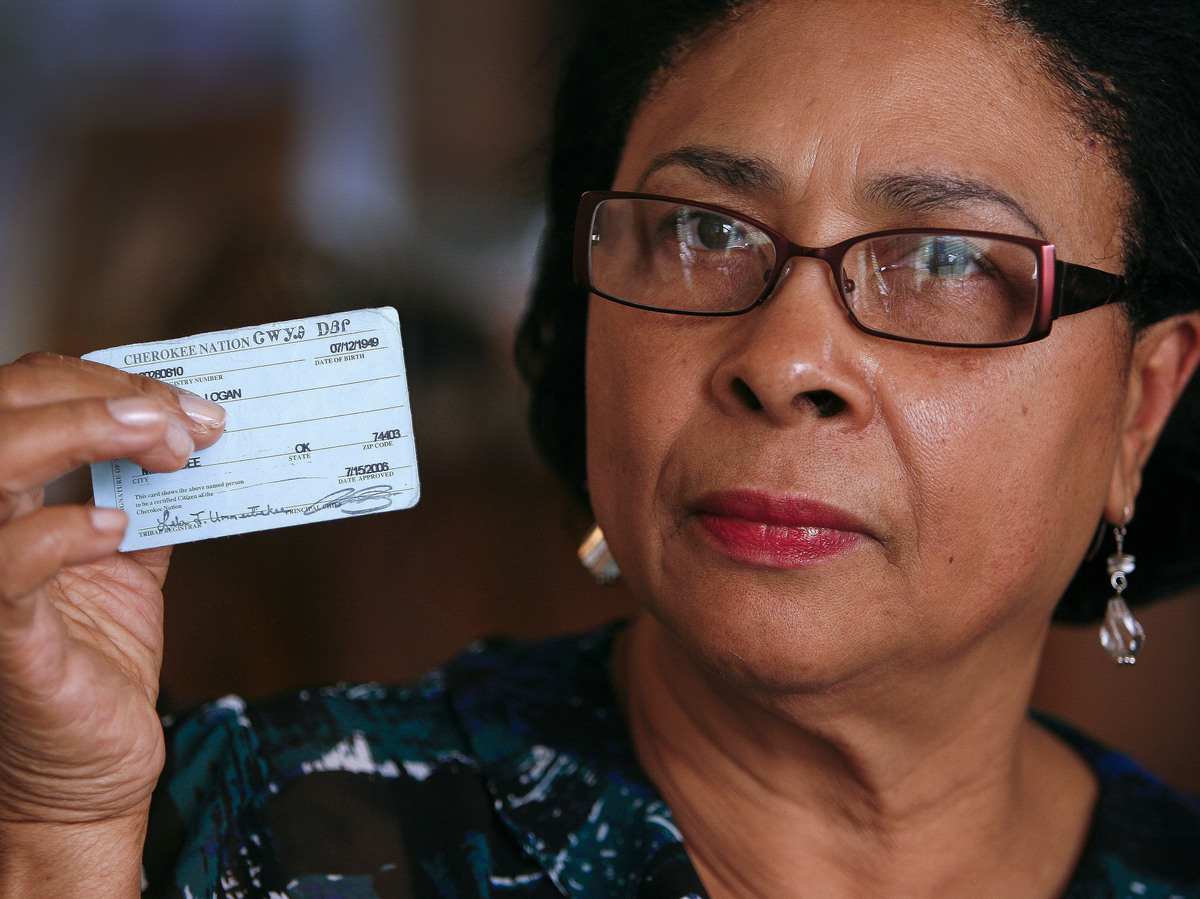
    Rena Logan, a member of a Cherokee Freedmen family, shows her identification card as a member of the Cherokee tribe at her home in Muskogee, Okla., in this photo from October 2011. She is among the some 8,500 people whose ancestors were enslaved by the Cherokee Nation in the 1800s.David Crenshaw/Associated Press

    The Cherokee Nation’s Supreme Court ruled this week to remove the words “by blood” from its constitution and other legal doctrines.

    The words, added to the constitution in 2007, have been used to exclude Black people whose ancestors were enslaved by the tribe from obtaining full Cherokee Nation citizenship rights.

    There are currently some 8,500 enrolled Cherokee Nation members descended from these Freedmen, thousands of whom were removed on the Trail of Tears along with tribal citizens.

    “The Freedmen, until this Cherokee Nation Supreme Court ruling, they couldn’t hold office, they couldn’t run for tribal council and they couldn’t run for chief,” says Graham Lee Brewer, an editor for Indigenous affairs at High Country News and KOSU in Oklahoma. “And I would argue that that made them second-class citizens.”…

    Read the entire story here. Download the story (00:04:10) here.

  • MIXED MESSAGES episode 1 – Marcus

    Mixed Messages with Sarah Doneghy
    2021-02-24

    Sarah Doneghy, Host

    Marcus discusses his Mixed Race experience.

    Watch the episode here.

  • None of this, of course, should encourage the reader to think of Louisiana as any sort of racial haven. Louisiana began as a white idea and remained one: Choctaw kindnesses were repaid with genocide, most Africans were shipped in as chattel slaves, and Europeans walked the land as rulers, just as they did everywhere else. What did make Louisiana, and especially its port city, New Orleans, different from the English colonies or the eastern seaboard was the way it understood race mixture. Though white Americans also had sex with Africans and Indians, they usually denied its result. Anyone with “one drop” of African blood was by the American schema defined as black, and everyone else was effectively white.

    Joe Wood, “Fade to Black: Once Upon a Time in Multi-Racial America,” The Village Voice, 12/08/1994. 25-34. https://www.villagevoice.com/2019/12/04/escape-from-blackness-once-upon-a-time-in-creole-america/.

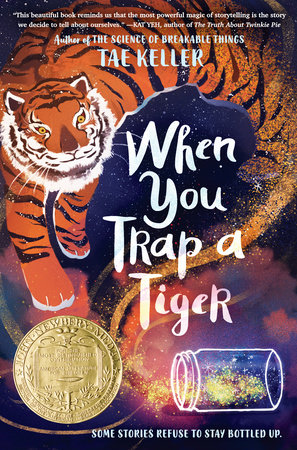
  • When You Trap a Tiger

    Penguin Random House
    2021-01-28
    304 Pages
    5-1/2 x 8-1/4
    Hardcover ISBN: 9781524715700
    Ebook ISBN: 9781524715724
    Audiobook ISBN: 9780593155455

    Tae Keller

    • Winner of the Newbery Medal
    • Winner of the Asian/Pacific American Award for Children’s Literature

    Would you make a deal with a magical tiger? This uplifting story brings Korean folklore to life as a girl goes on a quest to unlock the power of stories and save her grandmother.

    Some stories refuse to stay bottled up…

    When Lily and her family move in with her sick grandmother, a magical tiger straight out of her halmoni’s Korean folktales arrives, prompting Lily to unravel a secret family history. Long, long ago, Halmoni stole something from the tigers. Now they want it back. And when one of the tigers approaches Lily with a deal–return what her grandmother stole in exchange for Halmoni’s health–Lily is tempted to agree. But deals with tigers are never what they seem! With the help of her sister and her new friend Ricky, Lily must find her voice…and the courage to face a tiger.

    Tae Keller, the award-winning author of The Science of Breakable Things, shares a sparkling tale about the power of stories and the magic of family. Think Walk Two Moons meets Where the Mountain Meets the Moon!