• Special Issue “Beyond the Frontiers of Mixedness: New Approaches to Intermarriage, Multiethnicity, and Multiracialism”

    Genealogy
    2021-04-14
    Abstract Deadline: 2021-05-31
    Manuscript Submission Deadline: 2021-11-30

    Professor Dr. Dan Rodriguez-Garcia, Guest Editor and Serra Húnter Associate Professor
    Autonomous University of Barcelona, Barcelona, Spain

    Dear colleagues,

    This Special Issue of Genealogy invites essays on the topic of “Beyond the Frontiers of Mixedness: New Approaches to Intermarriage, Multiethnicity, and Multiracialism.”

    Deadline for manuscript submissions: 30 November 2021.

    The field of mixed-race studies has experienced an incredible expansion since the pivotal work of Paul Spickard (1989) and Maria Root (1992, 1995). In the last three decades, we have witnessed numerous publications in this area of study, including edited collections and special issues, which have advanced our knowledge of “mixedness,” an encompassing concept that refers to mixed unions, families, and individuals across national, ethnocultural, racial, religious, and class boundaries as well as to the sociocultural processes involved (Rodríguez-García 2015). As the super-diversification of societies continues, the ever-growing research interest in mixedness can be attributed to scholars’ understanding that such an area of study both reveals existing social boundaries and shows how societies are being transformed. Mixedness can be understood to have a transformative potential in the sense that it disturbs, contests, and may reinvent social norms and established identity categories.

    While intermarriage is on the rise and multiracial and multiethnic populations continue to grow worldwide, there are still many areas in which our knowledge of mixedness is limited or nascent. This Special Issue aims to expand our understanding of this complex phenomenon by exploring a variety of under-researched issues in the field, by seeking out research on untrodden topics and implications, and by employing innovative analytical approaches.

    This Special Issue is intended to be broad in scope and welcomes innovative contributions across disciplines in the social sciences that may be theoretical or empirically based and that address—but are not limited to—one or more of the following topics:

    • New conceptualizations of mixedness, intermarriage, and multiracialism;
    • Mixedness beyond race: ethnicity, religion, gender, sexual orientation, age, class, micro-locations;
    • Intersectional analyses of mixedness;
    • New methods and mixed methods applied to the study of mixedness;
    • Mixedness and statistics: the challenge of counting and categorizing intermarriage and mixed people;
    • Comparative (inter-local/international/inter-continental) analyses of mixedness, including outside European and English-speaking settings;
    • Decentering and decolonizing mixedness: multiracial and multiethnic identity formations outside of white-centric constructions;
    • Mixedness in super-diverse contexts;
    • New forms of cosmopolitanism and creolization;
    • Mixedness and the reconceptualization of majority/minority meanings (reshaping the mainstream);
    • Mixedness in highly segmented societies;
    • Mixedness and religion: interfaith couples, families, and individuals;
    • Mixedness, racialization, color blindness, and post-racialism;
    • Mixedness and colorism: intraracial discrimination and horizontal hostility;
    • Multiracial identifications for understanding racial formation;
    • Ethnoracialism: multiracialism and multiethnicity as different or complementary processes;
    • Mixedness, discrimination, and resilience/agency;
    • Mixedness and whiteness (white privilege, white identities);
    • Mixed-race privilege;
    • Mixedness and (in)visibility;
    • Contextual, multiform, translocational, malleable and shifting mixed identities: fixities and fluidities;
    • Kinning in mixed families: raising and socializing multiracial and multiethnic children; inter-generational changes and continuities;
    • Multiracial parents of multiracial children;
    • Queer, LGBTQ+, same-sex, and transgender interracial and interethnic unions/families;
    • Mixed-race masculinities;
    • Mixedness and indigenous groups;
    • Mixedness involving national ethnic minorities;
    • Transracial adoption;
    • Mixedness and the impact of COVID-19 (e.g., transnational reconfigurations, discrimination);
    • Mixedness and cyberspace (i.e., online identity narratives, dating preferences, and relationships across race and ethnicity);
    • Bridging the research-policy divide: working on mixedness with policymakers and third-sector practitioners.

    This Special Issue is also interested in contributions that use novel analytical perspectives and methodologies, whether quantitative or qualitative or a combination of both.

    For more information, click here.

  • CMRS Book Talk With Dr. Jasmine Mitchell

    Critical Mixed Race Studies
    2021-03-08

    We’re happy to announce that our first book talk with Dr. Jasmine Mitchell on Imagining the Mulatta: Blackness in U.S. and Brazilian Media is available for you to view on our website and YouTube.

    Also, keep a look out for the details of our upcoming book talks! We’ve lined up a couple of recently released books that you’ll love…

    Our next one will be with some of the authors from Multiracial Experiences in Higher Education: Contesting Knowledge, Honoring Voice, and Innovating Practice, edited by Drs. Marc P. Johnston-Guerrero and Charmaine L. Wijeyesinghe.

    Afterwards, we’ll talk with Drs. Chinelo L. Njaka and Jennifer Patrice Sims on their book, Mixed-Race in the US and UK: Comparing the Past, Present, and Future.

  • Regé-Jean Page rises above ‘Krypton’ casting controversy: ‘We still fly’

    The Los Angeles Times
    2021-04-06

    Christi Carras, Staff Writer


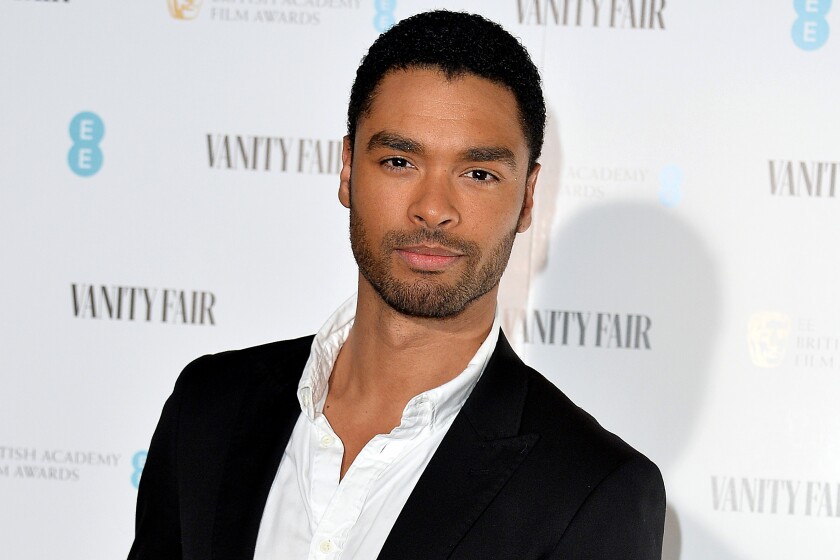
    Bridgerton” star Regé-Jean Page attends a 2020 Vanity Fair BAFTAs party in London. (Jeff Spicer / Getty Images)

    DC Entertainment reportedly passed on “Bridgerton” breakout Regé-Jean Page for a role in Syfy’sKrypton” after an executive allegedly argued that the series’ lead could not be portrayed by a Black actor.

    Before his star skyrocketed with the release of Shonda Rhimes’ hit period drama, Page auditioned to play Superman’s grandfather in the action program, according to The Hollywood Reporter. Despite the “Krypton” creators’ reported desire to diversify the DC Extended Universe, then-DC chief creative officer Geoffrey Johns allegedly said Superman’s grandfather could not be Black.

    In a statement paraphrased Tuesday by THR, a rep for Johns defended the casting decision on the grounds that the Hollywood exec “believed fans expected the character to look like a young Henry Cavill,” who is white and plays Superman in the DC films. The starring role in “Krypton,” which ran for two seasons from 2018 to 2019, eventually went to white actor Cameron Cuffe

    Read the entire article here.

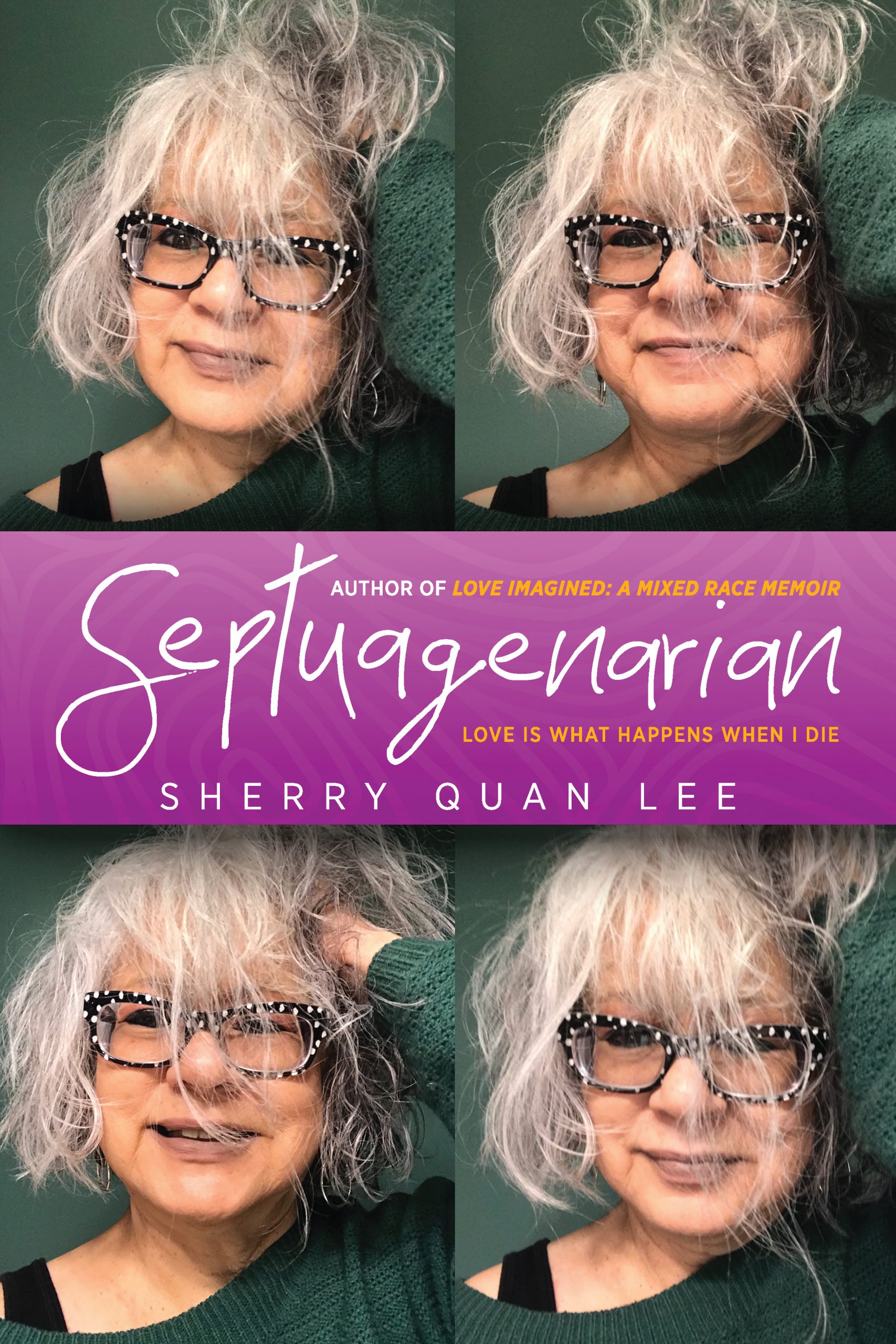
  • Septuagenarian: love is what happens when I die

    Modern History Press
    2021-03-01
    102 pages
    6 x 0.21 x 9 inches
    Paperback ISBN-13: 978-1615995684
    Hardcover ISBN-13: 978-1615995691

    Sherry Quan Lee

    Septuagenarian: love is what happens when I die is a memoir in poetic form. It is the author’s journey from being a mixed-race girl who passed for white to being a woman in her seventies who understands and accepts her complex intersectional identity; and no longer has to imagine love. It is a follow-up to the author’s previous memoir (prose), Love Imagined: a mixed-race memoir, A Minnesota Book Award finalist.

  • Love Imagined: A Mixed Race Memoir

    Modern History Press
    2014-08-15
    158 pages
    6.69 x 0.34 x 9.61 inches
    Paperback ISBN-13: 978-1615992331
    Hardcover ISBN-13: 978-1615992348

    Sherry Quan Lee

    Love Imagined is an American woman’s unique struggle for identity.

    Finalist – 27th annual Minnesota Book Awards (Memoir & Creative Nonfiction)

  • How one woman discovered her true cultural heritage

    BBC News
    2021-04-06

    What would you do if you discovered one of your parents wasn’t who they said they were?

    That’s what happened to Gail Lukasik who found out her mother had ‘passed’ as white to escape racial segregation in the US, in the early 20th Century.

    She was, in fact, mixed race but had kept it secret all her life and made Gail promise to keep the secret until after she died.

    Gail has turned her story into a book called White Like Her.

    Video produced by Trystan Young.

    Watch the video here.

  • Critical Mixed Race Studies Association – April Book Talk

    Critical Mixed Race Studies Association
    2021-04-08, 17:00Z (13:00 EDT)

    Don’t miss out on tomorrow’s CMRS Book Talk! We’re featuring Multiracial Experiences in Higher Education: Contesting Knowledge, Honoring Voice, and Innovating Practice, edited by Drs. Marc P. Johnston-Guerrero and Charmaine L. Wijeyesinghe, with a foreword by Dr. G. Reginald Daniel. Contributing authors, Drs. Charmaine L. Wijeyesinghe, Nick Davis, and our very own Naliyah Kaya, will present. Join live and be part of the Q&A!

    To register, click here.

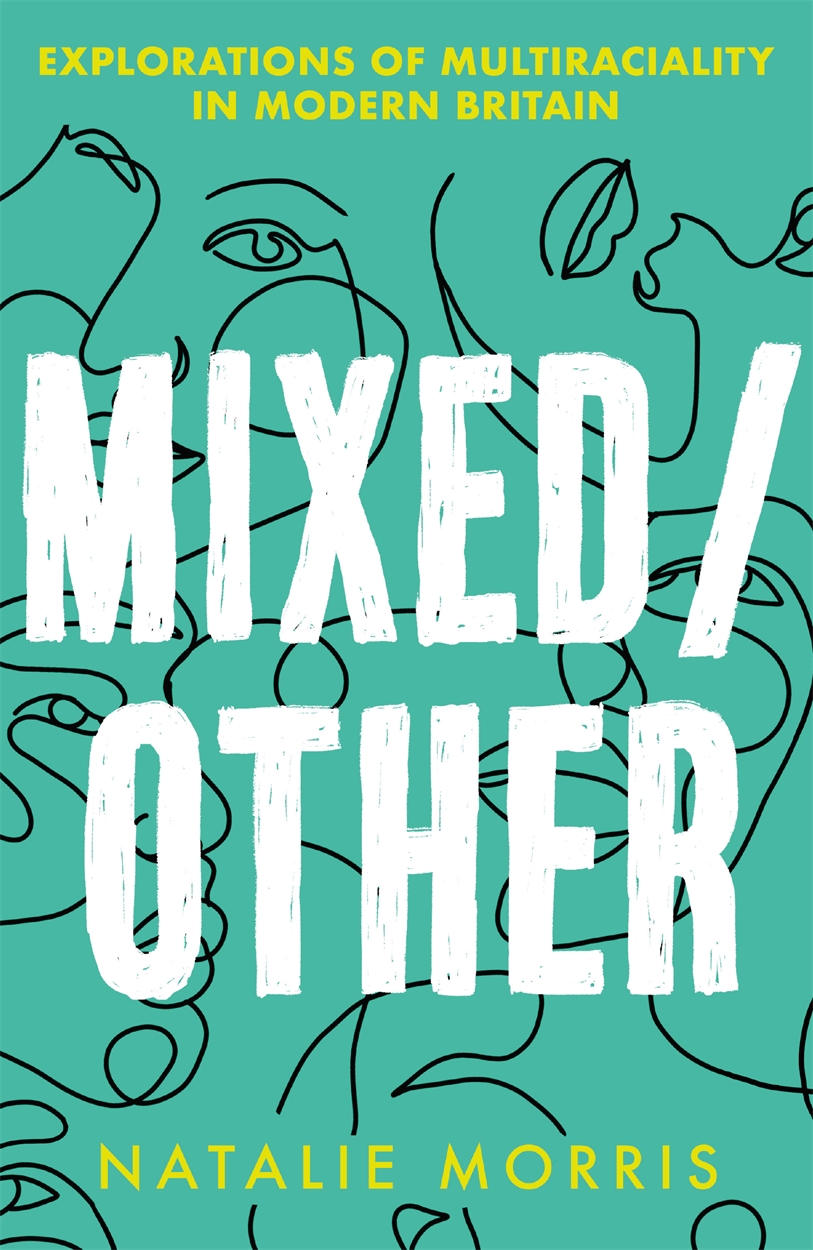
  • Mixed/Other: Explorations of Multiraciality in Modern Britain

    Trapeze
    2021-04-15
    240 pages
    eBook ISBN-13: 978140919716
    Hardcover ISBN-13: 9781409197140
    Audiobook ISBN-13: 9781409197225

    Natalie Morris

    An exploration of what it means to be mixed race in the UK today.

    • How does it feel when your heritage isn’t listed as an option on an identification form?
    • What is it like to grow up as the only person in your family who looks like you?
    • Where do you belong if you are simultaneously seen as being ‘too much’ of one race and ‘not enough’ of another to fit neatly into society’s expectations?

    The mixed population is the fastest-growing group in the U.K. today, but the mainstream conversation around mixedness is stilted, repetitive and often problematic. At a time when ethnically ambiguous models fill our Instagram feeds and our high street shop windows, and when children of interracial relationships are lauded as heralding in the dawn of a post-racial utopia, journalist Natalie Morris takes a deep dive into what it really means to be mixed in Britain today.

    From blackfishing to the fetishisation of mixed babies; from the complexities of passing and code-switching to navigating the world of work and dating, Natalie explores the ways in which all of these issues uniquely impact those of mixed heritage. Drawing from a wealth of research, interviews and her own personal experiences, in Mixed/Other, Natalie’s aims to dismantle the stereotypes that have plagued mixed people for generations and to amplify the voices of mixed Britons today, shining a light on the struggles and the joys that come with being mixed.

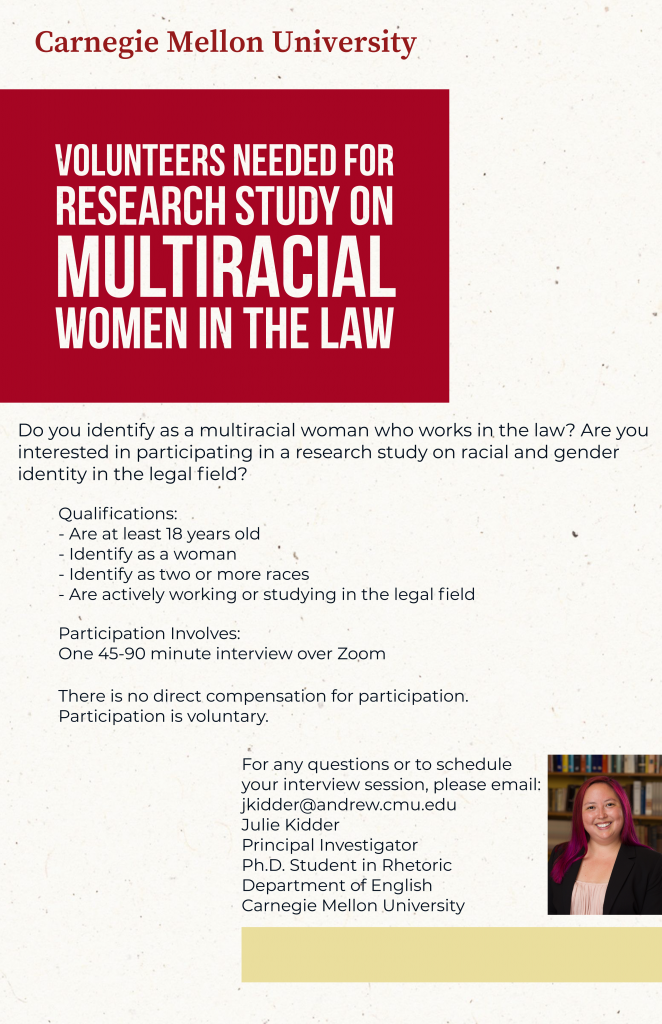
  • Volunteers Needed for Research Study on Multiracial Women and the Law

    Carnegie Mellon University
    2021-03-30

    Julie Mi-Yeong Kidder, Doctoral Student, Instructor of First Year Writing
    Rhetoric Program, Department of English
    Carnegie Mellon University, Pittsburgh, Pennsylvania

    Do you identify as a multiracial woman who works in the law? Are you interested in participating in a research study on racial and gender identity in the legal field?

    Qualifications:

    1. Are at least 18 years old
    2. Identify as a woman
    3. Identify as two or more races
    4. Are actively working or studying in the legal field
    1. Participation Involves One 45-90 minute interview over Zoom
    2. There is no direct compensation for participation.
    3. Participation is voluntary.

    For any questions or to schedule your interview session, please email Julie Kidder, Principal Investigator.

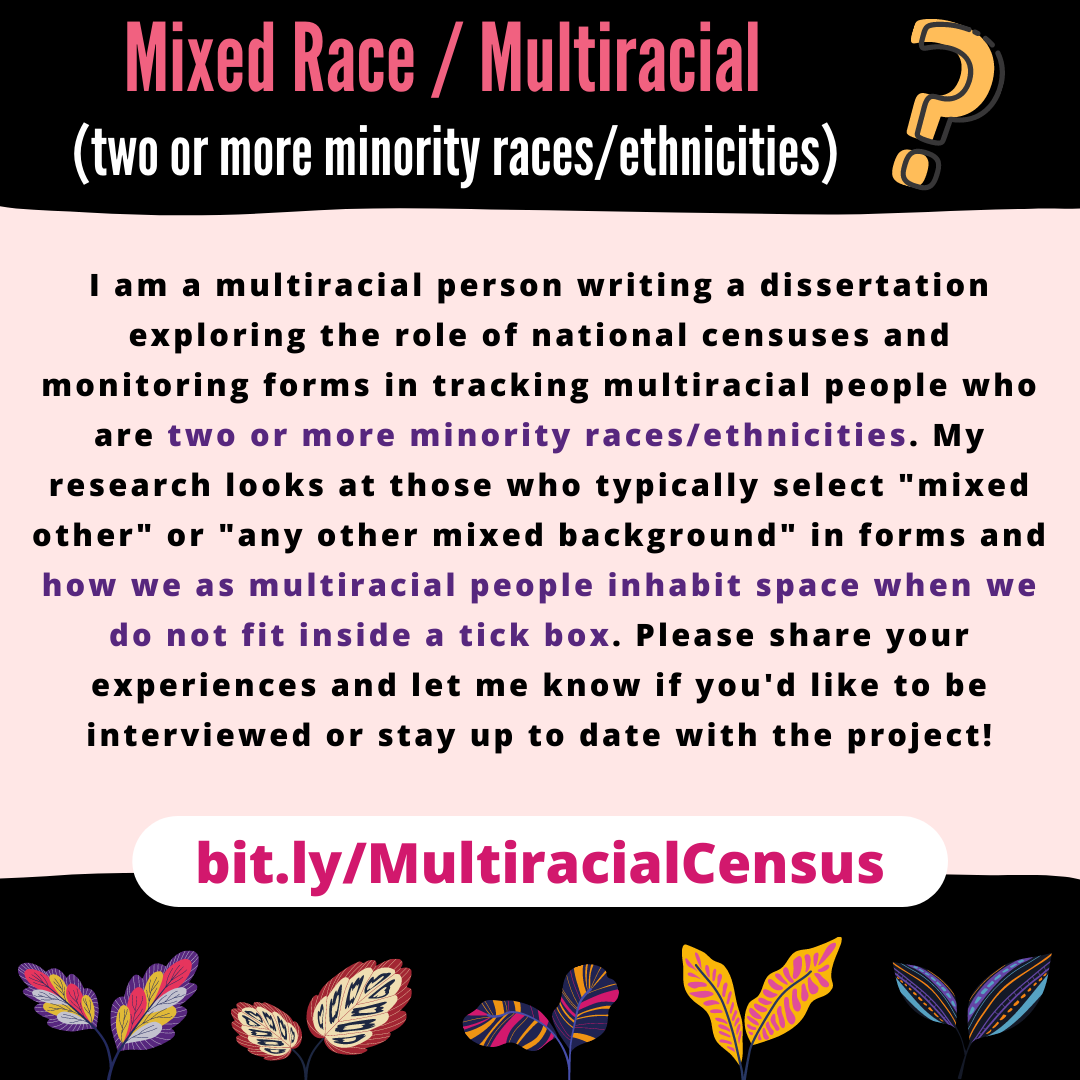
  • How do multiracial people inhabit space when we don’t tick a box?

    2021-03-22

    Syriah Bailey

    I am a multiracial person writing a dissertation exploring the role of national censuses and monitoring forms in tracking multiracial people who are two or more minority races/ethnicities.

    My research looks at those who typically select “mixed other” or “any other mixed background” in forms and how we as multiracial people inhabit space when we do not fit inside a tick box.

    The first component of the research is a survey open to people of all ages, genders and locations here.