• My Life in the Sunshine: Searching for My Father and Discovering My Family

    Viking (an imprint of Penguin Random House)
    2022-06-07
    320 Pages
    5-1/2 x 8-1/4
    Hardcover ISBN: 9780593295960

    Nabil Ayers
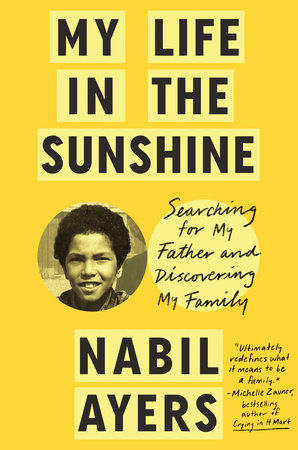
    A memoir about one man’s journey to connect with his musician father, ultimately redefining what family really means

    Throughout his adult life, whether he was opening a Seattle record store in the ’90s or touring the world as the only non-white band member in alternative rock bands, Nabil Ayers felt the shadow and legacy of his father’s musical genius, and his race, everywhere.

    In 1971, a white, Jewish, former ballerina, chose to have a child with the famous Black jazz musician Roy Ayers, fully expecting and agreeing that he would not be involved in the child’s life. In this highly original memoir, their son, Nabil Ayers, recounts a life spent living with the aftermath of that decision, and his journey to build an identity of his own despite and in spite of his father’s absence.

    Growing up, Nabil only meets his father a handful of times. But Roy’s influence is strong, showing itself in Nabil’s instinctual love of music, and later, in the music industry—Nabil’s chosen career path. By turns hopeful–wanting to connect with the man who passed down his genetic predisposition for musical talent—and frustrated with Roy’s continued emotional distance, Nabil struggles with how much DNA can define a family… and a person.

    Unable to fully connect with Roy, Nabil ultimately discovers the existence of several half-siblings as well as a paternal ancestor who was enslaved. Following these connections, Nabil meets and befriends the descendant of the plantation owner, which, strangely, paves the way for him to make meaningful connections with extended family he never knew existed.

    Despite his father’s absence, Nabil, through sheer will and a drive to understand his roots, redefines what family truly is.

  • The Meaning of Multiraciality: A Racially Queer Exploration of Multiracial College Students’ Identity Production

    Lexington Books (an imprint of Rowman & Littlefield)
    June 2022
    168 pages
    Trim: 6 x 9
    Hardback ISBN: 978-1-7936-1727-9
    eBook ISBN: 978-1-7936-1728-6

    Aurora Chang, Director of Faculty Development and Career Advancement
    George Mason University, Fairfax, Virginia

    The Meaning of Multiraciality: A Racially Queer Exploration of Multiracial College Students’ Identity Production provides a comprehensive overview of Multiraciality as a term, experience, and identity using data from a study of Multiracial college students and well as the author’s own experiences as a Multiracial person. Utilizing a racially queer framework, they discuss what it means to be a Multiracial insider (being a Multiracial researcher studying Multiracial study participants), the counter-stories of Multiracial college students, the theorizing that has emerged as a result, and the educational consequences and impacts on Mulitracial students overall. The author explores the following questions: How do Multiracial students produce their identities? How do Multiracial students exercise their agency? How does the notion of Multiraciality perpetuate and disrupt notions of race? How can we expand theoretical understandings of race so that they take Multiracial people into account, specifically within educational settings? The author illustrates the agentic ways in which Multiracial college students come to understand and experience the complexity of their racialized identity production. Their counter-narratives reveal an otherwise invisible student population, providing an opportunity to broaden critical discourses around education and race.

    Table of Contents

    • Acknowledgments
    • Introduction
    • Chapter One: Multiracial Me
    • Chapter Two: The History and Complexity of the Term, Multiracial
    • Chapter Three: Multiraciality and Critical Race Theory
    • Chapter Four: Multiracial College Students’ Counter-Narratives
    • Chapter Five: Multiracial Students and Educational Implications
    • Chapter Six: Racial Queerness
    • Epilogue
    • References
    • About the Author
  • Multiracial Heritage Week: June 7-14, 2022

    United States Census Bureau
    2022-06-07
    Release Number CB22-SFS.85

    From the Congressional Record, 117th Congress, HON. JIM COSTA OF CALIFORNIA, June 7, 2021. HONORING MULTIRACIAL HERITAGE WEEK, “Multiracial Heritage Week is an opportunity to celebrate the contributions and achievements of the multiracial community. Multiracial individuals are not only parts of other populations, but they are also a growing population in and of itself.”

    From Census.gov > Topics > Population > Race > About Race

    What is Race?

    The data on race were derived from answers to the question on race that was asked of individuals in the United States. The Census Bureau collects racial data in accordance with guidelines provided by the U.S. Office of Management and Budget (OMB), and these data are based on self-identification.

    The racial categories included in the census questionnaire generally reflect a social definition of race recognized in this country and not an attempt to define race biologically, anthropologically, or genetically. In addition, it is recognized that the categories of the race item include racial and national origin or sociocultural groups. People may choose to report more than one race to indicate their racial mixture, such as “American Indian” and “White.” People who identify their origin as Hispanic, Latino, or Spanish may be of any race.

    OMB requires five minimum categories: White, Black or African American, American Indian or Alaska Native, Asian, and Native Hawaiian or Other Pacific Islander…

    Read the entire release here.

  • The Importance of Being Turbaned

    The Antioch Review
    Volume 69, Number 2, Spring 2011
    pages 208-221

    Paul A. Kramer, Associate Professor of History
    Vanderbilt University, Nashville, Tennessee

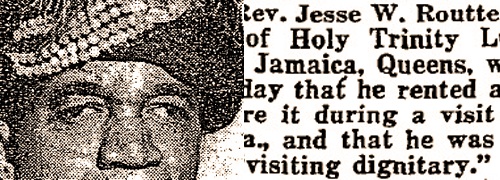
    This narrative piece, selected by The Best American Essays 2012 as a “notable essay,” tells the story of Rev. Jesse Routté, an African American Lutheran minister in New York who, in response to racist abuse during a 1943 trip to Mobile, Alabama, returned four years later disguised as a turbaned, Swedish-accented “foreigner.” When he reported positive treatment, it flaunted contradictions in Jim Crow’s racial definitions.

    Read the entire article here.

  • A Fable of Agency

    The New York Review of Books
    2022-05-26

    Brenda Wineapple

    Special Collections, University of Virginia Library

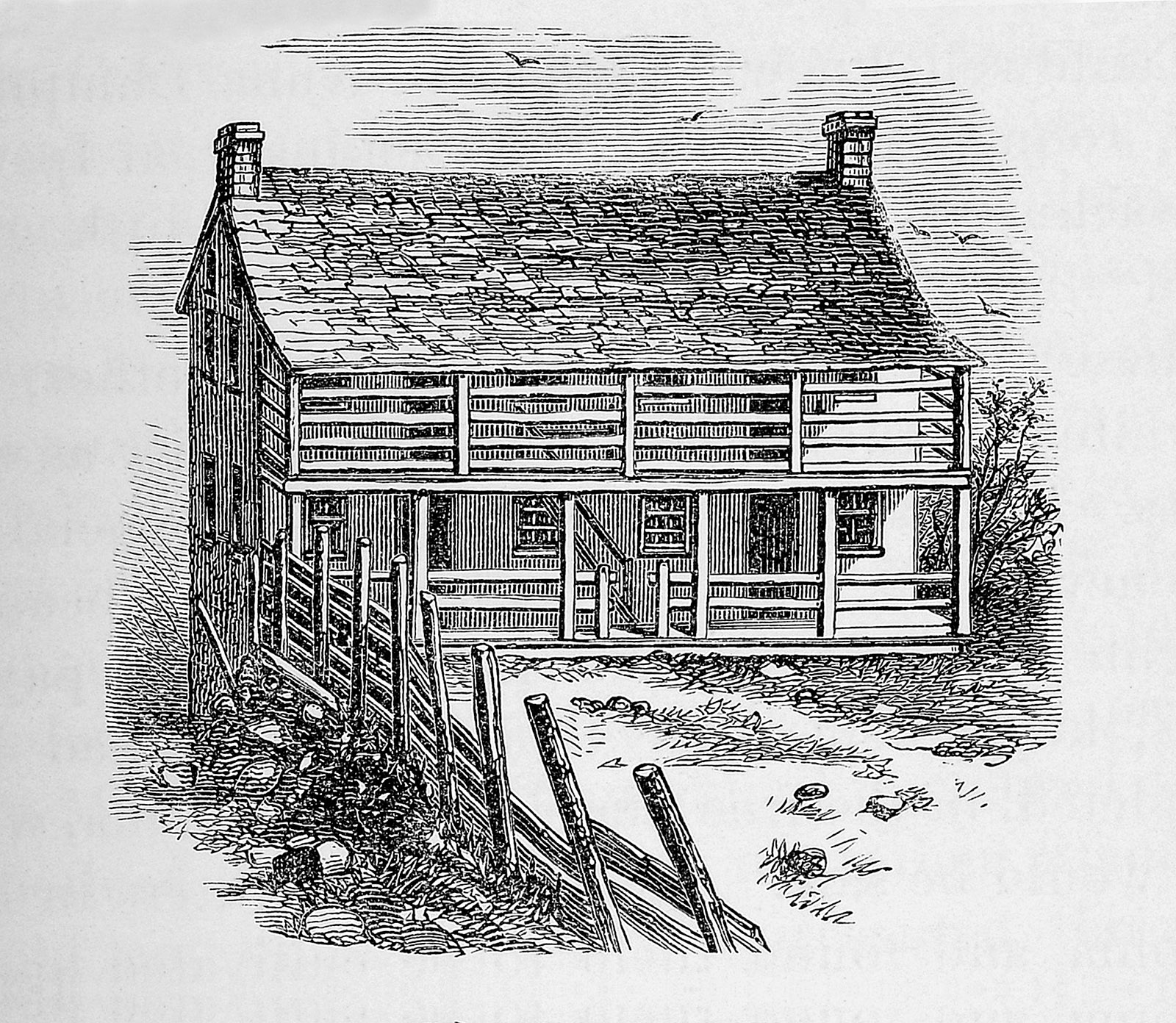
    Lumpkin’s Jail; engraving from A History of the Richmond Theological Seminary, 1895

    The Devil’s Half Acre: The Untold Story of How One Woman Liberated the South’s Most Notorious Slave Jail by Kristen Green. Seal, 332 pp., $30.00

    Kristen Green’s The Devil’s Half Acre recounts the story of a fugitive slave jail, and the enslaved woman, Mary Lumpkin, who came to own it.

    In The Allure of the Archives (1989), a gem of a book, the French historian Arlette Farge talks about unearthing, insofar as it’s possible, a past that’s not quite past—particularly in relation to the lives of women, whose histories have often been hidden, forgotten, or written over, women spoken about but whom we seldom hear speaking. Combing through the judicial archives at the Préfecture of Paris, Farge reads the sullen or angry answers that ordinary eighteenth-century Parisian women, some of the city’s poorest and most vulnerable, give to the police who have arrested them. And she knows that to understand what they say, or don’t say, we need to care and not to care: to distance ourselves with empathy while we set aside expectations and assumptions. Deciphering what’s left in the archives, Farge writes, “entails a roaming voyage through the words of others, and a search for a language that can rescue their relevance.”

    Piecing together stories about women who managed the uncertainties and privations of their situations is even more difficult when the women in question have been enslaved and thus forbidden even the basic rights that an eighteenth-century Parisian laundress enjoyed. That is Kristen Green’s task in her impassioned The Devil’s Half Acre, which she calls “the untold story of how one woman liberated the South’s most notorious slave jail.”

    Green is a journalist and also the author of Something Must Be Done About Prince Edward County (2015), a personal account of how that Virginia county defied Brown v. Board of Education and shut down its schools for almost five years rather than integrate them. In The Devil’s Half Acre, she recovers the life of Mary Lumpkin, an enslaved woman of mixed race born in 1832 who, likely by 1840, was held in bondage at Lumpkin’s Jail, a chamber of horrors located between Franklin and Broad Streets in Shockoe Bottom, the central slave-trading quarter in Richmond, Virginia

    Read the entire review here.

  • For some people, identifying themselves as more than one race matters little if Americans tend to put people in either the “Black” or “White” categories. Former President Barack Obama, who has a White mother though he identifies as Black, has described being mistaken for a waiter or parking valet before he was famous.

    “I am a White woman who married a Black man and had a Black baby,” said Amanda Lewis, a sociologist who runs the Institute for Research on Race and Public Policy at the University of Illinois at Chicago.

    “That’s the way others see her. That’s the way we think of her,” Lewis said of her daughter. “The opposite doesn’t happen. Instead of trying to make White people more comfortable, we need to embrace the multiracial democracy we’ve become.”

    Tim Henderson, “Multiracial Residents Are Changing the Face of the US,” Stateline, May 13, 2022. https://www.pewtrusts.org/en/research-and-analysis/blogs/stateline/2022/05/13/multiracial-residents-are-changing-the-face-of-the-us.

  • Interracial couple representation in pop culture isn’t as progressive as we think

    Andscape
    2021-05-21

    Rebecca Theodore-Vachon

    Chuck Anderson

    The optics, while a sign of change, don’t point to any change in the status quo

    In June 2013, Cheerios aired its usual family-friendly commercial where a cherub-faced little girl approaches her mother in the kitchen and asks, “Dad says Cheerios is good for your heart. Is that true?” What should have been a heartwarming ad about an everyday American family quickly attracted a firestorm of controversy. Why? This commercial depicted an interracial family consisting of a Black father, white mother and a mixed-race child.

    Over the last five years, these portrayals of interracial relationships are so common that they often go unmarked. Yet, even though there is more diversity of different kinds of pairings – multiethnic, non-monogamous, queer – the optics are just one part of the story. Are depictions of interracial unions and by extension, mixed-race and biracial children, a sign of racial progress?

    The answer isn’t as clear-cut as one might think. Hollywood has been wrestling with how to best reflect the representation and nuances of Black-white interracial unions with varying results. The critiques and conversations surrounding Black-white interracial relationships have evolved beyond just the visual representation to how filmmakers and TV showrunners choose to depict these unions. Are interracial couples rather than strictly monoracial, Black ones being presented because they’re more palatable to mainstream audiences? Do biracial, particularly light-skinned children, reinforce colorism? These are some of the concerns as the proliferation of interracial couplings continues to spread across media…

    Read the entire article here.

  • The Privilege of Racial Identity

    The Spectator: The University of Wisconsin-Eau-Claire’s Student Newspaper Since 1923
    2022-04-28

    Kiara Jackson

    I can’t, nor will I ever speak for all mixed-race people, because every story is different. Every story has its own challenges. But, I can try to speak for myself.

    Mixed people do not owe anyone an explanation for their Blackness.

    No one gets to decide their race. But most people get the privilege to say “I’m Black,” or “I’m Native Hawaiian.” They get the privilege of knowing exactly where they come from, exactly what to tell people when asked and exactly what bubble to fill in on standardized tests.

    They get the privilege of racial identity.

    Being mixed, you don’t get this same privilege. I can’t, nor will I ever speak for all mixed-race people, because every story is different. Every story has its own challenges. But, I can try to speak for myself…

    Read the entire article here.

  • Why Not Pass?

    Yes!
    2022-05-18

    Gila K. Berryman

    Illustration by Fran Murphy/YES! Media

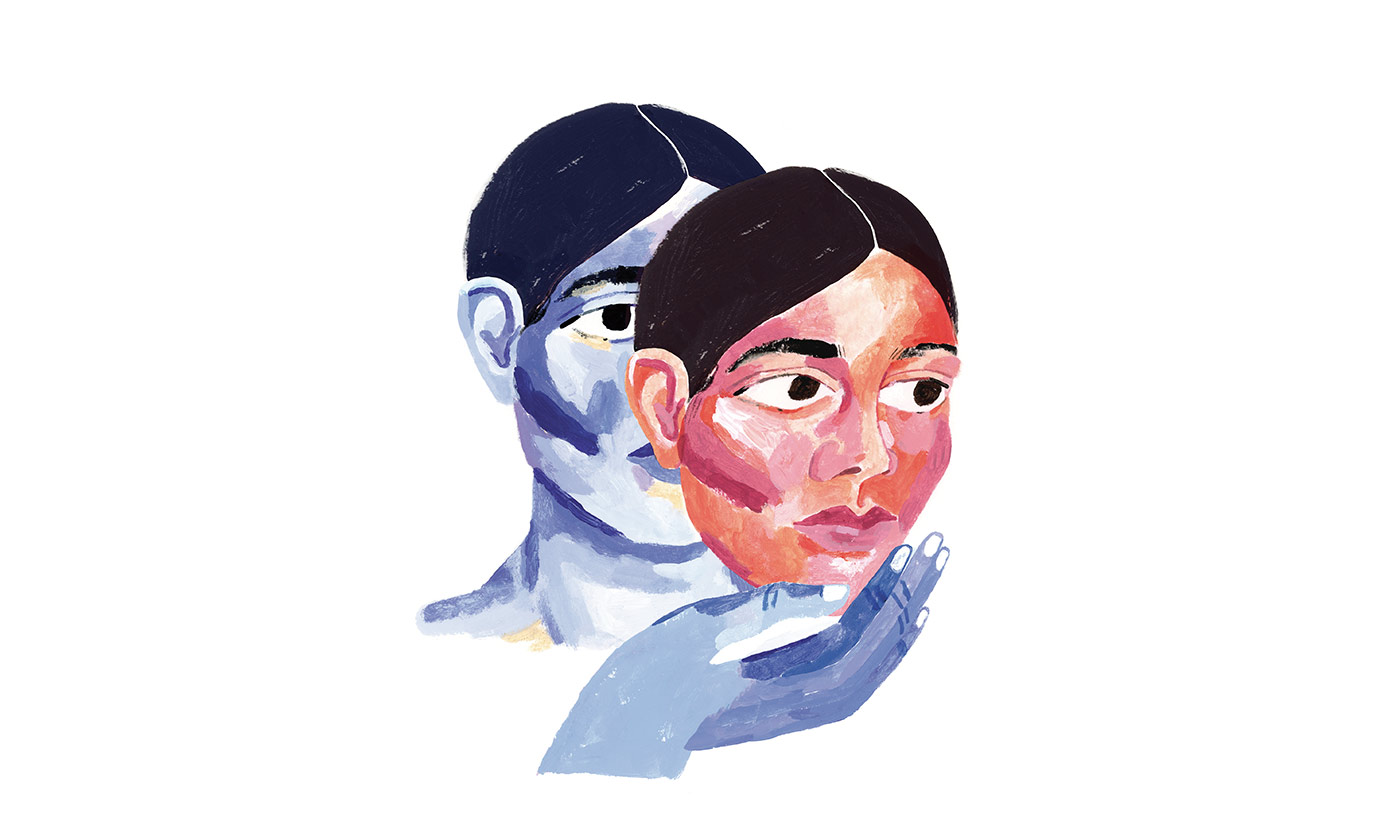
    The Vanishing Half” deals with the theme of racial “passing” in the 1950s. Passing is different today, but still presents a choice between safety and authenticity

    The Vanishing Half by Brit Bennett was one of the most popular novels of the last few years—a bestseller on multiple “best book” lists. The story begins in 1954, when identical twins Stella and Desiree, aged 16, run away from home and their Southern town of light-skinned Black folks. In a year, the twins will go their separate ways, “their lives splitting as evenly as their shared egg,” when Stella crosses over to pass as White—she disappears, marries her White employer, and doesn’t look back.

    American Whiteness exacts a high price in exchange for its safety and privilege. In order to pass, Stella severs every connection to her previous life so she can hide her true identity, even from her husband. As a result, she can never completely let her guard down around White people, and she refuses to have anything to do with Black people for fear that they might recognize some vestige of her Blackness…

    Read the entire article here.

  • Multiracial Residents Are Changing the Face of the US

    Stateline
    Pew Charitable Trusts
    2022-05-13

    Tim Henderson, Staff Writer

    A woman in Yellow Springs, Ohio, shows a portrait of her multiracial family. The number of people identifying as more than one race nearly doubled between 2010 and 2020 as stigmas fade and more people learn about multiracial backgrounds.

    John Minchillo / The Associated Press

    The number of Americans who identified as more than one race nearly doubled to 13.5 million people between 2010 and 2020, and did double or more in 34 states and the District of Columbia, a Stateline analysis of census figures shows.

    To some observers, the increase in the number of Americans identifying as more than one race shows that barriers are breaking down. But the increase also may reflect changes to census questions designed to tease out the heritage of multiracial people.

    The increases contributed to a first-ever decline in the population identifying solely as non-Hispanic White. The number of people identifying as White who also identified as Hispanic or another race did grow, however.

    “It’s not unreasonable to imagine that if people keep intermarrying, if they define themselves as White and they are accepted as White, the definition of White in 2052 could be much different than it is in 2022,” said Ellis Monk, an associate sociology professor at Harvard University who has studied the way official racial categories can be misleading.

    But Monk emphasized that he and other people with dark skin or other distinctive racial features continue to face discrimination and reduced opportunities, even if they identify as more than one race. Monk is Black, and like most African Americans he has White forebears, but he doesn’t consider himself to be biracial…

    Read the entire article here.