Mixed Race Studies

Scholarly perspectives on the mixed race experience.

    • About This Site
    • Bibliography
    • Contact Information
    • Date and Time Formats
    • Forthcoming… (Updated 2021-09-01)
    • Likely Asked Questions
    • List of Book Publishers
    • List of Definitions and Terms
    • My Favorite Articles and Papers
    • My Favorite Posts
    • My Recent Activities
    • Praise for Mixed Race Studies
    • Tag Listing
      • Tag Listing (Ordered by Count)
    • US Census Race Categories, 1790-2010
    • 1661: The First ‘Mixed-Race’ Milestone
    • 2010 U.S. Census – Some Thoughts

recent posts

  • The Routledge International Handbook of Interracial and Intercultural Relationships and Mental Health
  • Loving Across Racial and Cultural Boundaries: Interracial and Intercultural Relationships and Mental Health Conference
  • Call for Proposals: 2026 Critical Mixed Race Studies Conference at UCLA
  • Participants Needed for a Paid Research Study: Up to $100
  • You were either Black or white. To claim whiteness as a mixed child was to deny and hide Blackness. Our families understood that the world we were growing into would seek to denigrate this part of us and we would need a community that was made up, always and already, of all shades of Blackness.

about

  • Twitter
  • Facebook
  • Instagram
  • William flips her onto her stomach, and then he’s inside her breathing hotly into her ear, telling her that fucking her is just like fucking a black girl without having to fuck a black girl.

    2017-01-17

    William kneels between Sarah’s thighs. He uses a condom. He doesn’t know where the stripper has been. He practices some of the lingo he has learned from years of listening to rap music. “I’ve wanted to get all up in that since the day I first saw you, Sierra. I love your phat ass.” Sarah moans and heaves, reaches for her cell phone on the coffee table. It is just beyond her reach. William flips her onto her stomach, and then he’s inside her breathing hotly into her ear, telling her that fucking her is just like fucking a black girl without having to fuck a black girl. He smacks her thigh and tells her to do as Lil Jon instructs and bounce, bounce, bounce that ass.

    Roxane Gay, “La Negra Blanca,” The Collagist: Online literature from Dzanc Books, Issue Three (October 2009). http://thecollagist.com/the-collagist/la-negra-blanca.html.

  • For African Americans, Obama’s presidency had been largely defined by his reluctance to engage with the ways that racial discrimination was blunting the impact of his administration’s recovery efforts.

    2017-01-17

    For African Americans, Obama’s presidency had been largely defined by his reluctance to engage with the ways that racial discrimination was blunting the impact of his administration’s recovery efforts. Obama has not shown nearly the same reticence when publicly chastising African Americans for a range of behaviors that read like a handbook on anti-black stereotypes, from parenting skills and dietary choices to sexual mores and television-watching habits.

    Keeanga-Yamahtta Taylor, ”Barack Obama’s original sin: America’s post-racial illusion,” The Guardian, January 13, 2017. https://www.theguardian.com/us-news/2017/jan/13/barack-obama-legacy-racism-criminal-justice-system.

  • As I see it, Mr. Obama is the only figure to ever give Dr. King a run for his money as Greatest Black Man in American history.

    2017-01-17

    President Obama’s historic tenure ends as the nation celebrates what would have been Martin Luther King’s 88th birthday. As I see it, Mr. Obama is the only figure to ever give Dr. King a run for his money as Greatest Black Man in American history. More than a gentle rivalry for supremacy in the history books joins the two. They are tethered by death, too — if not by its actual occurrence, then by its looming possibility.

    Michael Eric Dyson, “How Black America Saw Obama,” The New York Times, January 14, 2017. https://www.nytimes.com/2017/01/14/opinion/sunday/how-black-america-saw-obama.html.

  • Writing the biography of a black person who passed for white in 20th-century America adds an extra layer of difficulty to the detective work any biographer must undertake. This is especially true since Herriman seems never to have addressed his deception in his personal writings or confided his feelings about racial identity to family or friends.

    2017-01-17

    Writing the biography of a black person who passed for white in 20th-century America adds an extra layer of difficulty to the detective work any biographer must undertake. This is especially true since [George] Herriman seems never to have addressed his deception in his personal writings or confided his feelings about racial identity to family or friends. He claimed he came from a family of bakers and had worked in his youth as a house painter and carnival barker. In truth he was the great-grandson of Stephen Herriman, a married white boat’s captain from Long Island with roots in England, who purchased enslaved workers after settling in Louisiana, and Justine Olivier, a “free woman of color” who engaged in a plaçage relationship in which her lover financially supported her and her two children.

    Nelson George, “Invisibly Black: A Life of George Herriman, Creator of ‘Krazy Kat’,” The New York Times, January 12, 2017. https://www.nytimes.com/2017/01/12/books/review/krazy-george-herriman-biography-michael-tisserand.html.

  • Definition of race can vary from country to country, and the use of the ‘one drop rule’ – as defined in law – is particular only to the USA. Similarly in the UK, as with the USA, despite a significant proportion of individuals self-defining as Mixed Race whilst partaking in respective census measures, the media in each country has continued to define ‘people of colour’ as black.

    2017-01-17

    The definition of race has come under scrutiny by a number of researchers (Case, 2012; Soudien, 2010; Rose & Paisley, 2012). This can include the arguments surrounding the ‘one drop rule.’ This has its origin in the racial segregation laws in the USA that defines the extent to which any person can be considered African-American relates to their having just one African-American ancestor. ‘A black is any person with any known African black ancestry’ (Davis, 2001, p.5). A difficulty with this definition is the fact that race can also be affected in both directions. As Davis (2001, p.6) points out, ‘many of the nation’s black leaders have been of predominantly white ancestry.’ Definition of race can vary from country to country, and the use of the ‘one drop rule’ – as defined in law – is particular only to the USA. Similarly in the UK, as with the USA, despite a significant proportion of individuals self-defining as Mixed Race whilst partaking in respective census measures, the media in each country has continued to define ‘people of colour’ as black. Miscegenation promotes assimilation with all other racial groups, but for African-Americans it disadvantages the white element; for other racial groups it advantages the non-white element (Soudien, 2010). This varied definition of race can thus undermine the fuller understanding of the intersectionality between race: in the USA, not even all non-white groups are discriminated against equally. This renders patterns of discrimination more complex and multilayered than might otherwise be considered.

    J. J. Lindsley, “Peggy McIntosh (1997: 291) describes White privilege as ‘an invisible package of unearned assets’. A discussion on the relative advantages and disadvantages of this analogy in advancing our understanding of Whiteness,” Medium, January 8, 2017. https://medium.com/@JohnJLindsley/peggy-mcintosh-1997-291-describes-white-privilege-as-an-invisible-package-of-unearned-assets-732c671f5fb5.

  • Invisibly Black: A Life of George Herriman, Creator of ‘Krazy Kat’

    2017-01-16

    Invisibly Black: A Life of George Herriman, Creator of ‘Krazy Kat’

    The New York Times
    2017-01-12

    Nelson George

    KRAZY: George Herriman, a Life in Black and White
    By Michael Tisserand
    Illustrated. 545 pp. Harper/HarperCollins Publishers. $35.

    In our superficially more enlightened age, the phrase “mixed race” has become the accepted term to describe people with parents of different races. In fact the phrase has become a tool of marketers and brand-conscious celebrities to suggest whatever they’re selling is all-inclusive, a living embodiment of diversity. Many take great care in, for example, their Instagram biographies to list their hyphenated backgrounds.

    But there are limits to the term’s utility, especially for people with African ancestry. Barack Obama was America’s first mixed-race president. His father was Kenyan and his mother a white woman from Kansas. Yet the tawdry racial history of this Republic demanded that he claim blackness as his primary identity because one drop of black blood has always decided your fate in this country. “Mixed race” notwithstanding, an African heritage in America is never just a cool exotic spice; one taste and it becomes all anyone remembers of the meal.

    This rigid attitude toward race is often enforced by black Americans as fiercely as whites. For them the “mixed race” label, when employed by black people with a nonblack parent or grandparents, seems more a transparent attempt to dodge racial pigeonholing than a heartfelt assertion of identity. Jim Crow, which ended officially in the 1960s, has never been completely dismantled. So attempts to escape its grip, while understandable, create resentment in those unable to slip across the racial boundaries.

    All of which makes Michael Tisserand’s “Krazy: George Herriman, a Life in Black and White” a fascinating and frustrating biography. Though Herriman’s “Krazy Kat” comic strip was admired in his lifetime, it wasn’t until years after his death in 1944 that his vast influence received widespread critical respect. Herriman’s depiction of the tangled relationships among the black cat Krazy, his white mouse tormentor and sometime love interest Ignatz and the bulldog Officer Pupp, set against a desert backdrop in fictional Coconino County (taken from a real area of Arizona), inspired several generations of cartoonists. Charles M. Schulz’s “Peanuts,” Ralph Bakshi’s “Fritz the Cat” and Art Spiegelman’s “Maus” all owe a debt to Herriman’s draftsmanship and poetic sense…

    Read the entire review here.

  • Interview with Scenters-Zapico

    2017-01-16

    Interview with Scenters-Zapico

    As Us
    Issue 2 (December 2015)

    Casandra Lopez, Co-Founder, Editor-in-Chief

    “As a poet, I’m interested in what art can be created from the anxieties of being from such a place. What can we create from these experiences? I’m a poet, not a rhetorician—it’s not my place to tell you as a reader how best to interpret the world. I want to write about the things that keep me longing and the things that keep me up at night.”

    [Casandra Lopez]1. Having read some of your work in workshop I was delighted to read your full manuscript. Can you describe what your manuscript is about. I am particularly interested in hearing about the “twin” element that is prevalent in many of your poems and how place functions in your work.

    [Natalie Scenters-Zapico] On a literal level this manuscript is about where I am from, the sister cities of El Paso, Texas and Ciudad Juárez, México. It stems from a place of longing for where I am from, both what it is and what it used to be. They are poems about immigration, language, pollution, brutality against women and men, war, love, marriage, weddings, and the hybrid sense of these things that exists in these two cities. The metaphor of the cities being twins runs throughout the manuscript. El Paso and Cd. Juárez were one city, El Paso del Norte, that was then divided by the river into the U.S. and México leaving them forever in a state of longing for each other. In the manuscript, this longing manifests itself in a variety of ways and I became interested in how twins can feel a connection that is beyond that of regular siblings. I also liked that I could write about a relationship between a set of twins and only hint that they might be cities….

    [CL]2. Can you talk a little about how you identify both as a poet and as an individual. How or in what ways to do think these identities influence your writing and topics you choose to explore in your work.

    [NSZ] This is a very interesting question for me, mainly because I have such a hybrid identity and experience. My father is Anglo, from Wisconsin, and my mother is from Asturias, Spain. My mother came to the U.S. in her twenties after falling in love with my father. I grew up in a fully bi-lingual household, in a bi-lingual city, El Paso, Texas, and went to a high school at a time when over half of my graduating class was from Cd. Juárez and crossed the bridge every day for school. I also married a Mexican man, who was educated in México and the U.S. and is also bilingual. I grew up surrounded by hybridity and a variety of experience. I grew up where multiplicity was never seen as a positive or negative thing, only a fact of existence on the border. I think that all of these things affect how I identify as an individual and then what my concerns are as a poet…

    Read the entire interview here.
  • I think it’s important to recognize that to be Latinx is to be hybrid. There is no such thing as purity in Latinidad…

    2017-01-16

    “I think it’s important to recognize that to be Latinx is to be hybrid. There is no such thing as purity in Latinidad, if you even buy into this very American idea of Latinidad.” —Natalie Scenters-Zapico

    Sebastian Hasani Paramo, “A Conversation With Natalie Scenters-Zapico,” The American Literary Review, March 27, 2016. http://www.americanliteraryreview.com/reviews–interviews/a-conversation-with-natalie-scenters-zapico.

  • Chan, poetry by Hannah Lowe

    2017-01-16

    Chan, poetry by Hannah Lowe

    The Asian Review of Books
    2017-01-08

    Theophilus Kwek

    From the gangplank of a pre-war steamship to the present, via the jazz underground of 1960s London, Hannah Lowe’s rewarding second collection revels in the company of an unlikely crew of voices and personalities. Chan takes its name from the poet’s father (nicknamed, in turn, after the Polish card magician Chan Canasta) but does not shy away from the older resonances of the word, tracing these back into her Hakka heritage and the journeys of a global diaspora. Along the way, the poems investigate lives that intersect with Lowe’s personal history, no matter how brief the acquaintance: from the magnetic jazz saxophonist Joe Harriott, her father’s first cousin, to the travellers and stowaways who join Gilbert Lowe on the SS Ormonde in 1947 as it sails from Kingston to Liverpool…

    Read the entire review here.

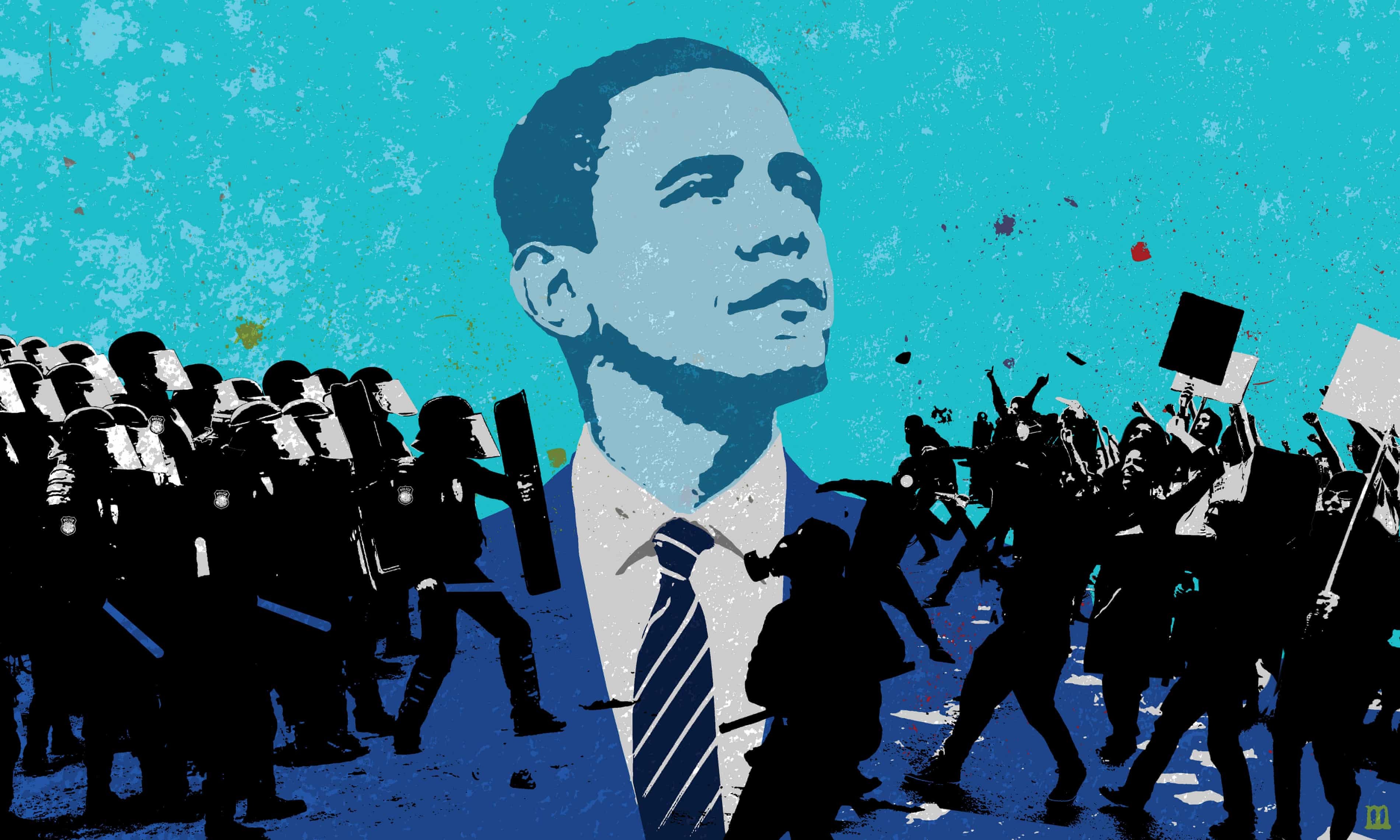
  • Barack Obama’s original sin: America’s post-racial illusion

    2017-01-16

    Barack Obama’s original sin: America’s post-racial illusion

    The Guardian
    2017-01-13

    Keeanga-Yamahtta Taylor, Assistant Professor of African American Studies
    Princeton University


    Illustration by Joe Magee

    Barack Obama’s refusal to use his position as president to intervene on behalf of African Americans is a stain on his record many activists will never forget

    In the first hours of the new year in 2009, just weeks before Barack Obama was to be inaugurated as the next president, shots rang out in Oakland, California. A transit officer named Johannes Mehserle shot an unarmed 22-year-old black man who lay face-down in handcuffs on a public transportation platform. His name was Oscar Grant…

    Read the entire article here.

Previous Page
1 … 322 323 324 325 326 … 1,428
Next Page

Designed with WordPress