Skip to content

Mixed Race Studies

Scholarly perspectives on the mixed race experience.

    • About This Site
    • Bibliography
    • Contact Information
    • Date and Time Formats
    • Forthcoming… (Updated 2021-09-01)
    • Likely Asked Questions
    • List of Book Publishers
    • List of Definitions and Terms
    • My Favorite Articles and Papers
    • My Favorite Posts
    • My Recent Activities
    • Praise for Mixed Race Studies
    • Tag Listing
      • Tag Listing (Ordered by Count)
    • US Census Race Categories, 1790-2010
    • 1661: The First ‘Mixed-Race’ Milestone
    • 2010 U.S. Census – Some Thoughts

recent posts

  • Mixed Roots: Writers on Multiracial Identity and Both/And Belonging
  • The Routledge International Handbook of Interracial and Intercultural Relationships and Mental Health
  • Loving Across Racial and Cultural Boundaries: Interracial and Intercultural Relationships and Mental Health Conference
  • Call for Proposals: 2026 Critical Mixed Race Studies Conference at UCLA
  • Participants Needed for a Paid Research Study: Up to $100

about

  • Twitter
  • Facebook
  • Instagram
  • Ep.9 – Genetics and Identity

    2017-01-27

    Ep.9 – Genetics and Identity

    Scientifica Radio: a CKUT radio science magazine
    CKUT 90.3 FM
    Montreal, Canada
    2017-01-27

    On today’s episode, Rackeb Tesfaye and Brïte Pauchet explore the link between genetics and identity.

    Can genetic DNA testing determine our identity? Are they overhyped?

    Amanda Morgan, a genetic counselling graduate student at McGill University, explains what genetic testing is, how it can be used, and what to take into account when you use companies like 23andme or ancestry.com.

    We then talk to Dr. Kim TallBear, Associate Professor in the Faculty of Native Studies at the University of Alberta, to discuss the intersection of genetics, Indigenous identity and cultural appropriation

    Listen to the episode here.

  • Captain “Hell Roaring” Mike Healy: From American Slave to Arctic Hero

    2017-01-27

    Captain “Hell Roaring” Mike Healy: From American Slave to Arctic Hero

    University Press of Florida
    2017-04-35
    352 pages
    6.125 x 9.25
    Hardcover ISBN 13: 978-0-8130-3368-6
    Paper ISBN 13: 978-0-8130-5485-8

    Dennis L. Noble, Senior Chief Petty Officer (Retired)
    United States Coast Guard

    Truman R. Strobridge

    Foreword by James C. Bradford and Gene Allen Smith, Series Editors

    One of the Coast Guard’s great heroes and the secret he kept hidden

    In the late 1880s, many lives in northern and western maritime Alaska rested in the capable hands of Michael A. Healy (1839-1904), through his service to the U.S. Revenue Cutter Service. Healy arrested lawbreakers, put down mutinies aboard merchant ships, fought the smuggling of illegal liquor and firearms, rescued shipwrecked sailors from a harsh and unforgiving environment, brought medical aid to isolated villages, prevented the wholesale slaughter of marine wildlife, and explored unknown waters and lands.

    Captain Healy’s dramatic feats in the far north were so widely reported that a New York newspaper once declared him the “most famous man in America.” But Healy hid a secret that contributed to his legacy as a lonely, tragic figure.

    In 1896, Healy was brought to trial on charges ranging from conduct unbecoming an officer to endangerment of his vessel for reason of intoxication. As punishment, he was put ashore on half pay with no command and dropped to the bottom of the Captain’s list. Eventually, he again rose to his former high position in the service by the time of his death in 1904. Sixty-seven years later, in 1971, the U.S. Coast Guard learned that Healy was born a slave in Georgia who ran away to sea at age fifteen and spent the rest of his life passing for white.

    This is the rare biography that encompasses both sea adventure and the height of human achievement against all odds.

  • Exploring Classification of Black-White Biracial Students in Oregon Schools

    2017-01-25

    Exploring Classification of Black-White Biracial Students in Oregon Schools

    University of Oregon
    December 2012
    145 pages

    Deana M. James

    Presented to the Department of Educational Methodology, Policy, and Leadership  and the Graduate School of the University of Oregon in partial fulfillment of the requirements for the degree of Doctor of Philosophy

    Multiracial children constitute one of the fastest growing racial groups in the United States. However, biracial children, in particular Black-White biracial children, often are not recognized in the educational system. For instance, the current classification of Black-White biracial students in the state and federal educational systems is not disaggregated and does not allow for analyses of educational outcomes for this population. Not only is this population invisible in state education data, the demographic data at the school level often fail to represent this population. Not acknowledging multiple heritages dismisses the identity and experiences of students who are multiracial and thus symbolically negates a part of who they are. Additionally, multiracial students may be classified in a single category by administrators for the purposes of schools and funding. This study offers the perspective of administrators and current state and federal policies on this issue as applied to Black-White self-identified children and describes the complexities and relevance of addressing multiracial policies in educational systems. An ecological theoretical framework is used to explore four research questions in this area. Data were collected from seven school district administrators across Oregon through semi-structured interviews and document analysis. Relationships in the data between responses and procedures from the seven sampled school districts are examined. Results suggest that across the seven school districts in this study, implementation of the policies and procedures of racial and ethnic categorization varied substantially. Furthermore, even though this revised race and ethnicity reporting policy was in part created to more accurately represent the multiracial population, it may actually be obscuring the multiple identities of these students. Detailed policy implications are discussed in further details in the Conclusions chapter.

    Read the entire dissertation here.

  • Obama Tapped His Inner Krazy Kat When He Taught Us to Embrace Mutts

    2017-01-25

    Obama Tapped His Inner Krazy Kat When He Taught Us to Embrace Mutts

    The Daily Beast
    2017-01-18

    Michael Tisserand

    Michael Tisserand is the author of Krazy: George Herriman, a Life in Black and White.

    A self-described ‘mutt,’ Obama encouraged us to think about race in ways that erased the color line. But George Herriman, another mutt, and his creation Krazy Kat were there first.

    A listing of President Barack Obama’s statements about race might start with his campaign speech “A More Perfect Union,” when the self-described son of a “black man from Kenya and a white woman from Kansas” said that the idea that this nation is greater than its parts is seared into his genetic makeup.

    During his presidency itself, there were the elegant “remarks by the president on Trayvon Martin,” when Obama imagined aloud how the slain Martin might have been his son, and the stirring eulogy for the Reverend Clementa C. Pinckney, slain during the South Carolina church shooting.

    Yet history should not neglect a more offhand comment delivered in late 2008 when the then president-elect was chatting with reporters about the family’s search for a family pet. At the time, the Obamas were considering adopting a dog from an animal shelter, although due to Malia Obama’s allergies they eventually accepted a Portuguese Water Dog from Senator Ted Kennedy…

    Read the entire article here.

  • Defined by mixed race

    2017-01-25

    Defined by mixed race

    The Globe & Mail
    2017-01-23

    Mckenzie Small
    Mississauga, Ontario, Canada

    Differences make you stand out, Mckenzie Small writes, and it’s something to be proud of

    She just keeps staring at me – as if I’m from another dimension – and then she asks the all-too-familiar question: “So what are you, exactly?”
    I have to ask myself: Is she asking about my race or my species?

    I’m mixed with more than one race. It has defined me a lot more than you would think. This part of my life shaped the way I grew up and I never really noticed until I got older.

    Ever heard of the guessing game?

    Probably not. It’s a game people play where they try to guess where you’re from, because “Canada” is never sufficient…

    Read the entire article here.

  • ‘Our children can become president, too’: Obama’s presidency was a dream realized

    2017-01-20

    ‘Our children can become president, too’: Obama’s presidency was a dream realized

    The Grio
    2017-01-19

    Kevin Cokley, Professor of Educational Psychology; Professor of African and African Diaspora Studies
    University of Texas, Austin


    Large crowds watch the inauguration of Barack Obama as the 44th president of the United States on a large screen in the neighborhood of Harlem on January 20, 2009, in New York City. (Photo by Chris McGrath/Getty Images)

    Friday marks the end of an historic and improbable presidency of Barack Hussein Obama, the first black president of the United States.

    In his 2008 victory speech, President Obama emphasized a message of hope and said that “change had come to America.” His presidency marked what some believed was a milestone in race relations and the ushering in of a “postracial” country.

    For African-Americans, President Obama was a powerful symbol of what African-Americans could achieve in a country stained by a history of anti-black racism and oppression. So, what was the psychological impact of Barack Obama’s presidency on black America?

    As an African-American professor of psychology and Black Studies and a scholar on racial identity, I am particularly interested in this question. The election of Obama as president was an indicator for some African-Americans that racism against blacks was finally decreasing. Black people became much more optimistic about the ‘American dream.’…

    Read the entire article here.

  • A Black Female Astrophysicist Explains Why Hidden Figures Isn’t Just About History

    2017-01-19

    A Black Female Astrophysicist Explains Why Hidden Figures Isn’t Just About History

    Gizmodo
    2017-01-17

    Rae Paoletta


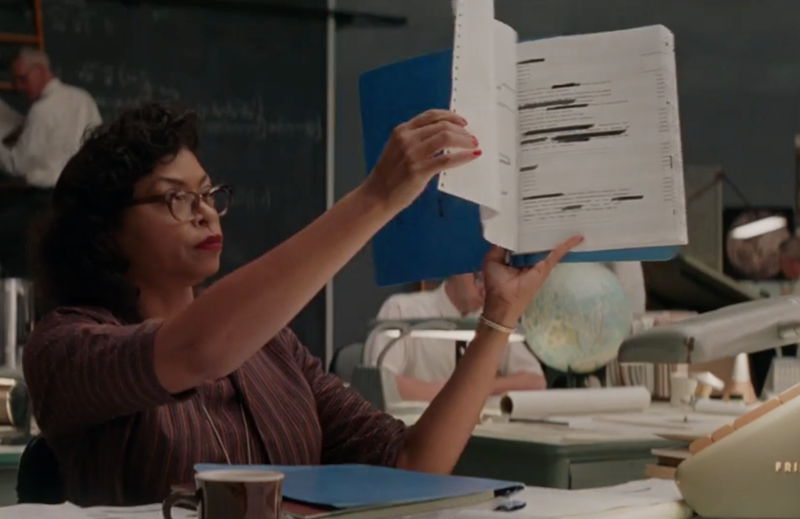
    Taraji P. Henson as Katherine Johnson in Hidden Figures. Image: 20th Century Fox/YouTube

    First, it beat Star Wars: Rogue One. Now, for the second weekend since its wide-release debut, Hidden Figures—the true story of three black female mathematicians at NASA—is number one at the box office. It’s raked in roughly $6o million so far, and counting.

    The inspiring story of Katherine Johnson, Mary Jackson, and Dorothy Vaughan has reenergized the ongoing conversation about the importance of inclusivity in STEM. Though we’ve long done away with the Jim Crow laws depicted in Hidden Figures, black women in are still notoriously underrepresented in mathematical sciences, including physics. A quick look at the numbers proves it: between 1973 and 2012, 22,172 white men received PhDs in physics. Only 66 black women did.

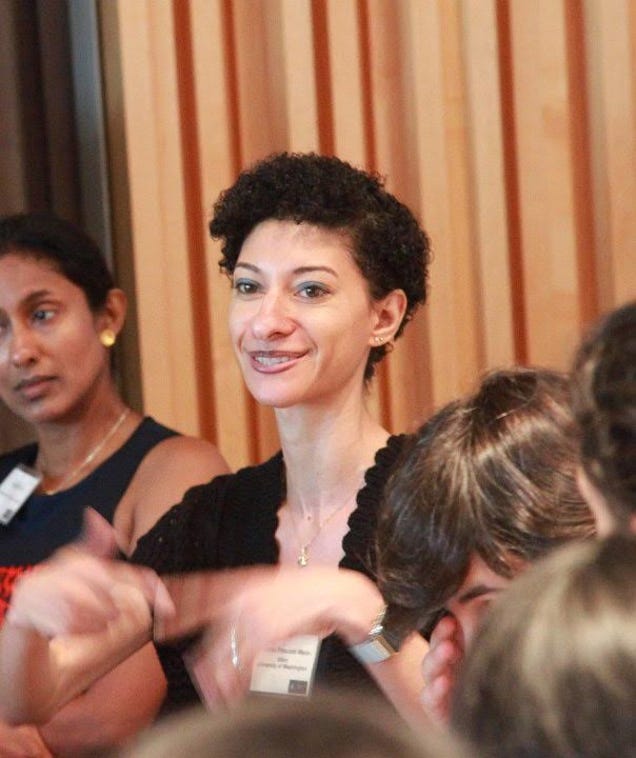
    Dr. Chanda Prescod-Weinstein was one of those women.


    Chanda Prescod-Weinstein Image Credit: GR21 LOC

    In 2010, Prescod-Weinstein became the 63rd black American woman to ever earn a PhD in physics, from the Perimeter Institute at the University of Waterloo in Canada. Now, as a theoretical astrophysicist who’s worked at MIT and, more recently, the University of Washington, she is an advocate for black women and non-binary people in STEM…

    Read the entire interview here.

  • 98-Year-Old NASA Mathematician Katherine Johnson: ‘If You Like What You’re Doing, You Will Do Well’

    2017-01-19

    98-Year-Old NASA Mathematician Katherine Johnson: ‘If You Like What You’re Doing, You Will Do Well’

    People
    2016-11-04

    Caitlin Keating

    Katherine Johnson thinks all of her accomplishments over the 98 years she’s been alive are “ordinary.”

    But to the rest of the world, they’re anything but.

    Johnson, a physicist, space scientist and mathematician graduated from high school at 14-years-old, attended college the very next year and was the first African-American woman to desegregate the graduate school at West Virginia University…

    …In 1953, after years of being a teacher, she began working for NASA where she was nicknamed the “human computer.”

    Johnson was able to calculate the trajectory for numerous space missions, including for the space flight of Alan Shepard, the first American in space and the trajectory for the 1969 Apollo 11 flight to the Moon…

    Read the entire interview here.

  • Statement by Joseph Boyden

    2017-01-19

    Statement by Joseph Boyden

    CNW: A Cision Company
    2017-01-11

    Joseph Boyden

    TORONTO, Jan. 11, 2017 /CNW/ – A few weeks ago, I found out that my 85-year-old mom had been contacted by a journalist who prodded her with pointed and personal questions about her heritage. Specifically, he asked her to prove how Indigenous she is.

    My family’s heritage is rooted in our stories. I’ve listened to them, both the European and the Indigenous ones, all my life. My older sisters told me since childhood about my white-looking father helping his Indian-looking brother hide their blood in order to survive in the early 1900’s. My mother’s family history is certainly not laid out neatly in the official records, or on ancestry.ca either. From the age of nine or ten, the woman I knew as my grandmother told me stories about my mother that, until recently, my mother preferred not to share with anyone. The details are private and painful, yet my mother has been forced to revisit aspects of her past she believed were closed away forever.

    Children don’t go about consciously presenting identities; they just are who they are. And that’s how I was: a white kid from Willowdale with native roots. The Ojibwe family I grew-up with in summers on Christian Island still call me cousin or uncle.  The bad poetry I first scribbled as a troubled teen was about searching for my mother’s clan.  For the last 22 years I’ve been a member of a Moose Cree First Nation family, active in their community and doing everything we can to get youth out onto the land at Camp Onakawana on the Abitibi River. This is my life.  And I’ve always said pretty much the same thing: “a small part of me is Indigenous, but it’s a big part of who I am.”…

    Read the entire new release here.

  • President with a torpedo in his crotch: how the works of Lubaina Himid speak to Trump times

    2017-01-19

    President with a torpedo in his crotch: how the works of Lubaina Himid speak to Trump times

    The Guardian
    2017-01-17

    Hettie Judah


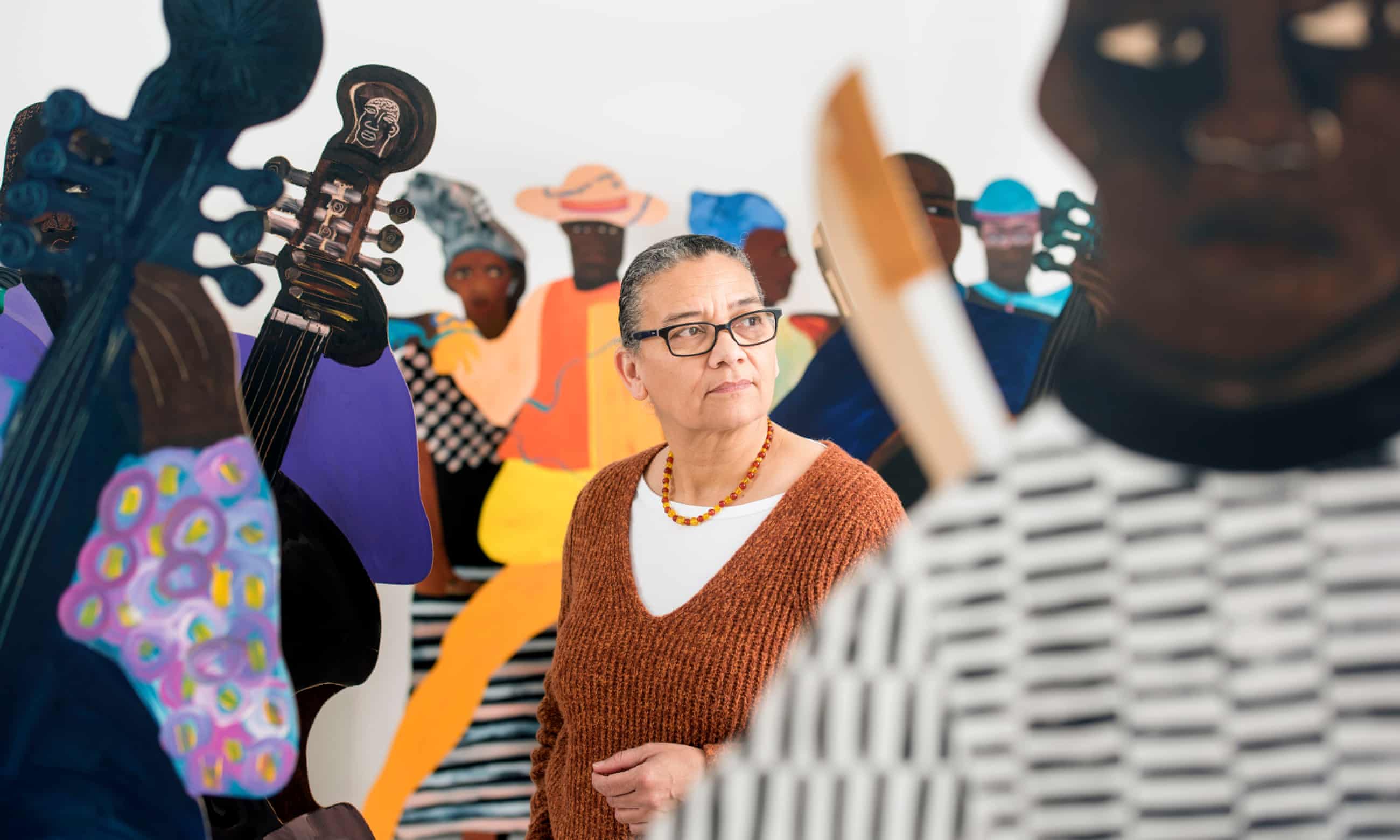
    Lubaina Himid among the cutouts of slaves that form her 2004 piece Naming the Money, at Spike Island contemporary art centre in Bristol. Photograph: Adrian Sherratt for the Guardian

    Born in Zanzibar and raised in Britain, Lubaina Himid makes work about everything from slavery to Thatcher to the cotton trade. Now in her 60s, she’s finally getting the recognition she deserves

    Lubaina Himid was just four months old when her father died. It was 1954 and her Blackpool-born mother decided to leave their home in Zanzibar and head back to Britain, where she brought her daughter up as a Londoner. Himid would not return to the place of her birth for 43 years…

    Read the entire article here.

Previous Page
1 … 321 322 323 324 325 … 1,428
Next Page

Designed with WordPress