• Who The Census Misses

    FiveThirtyEight
    2021-12-13

    Jasmine Mithani and Alex Samuels


    Sibba Hartunian
    Large groups of people have always fallen through the cracks of its racial categories — often by design.

    For James Harmoush of Colorado, none of the census boxes quite fit.

    In 2010 and 2020, when the census asked him to select a box regarding his race, he picked “white.” But there’s one major problem there: Harmoush doesn’t — and has never — seen himself that way.

    “Nobody would ever look at me or talk to me and say, ‘You’re white,’” said the 30-year-old Arab American lawyer. The son of Lebanese immigrants, Harmoush sees himself as part of a minority group, but the U.S. Census Bureau legally classifies him as a white man.

    Harmoush is not alone. Many Americans we spoke with felt the census classifications — both “white” specifically as well as the other available categories more generally — do not match the way they identify. In total, we heard from over 200 people with frustrations ranging from the naming of categories (like “Asian Indian” to represent people with ancestry from India) to confusion over why some racial groups, like Japanese or Samoan, were given their own boxes, while Middle Eastern, North African, Southwest Asian and others were lumped together under a catchall “white” racial group. We also heard from some Americans who were now completely rethinking how they personally identified due to the way they saw race and politics intermingle in society today…

    Read the entire article here.

  • The Recovered Life of Isaac Anderson

    University Press of Mississippi
    2021-12-15
    256 pages
    16 b&w illustrations
    Hardcover ISBN: 9781496835147
    Paperback ISBN: 9781496835130

    Alicia K. Jackson, Associate Professor of History
    Covenant College, Lookout Mountain, Georgia

    The story of an enslaved man who became a Georgia state senator, helped found a church, and led his people to promise and hope

    Owned by his father, Isaac Harold Anderson (1835–1906) was born a slave but went on to become a wealthy businessman, grocer, politician, publisher, and religious leader in the African American community in the state of Georgia. Elected to the state senate, Anderson replaced his white father there, and later shepherded his people as a founding member and leader of the Colored Methodist Episcopal church. He helped support the establishment of Lane College in Jackson, Tennessee, where he subsequently served as vice president.

    Anderson was instrumental in helping freed people leave Georgia for the security of progressive safe havens with significantly large Black communities in northern Mississippi and Arkansas. Eventually under threat to his life, Anderson made his own exodus to Arkansas, and then later still, to Holly Springs, Mississippi, where a vibrant Black community thrived.

    Much of Anderson’s unique story has been lost to history—until now. In The Recovered Life of Isaac Anderson, author Alicia K. Jackson presents a biography of Anderson and in it a microhistory of Black religious life and politics after emancipation. A work of recovery, the volume captures the life of a shepherd to his journeying people, and of a college pioneer, a CME minister, a politician, and a former slave. Gathering together threads from salvaged details of his life, Jackson sheds light on the varied perspectives and strategies adopted by Black leaders dealing with a society that was antithetical to them and to their success.

  • Netflix’s Passing Made Me Rethink How I Carry My Racial Ambiguity

    Popsugar
    2021-12-13

    Adele Stewart

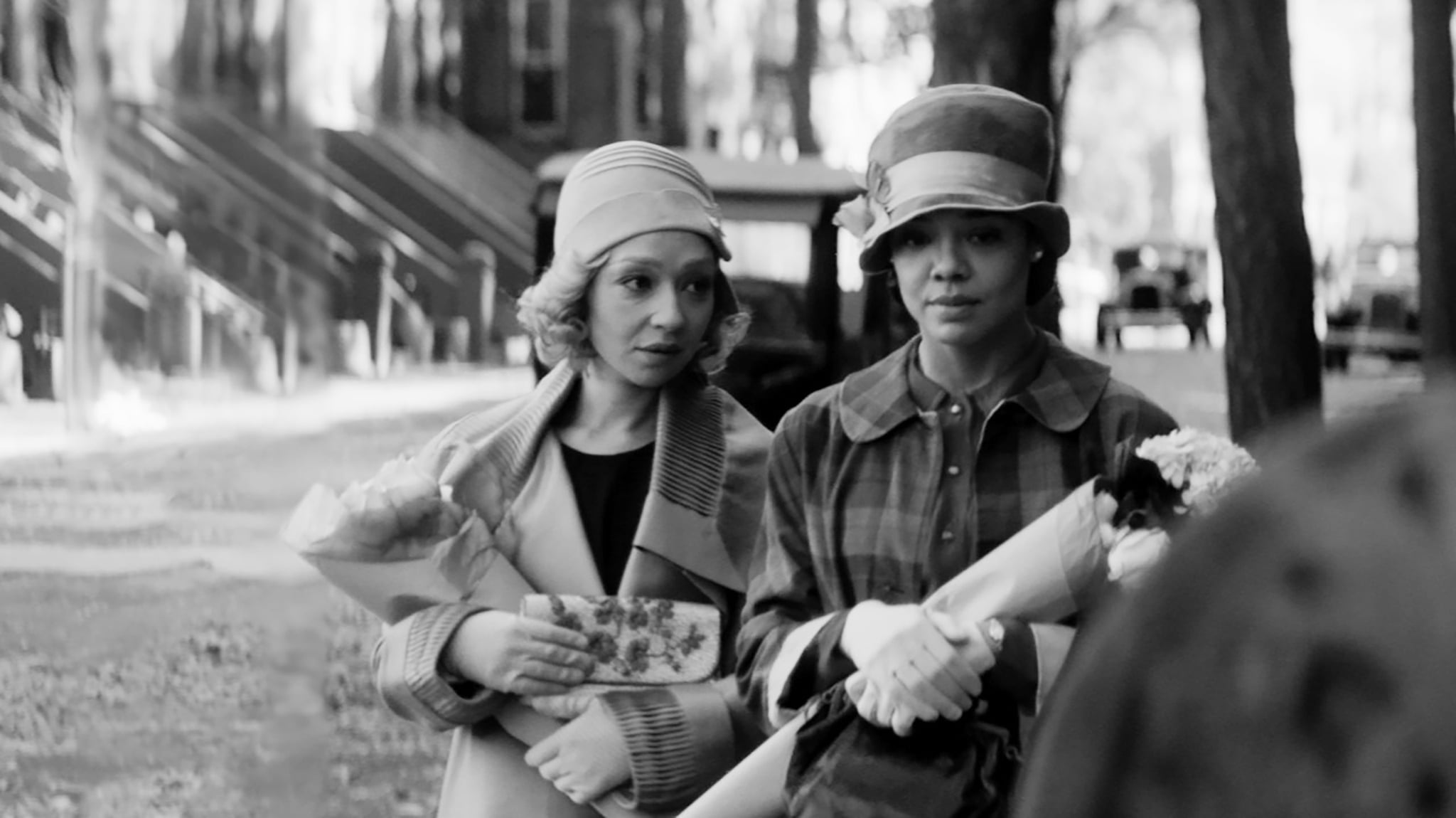
    As a white-passing biracial woman, I really resonated with Rebecca Hall’s film adaptation of Nella Larsen’s 1929 novel, Passing. The story centers on two biracial Black women, Irene Redfield (Tessa Thompson) and Clare Kendry (Ruth Negga), who are light-skinned enough to pass as white in 1920s New York. When Irene bumps into her old friend Clare, she almost doesn’t recognize her. Unlike Irene — who is living her life openly as a Black woman despite being able to pass for white if she wanted to — Clare has accentuated her already-light features with blond hair to help her pass as white in everyday society. Taking her deception even further, she’s married a wealthy white man (Alexander Skarsgard), who not only doesn’t know she’s Black but also holds an extreme, violent hatred toward Black people.

    In some ways, I identify with Clare, particularly when it comes to how easy it is for me to blend in and reap the benefits of white privilege without facing the inequities of being Black in the US. While it was never intentional like it was with Clare, I have always gone through the world passing as white and seeing things through a “white” lens because that’s simply what most people assume I am. It wasn’t until my late teenage years that I started to see how my Black family, friends, or boyfriends were treated differently than I was. I seemed to have been floating through life unknowingly reaping the benefits of my racial ambiguity for a very long time. Often, it feels like I have a secret Black identity that doesn’t quite know where she fits and when (or if) she should reveal herself. Truth is, I want to belong everywhere — with my white family and friends, but also with my Black family and friends — so I tend to blend in and code-switch depending on who I’m with. As a result, I never feel like I entirely belong in either community…

    Read then entire article here.

  • The woman defending Black lives on the border, including her own

    The Los Angeles Times
    2021-12-27

    Molly Hennessy-Fiske, Houston Bureau Chief
    Photography by Gina Ferazzi

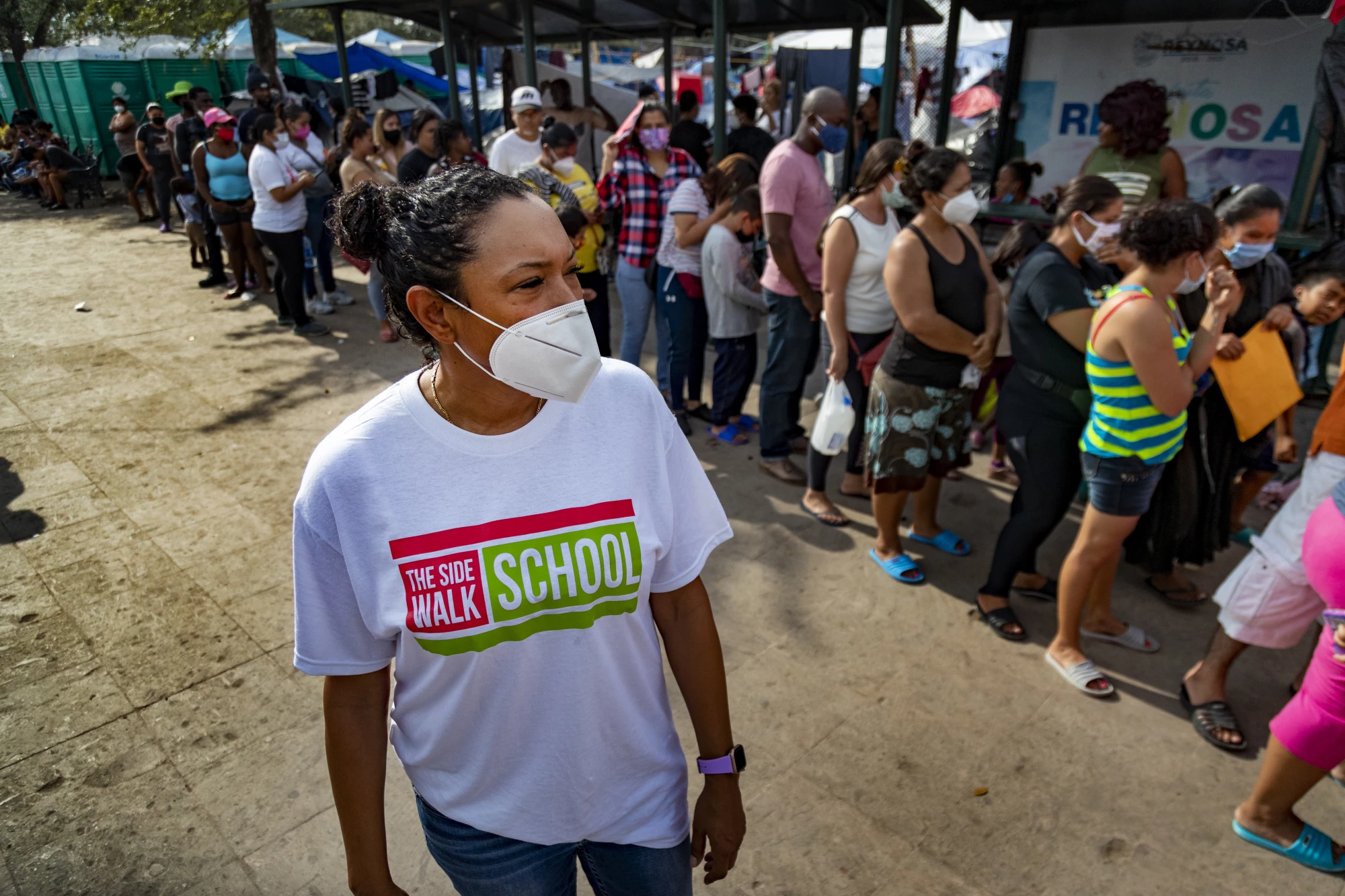
    Black border activist Felicia Rangel-Samponaro walks along a line of migrants at a border camp clinic Dec. 6 in Reynosa, Mexico. The nonprofit Sidewalk School she founded three years ago provides education and other services. (Gina Ferazzi / Los Angeles Times)

    REYNOSA, Mexico — So much of her is hyphenated, not just her name: Felicia Rangel-Samponaro. With caramel skin and curly brown hair that’s often tied back, she can pass as Latina.

    But she identifies as Black.

    On the Texas-Mexico border, she’s emerged as a vigorous defender of immigrants, and that work often forces her to reckon with how race and ethnicity — real and perceived — shape lives on the border, including her own.

    “There’s a lot of oppression, discrimination and racism that goes on, on both sides of the border,” she said…

    Read the entire article here.

  • I thought I was White until I learned my mother’s secret. The census helped me tell my family story.

    The Washington Post
    2021-10-13

    Gail Lukasik

    Gail Lukasik’s mother, Alvera Frederic Kalina, in New Orleans circa 1942. Kalina was born into a Black family in New Orleans but spent her life passing as White. (Family photo)

    The first time I was grilled about my racial identity, I’d just given a talk to an all-White audience at a suburban Chicago library.

    “What are you, anyway?” a woman asked. Her blunt tone put me on edge.

    I’d just related my mother’s story of racial passing. How she and her New Orleans family were designated as “Negro” during the Jim Crow era, how she moved north to Ohio, married my White, bigoted father, and hid her mixed race from him and eventually us. Looking back, there were small clues, like she always wore face makeup, even to bed.

    I’d told the audience about my journey of finding my mother’s birth certificate and discovering her racial secret when I was 49, confronting her — and her swearing me to secrecy until her death. Then 18 years later, I found my mother’s lost family, thanks to my appearance on PBS’sGenealogy Roadshow.”…

    Read the entire article here.

  • “My Uncle’s Cousin’s Great-Grandma Were a Cherokee” and I am Descended from an Ashanti King: The American Blood Idiom in the Simple Stories

    The Langston Hughes Review
    Volume 27, No. 1, SPECIAL ISSUE: “The Negro Speaks of Rivers” at 100: Part One Shane Graham and Chiyuma Elliott (2021)
    pages 29-56
    DOI: 10.5325/langhughrevi.27.1.0029

    DeLisa D. Hawkes, Assistant Professor of English
    University of Texas, El Paso

    Langston Hughes satirizes America’s obsession with so-called “racial purity” in his stories featuring Jesse B. Semple to shed light upon internalized racism and white American attempts to erase US histories that complicate the standardized black-white color line. In his poem “The Negro Speaks of Rivers” (1920), the speaker challenges a singular view of the many Black histories that exist through the metaphor of rivers. In his Simple stories, Hughes’s character Jesse B. Semple reflects on American Blackness and blood stereotypes that impact racial identity formation and community building. By invoking the “Indian grandmother” and royal African ancestor tropes, Hughes complicates those compartmentalized identities and US histories implied via the American blood idiom to denote associations with enslavement that bolster notions of intraracial difference and white supremacist ideology. Hughes’s Simple stories culminate his trajectory in establishing African American pride in African ancestry and an anticolonial rejection of racial purity as a legal and social principle that contributes to monolithic conceptions of American Blackness.

    Read or purchase the article here.

  • Seeking Black, Multiracial Women for Research Study

    2021-12-19

    Shwana Gann, Ph.D. Candidate
    The Chicago School of Professional Psychology

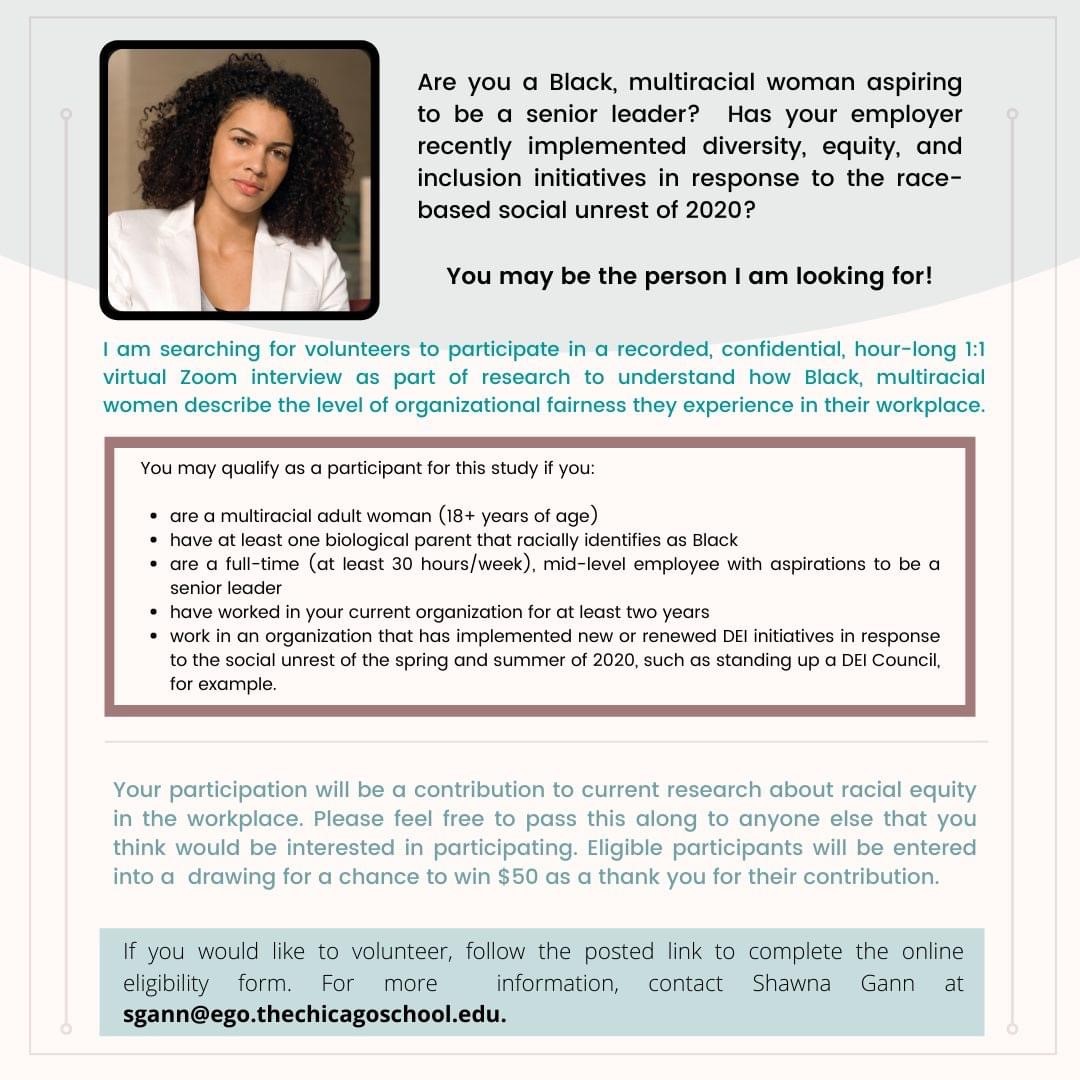
    Are you a Black, multiracial woman aspiring to be a senior leader? Has your employer recently implemented diversity, equity, and inclusion initiatives in response to the race-based social unrest of 2020?

    You may be the person I am looking for!

    I am searching for volunteers to participate in a recorded, confidential, hour-long 1:1 virtual Zoom interview as part of research to understand how Black, multiracial women describe the level of organizational fairness they experience in their workplace.

    Your participation will be a contribution to current research about racial equity in the workplace. Please feel free to pass this along to anyone else that you think would be interested in participating. Eligible participants will be entered into a drawing for a chance to win $50 (USD) as a thank you for their contribution.

    Eligible participants:

    • are Multiracial women 18+ years of age
    • have at least one biological parent that racially identifies as Black
    • are full-time employees (working at least 30 hours/week) in a mid-level position
    • aspire to be a senior leader
    • have worked in their current organization for at least 2 years
    • work in an organization with new or renewed diversity, equity, and inclusion (DEI) initiatives in response to the racially charged social unrest following events in the spring and summer of 2020

    Some examples of DEI initiatives include but are not limited to:

    • establishing or restructuring a Diversity Council or task force
    • establishing or restructuring Employee Resource Groups (ERGs) or Affinity Groups
    • hiring a dedicated DEI professional
    • publishing public statements condemning police brutality, racism, and discrimination
    • implementing DEI training
    • conducting pay and policy audits
    • conducting DEI climate assessments/employee surveys

    If you would like to volunteer, follow the link here to complete the online eligibility form. For more information, contact Shawna Gann at sgann@ego.thechicagoschool.edu.

  • How the mixed-race mestizo myth warped science in Latin America

    Nature
    Number 600 (2021-12-13)
    pages 374-378
    DOI: 10.1038/d41586-021-03622-z

    Emiliano Rodríguez Mega, Science Journalist
    Mexico City, Mexico

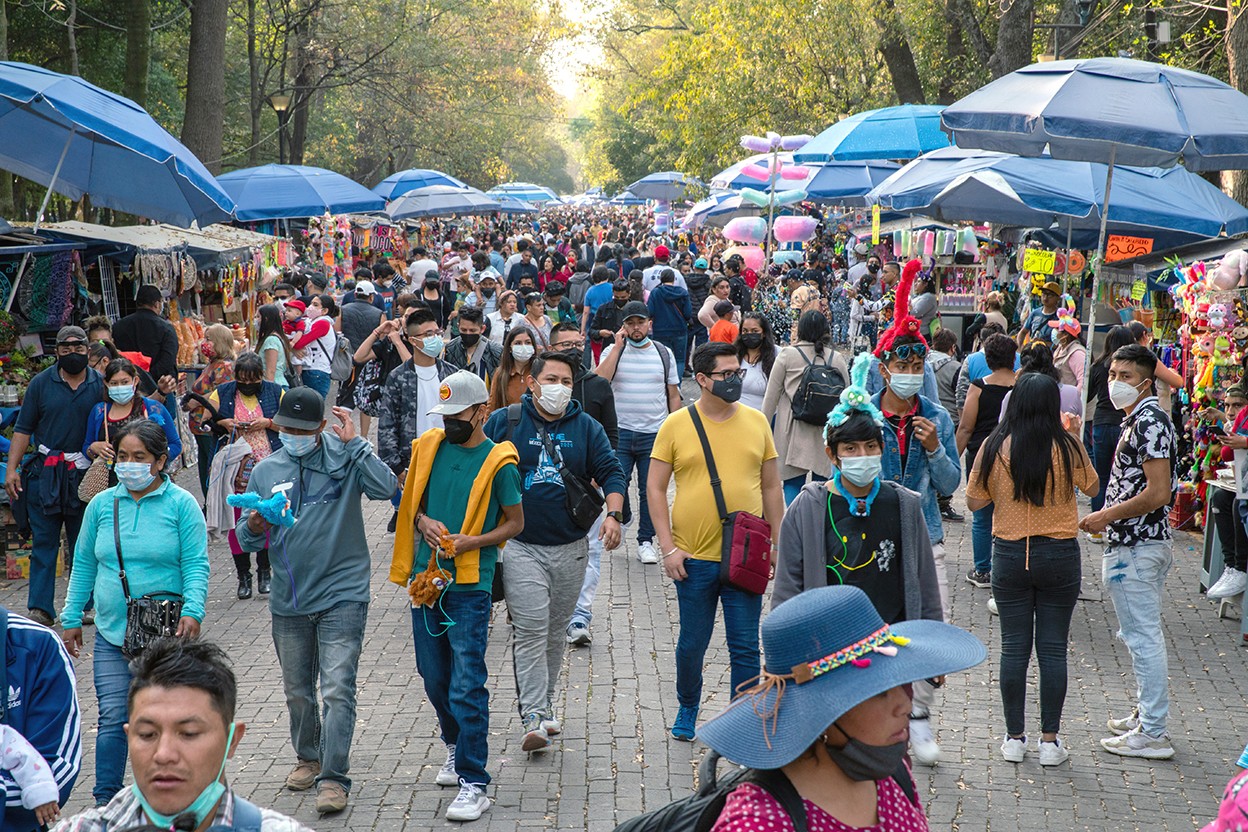
    Genetic studies have found a striking amount of diversity among people in Mexico. Credit: Stephania Corpi Arnaud for Nature

    Researchers are trying to dismantle the flawed concept of homogeneous racial mixing that has fostered discrimination in Mexico, Brazil and other countries.

    Nicéa Quintino Amauro always knew who she was.

    She was born in Campinas, the last city in Brazil to prohibit slavery in 1888. She grew up in a Black neighbourhood, with a Black family. And a lot of her childhood was spent in endless meetings organized by the Unified Black Movement, the most notable Black civil-rights organization in Brazil, which her parents helped to found to fight against centuries-old racism in the country. She knew she was Black.

    But in the late 1980s, when Amauro was around 13 years old, she was told at school that Brazilians were not Black. They were not white, either. Nor any other race. They were considered to be mestiços, or pardos, terms rooted in colonial caste distinctions that signify a tapestry of European, African and Indigenous backgrounds. And as one single mixed people, they were all equal to each other.

    The idea felt odd. Wrong, even. “To me, it seemed quite strange,” says Amauro, now a chemist at the Federal University of Ubêrlandia in Minas Gerais and a member of the Brazilian Association of Black Researchers. “How can everyone be equal if racism exists? It doesn’t make sense.”

    Amauro’s concerns echo across Latin America, where generations of people have been taught that they are the result of a long history of mixture between different ancestors who all came, or were forced, to live in the region…

    Read the entire article here.

  • A Point of View: Mixed Race Experience is Hard to Categorize. Stop Trying.

    The Inclusion Solution
    2021-05-27

    Rochelle Younan-Montgomery, Founder & Facilitator at Holistic Workplace Inclusion LLC

    I am mixed Egyptian and white, and I love being biracial. I can navigate differing cultural contexts with relative ease, I enjoy connecting with a wide variety of folx in a multitude of settings, and I take pleasure in deepening my non-Western cultural background. My racial identity has also been the source of an immense amount of pain. My white mother struggled with how to care for my unruly curly hair and would aggressively brush through it when it was dry (a major no-no for tight, thick curls), to the point of bringing me to tears. She now jokes that when I was 5 years old, she had my hair cut short for her birthday, to make things easier on herself. As a mother, I understand how hard parenting can be. However, the choice to “eliminate the hair problem” felt as though my natural hair was a burden for her, rather than something to be curious about, to celebrate, to work with, rather than work against. I am not alone in this; so many mixed children experience the pain of othering by their own families…

    Read the entire article here.