• Growing up Ethiopian and German

    Ethiopian Observer
    2021-05-20

    Tigist Selam

    Born to an Ethiopian mother and a German father, Tigist Selam enjoyed the diverse experience of growing up in Nigeria, Argentina, and foremost Germany. In an article featured in the book “One Drop: Shifting the Lens on Race“, Tigist explores the complexities of racial classifications, and the different ways that people live and experience Blackness.

    I personally identify as Black racially, Ethiopian, and German/ American culturally. I never say that I’m Black except in a political context because I don’t even know what that means. Like being Black. What is Black culture? Is it African culture? Is it the Caribbean? To me, culture is very specific and I’m multicultural. So, when I identify as Black, I’m making a political statement; I am not trying to simplify my own cultural complexity.

    My father was born in 1945. That’s the end of World War II. He still had the swastika in his passport and on his birth certificate. And my mom, she survived Haile Selassie and Mussolini. Both of my parents are very proud to be German, very proud to be Ethiopian, respectively. Very, very strong people identity-wise. But they’re not very sensitive when it comes to race. To them, everybody else is an idiot. And that was really helpful growing up because my mom never backed down. When she didn’t get seated, she would say something or not pay for the meal. My dad took me voting when i was 11. I was forced to watch international news every day. So me and my brother got politicised at a very early age. But it was also the experience of living everywhere-Nigeria for two years, Argentina for three years, Germany ten years, and now America off and on for 10 years…

    Read the entire article here.
  • “I wrote Mixed/Other to add some much-needed nuance to a conversation that is so frequently stilted and oversimplified in mainstream spaces. Perceptions of mixedness are still so frustratingly binary and often centred around whiteness – I wanted to challenge those narratives and open a more inclusive conversation. I wanted to tell stories or joy, hope and belonging as well as the more painful and sometimes complicated parts of being mixed. It’s the book I wanted to read in my teens and early twenties.” —Natalie Morris

    Isabella Silvers, “Natalie Morris: “Ideas of mixedness are binary and centred around whiteness”,” Mixed Messages, April 19, 2021. https://mixedmessages.substack.com/p/natalie-morris-ideas-of-mixedness.

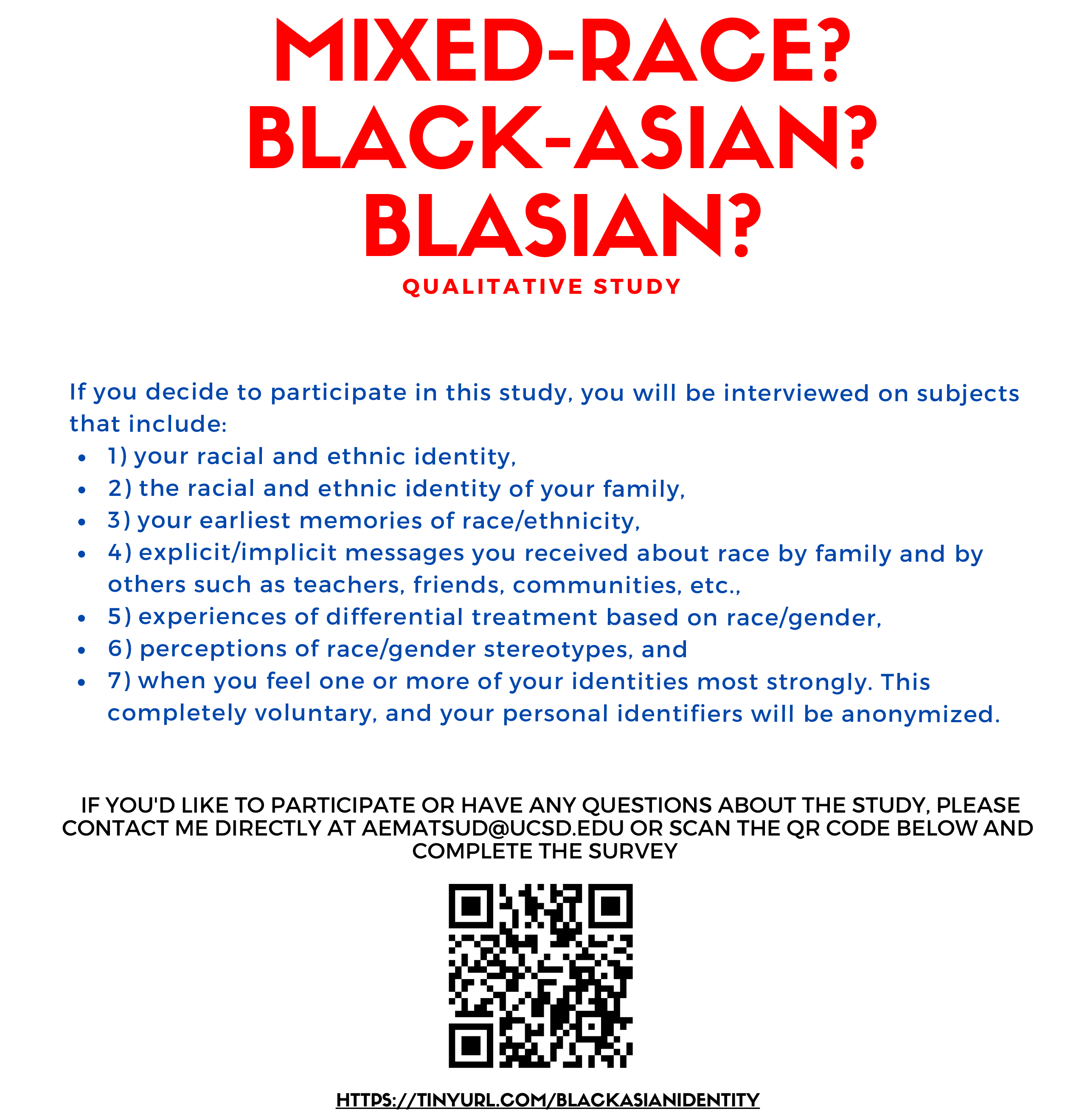
  • Mixed-Race? Black-Asian? Blasian? A Qualitative Study

    2021-05-23

    Ayumi Matsuda Rivero, Ph.D. Candidate in Sociology
    University of California, San Diego

    I am a multiracial Latinx-Asian doing research on the unique experiences of multiracial Black-Asians.

    I am exploring how these individuals navigate and negotiate their ethnic and racial identity in predominantly white, Black, and Asian spaces. The first part of my research involves a short survey followed by interviews via Zoom. To be eligible for the study participants must either identify as multiracial Black-Asians or have parents who identify as Black and Asian.

    If you decide to participate in this study, you will be interviewed on subjects that include:

    1. your racial and ethnic identity,
    2. the racial and ethnic identity of your family,
    3. your earliest memories of race/ethnicity,
    4. explicit/implicit messages you received about race by family and by others such as teachers, friends, communities, etc.,
    5. experiences of differential treatment based on race/gender,
    6. perceptions of race/gender stereotypes, and
    7. when you feel one or more of your identities most strongly. This completely voluntary, and your personal identifiers will be anonymized.

    If you’d like to participate or have any questions about the study, please contact me directly at aematsud@ucsd.edu.

  • Multiracial Families Study: Seeking Multiracial Teens and their Parents/Caregivers

    Arizona State University
    2021-05-20

    Annabelle Lin Atkin, PhD, Postdoctoral Scholar
    T. Denny Sanford School of Social and Family Dynamics
    Arizona State University

    We would like to invite families with a Multiracial American teen between the ages of 14 and 18 to take a survey! The Multiracial teen and their parents/primary caregivers will each take a 20-30 minute survey and each be compensated with a $10 USD Amazon gift card.

    Please find more information and sign up for the study here.

    The findings from this research will be used towards educating society about Multiracial experiences and developing workshops and interventions for parents with Multiracial children.

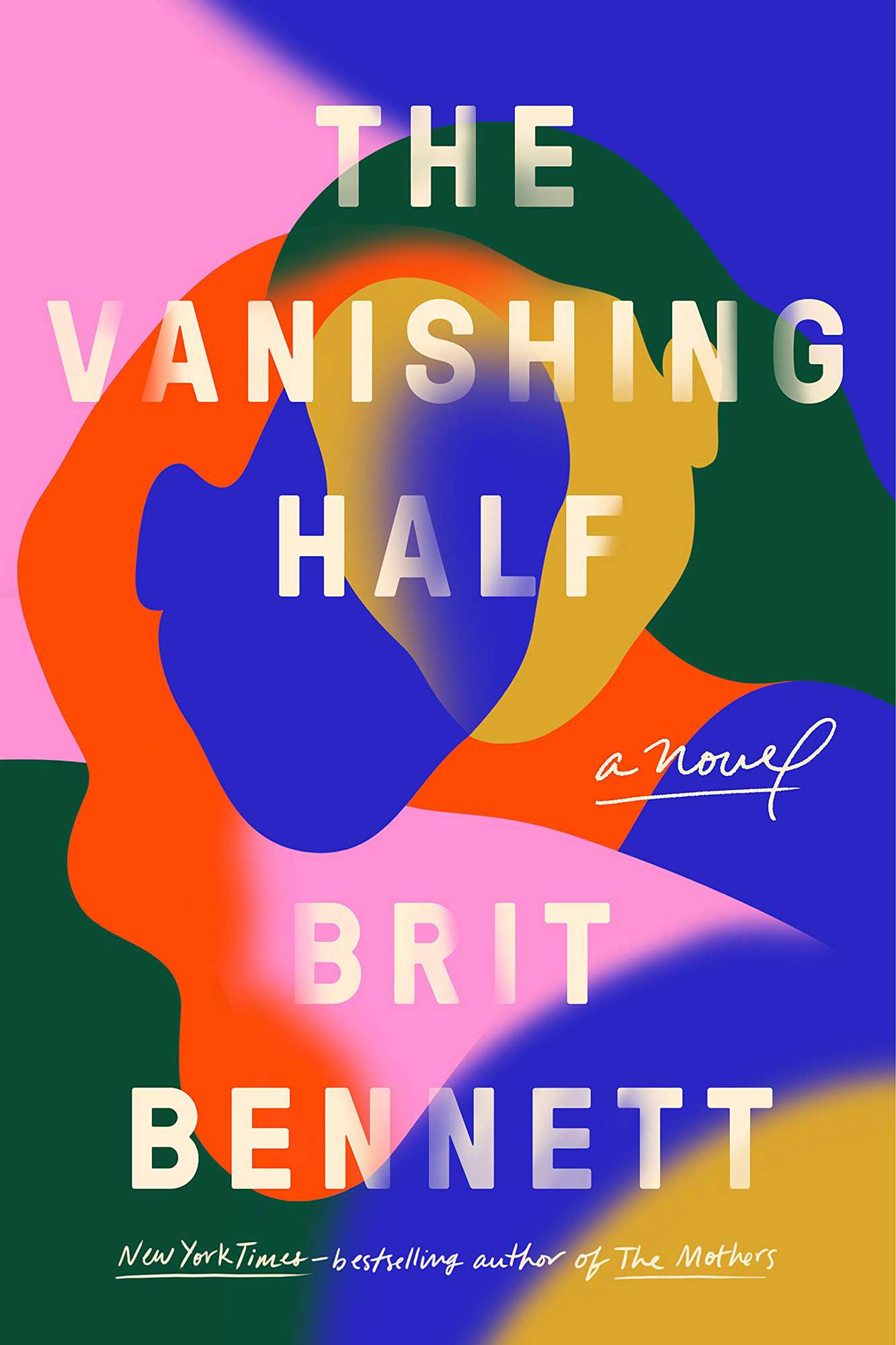
  • Author Brit Bennett Based Her Hit Novel The Vanishing Half On A Town Near Her Mother’s Home: “Everyone was Obsessed with Color”

    PEOPLE
    2021-05-10

    HBO plans to produce a limited series adaptation of the novel for the screen.

    Mothers know best — and sometimes, they know the idea to a best selling novel.

    Brit Bennett author of the hit book The Vanishing Half spoke with PEOPLE Every Day host Janine Rubenstein about the inspiration behind the story book clubs can’t stop talking about.

    The Vanishing Half tells the story of two twin sisters who grow up to “live their lives off the color line“, one living as a White woman and one as a Black woman. Bennett’s mother, who is originally from Louisiana, once told her a story from her childhood about a nearby town where people were “obsessed with color”, in regards to the color of their skin.

    “And, that immediately struck me as, ‘Oh, this is the setting for a novel’,” said Bennett…

    Read the entire interview here.

  • Majority-Minority Myths

    Dissent
    Spring 2021

    Jake Rosenfeld, Professor of Sociology
    Washington University, St. Louis, Missouri


    Outside a Latinos for Trump campaign rally in Orlando, Florida, in October 2020 (Paul Hennessy/NurPhoto via Getty Images)

    It’s time to let go of the belief that changing demographics will bring about a progressive America.

    The Great Demographic Illusion: Majority, Minority, and the Expanding American Mainstream
    by Richard Alba
    Princeton University Press, 2020, 336 pp.

    Dangerously Divided: How Race and Class Shape Winning and Losing in American Politics
    by Zoltan L. Hajnal
    Cambridge University Press, 2020, 362 pp.

    The Case for Identity Politics: Polarization, Demographic Change, and Racial Appeals
    by Christopher T. Stout
    University of Virginia Press, 2020, 268 pp.

    In a commencement address at the University of California, San Diego in 1997, President Bill Clinton spoke of a time when white people would no longer constitute a majority in the United States. In the decades since, the idea that growing diversity will bring about a “majority-minority” America in the near future has become a widespread belief across the ideological spectrum, propelled by periodic Census updates, like a report that 2013 marked the first year that more nonwhite babies had been born in the United States than white ones.

    There are three major problems with this now-clichéd belief. First, it scares many white people, pushing their political stances toward the right. Numerous studies confirm that merely mentioning the demographic shift is enough to change their political views. As Ezra Klein has written, “The simplest way to activate someone’s identity is to threaten it.” Many white people interpret stories about the imminent reordering of the country’s racial and ethnic hierarchy as a threat.

    Second, it leads Democrats astray. Divvying up the nation between whites and nonwhites implies a neat, fixed, and immutable ordering of a complex set of shifting racial and ethnic identities. The corollary—that a shared political identity should bind minorities to a leftist, emancipatory project against white oppression—induces complacency in Democratic Party organizing and policymaking realms, and ignores the varied ethnic and class backgrounds of those who comprise this broad, diverse population.

    The 2020 election shook the premise that nonwhite voters shared a liberal political identity, with growing evidence of an across-the-board shift toward the GOP among Latinos and, to a smaller degree, African Americans. But evidence that the “browning of America” may not lead to progressive nirvana predated the election. Bush’s 2004 re-election bid was buoyed by his record performance among Latinos. Since then, between a quarter and a third of Latinos have voted for Republican presidential candidates despite the restrictionist turn in the party’s immigration policies.

    Which brings us to the third problem with the majority-minority claim: it’s empirically wrong…

    Read the entire article here.

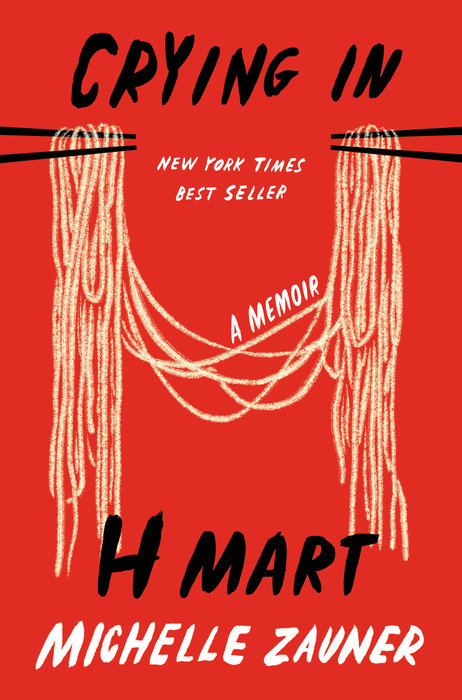
  • Crying in H Mart: A Memoir

    Knopf (A imprint of Penguin Random House)
    2021-04-20
    256 Pages
    5-1/2 x 8-1/4
    Hardcover ISBN: 9780525657743
    Ebook ISBN: 9780525657750
    Audiobook ISBN: 9780593153895

    Michelle Zauner

    From the indie rockstar of Japanese Breakfast fame, and author of the viral 2018 New Yorker essay that shares the title of this book, an unflinching, powerful memoir about growing up Korean American, losing her mother, and forging her own identity.

    In this exquisite story of family, food, grief, and endurance, Michelle Zauner proves herself far more than a dazzling singer, songwriter, and guitarist. With humor and heart, she tells of growing up one of the few Asian American kids at her school in Eugene, Oregon; of struggling with her mother’s particular, high expectations of her; of a painful adolescence; of treasured months spent in her grandmother’s tiny apartment in Seoul, where she and her mother would bond, late at night, over heaping plates of food.

    As she grew up, moving to the East Coast for college, finding work in the restaurant industry, and performing gigs with her fledgling band–and meeting the man who would become her husband–her Koreanness began to feel ever more distant, even as she found the life she wanted to live. It was her mother’s diagnosis of terminal cancer, when Michelle was twenty-five, that forced a reckoning with her identity and brought her to reclaim the gifts of taste, language, and history her mother had given her.

    Vivacious and plainspoken, lyrical and honest, Zauner’s voice is as radiantly alive on the page as it is onstage. Rich with intimate anecdotes that will resonate widely, and complete with family photos, Crying in H Mart is a book to cherish, share, and reread.

  • “I wish I didn’t look so White”: examining contested racial identities in second-generation Black–White Multiracials

    Ethnic and Racial Studies
    Published online: 2020-11-05
    DOI: 10.1080/01419870.2020.1841256

    Haley Pilgrim
    Department of Sociology
    University of Pennsylvania, Philadelphia

    Multiracials are one of the fastest growing populations in the United States. However, we are still learning how the children of Multiracial individuals understand their racial identity. I interviewed 30 “second-generation” Black–White Multiracials, who have one Black–White parent and one White parent, on the meanings they assign to racial categories, phenotypes, and their racial identity. Many cite reflected appraisals as non-Black for why they do not identify as Black, but orientation toward Blackness differs from those who identify as Multiracial. Between these two groups of Multiracials, I find distinctive responses to racial contestation consistent with differing stigmatization of racial groups, salience of racial identity, and identification as a person of colour. These findings indicate differing responses to similarly reflected appraisals and highlight the need to investigate Multiracials of multiple generational statuses to understand the varying meanings of a Multiracial identity to Multiracials.

    Read or purchase the article here.

  • Critical Mixed Race Studies Book Talk Series: Mixed-Race in the US and UK: Comparing the Past, Present, and Future

    Critical Mixed Race Studies Association
    2021-05-06, 13:30Z (09:30 EDT)


    There is a photo of both authors in the upper right-hand corner of the flyer. Jennifer Patrice Sims (left) and Chinelo L. Njaka (right) are pictured outdoors from the waist up and standing in front of a sand-colored brick wall. Dr. Sims wears a pink cardigan sweater over a white collared shirt and glasses. Dr. Njaka wears a blue cardigan sweater over a white collared shirt with a ditsy floral print. They are both smiling.

    Our next CMRS Book Talk is right around the corner! We’re featuring Mixed-Race in the US and UK: Comparing the Past, Present, and Future, by Dr. Jennifer Patrice Sims and our very own Chinelo L. Njaka. Join live and be part of the Q&A!

    Mixed-Race in the US and UK: Comparing the Past, Present, and Future
    By: Jennifer Patrice Sims and Chinelo L. Njaka
    Recipient of the 2020 Mid-South Sociological Association Stanford M. Lyman Distinguished Book Award

    Jennifer Patricia Sims, Ph.D. (she/her/hers) is an Assistant Professor in the Department of Sociology at the University of Alabama in Huntsville. Taking mixed-race people as her main focus, Dr. Sims’ research examines racial construction, perception, and identity. She is the editor of The Sociology Of Harry Potter (Zossima Press, 2012)

    Chinelo L. Njaka, Ph.D. (she/her/hers) is the Founder/Director of Peckham Rights! and an independent social researcher. Dr. Njaka is also a United Nations fellow for People of African Descent. Her research examines racialisation processes across different national, institutional, and organizational contexts; with a focus on the African Diaspora in Europe and human rights.

    To register, click here.

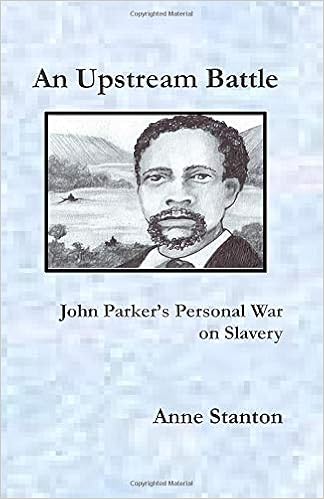
  • An Upstream Battle: John Parker’s Personal War on Slavery

    Anne Stanton Publications
    2019-02-12
    136 pages
    ISBN-13 : 978-1796696295
    5.5 x 0.34 x 8.5 inches

    Anne Stanton

    *** Free download available from 2021-05-05 through 2021-05-09 here! ***

    John Parker wasn’t interested in helping anyone run away. He had worked too hard getting himself free to want to risk losing it for someone he didn’t know. But Sam didn’t give up, and soon John was enlisted to help two young women cross the Ohio River to freedom. What neither man knew at the time was that this marked the beginning of a personal war on slavery for John Parker, one in which he would help hundreds of runaways escape. An Upstream Battle is comprised of four stories from the life of John Parker, an African American businessman and inventor. Based on events portrayed in Parker’s autobiography, An Upstream Battle illustrates the real danger that Parker and other members of the Underground Railroad were exposed to, and their commitment to helping runaway slaves, despite that danger. This book makes a great gift for YA readers who couldn’t put down “Bud, not Buddy”.