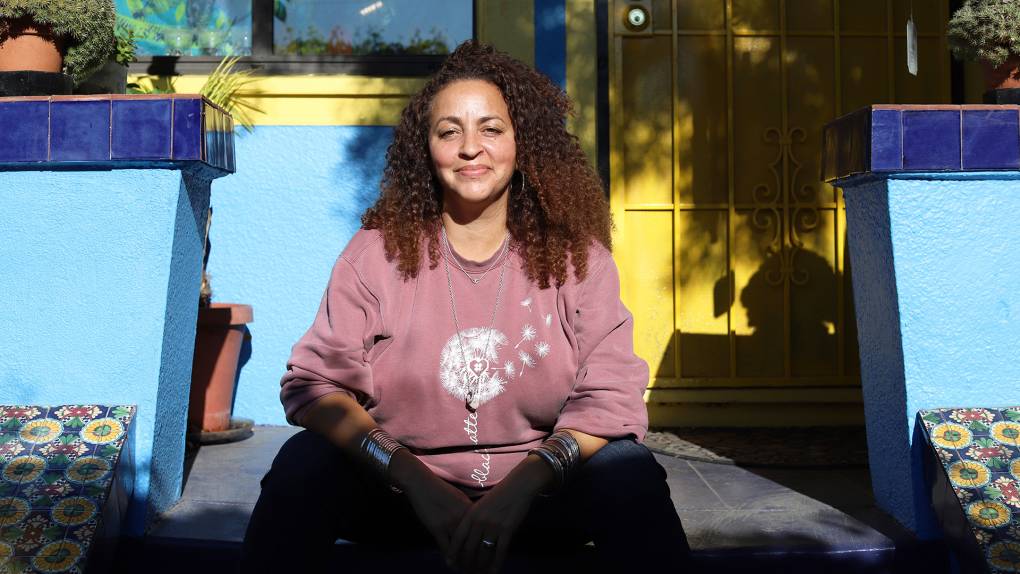
“She called me up in tears when she first saw it and she just said, ‘You’ve liberated us,’” Hall said. “I grew up observing my mother and thinking about the psychological impact of being brought up in an environment where you weren’t allowed to talk about something. To me, she always looked like a Black woman. I was saying to her, ‘Tell me about this. What are we? Tell me the story.’ She didn’t know. It’s not that she wouldn’t. She couldn’t. She was respecting her father’s wishes.”…
Read the entire article and watch the video discussion here.
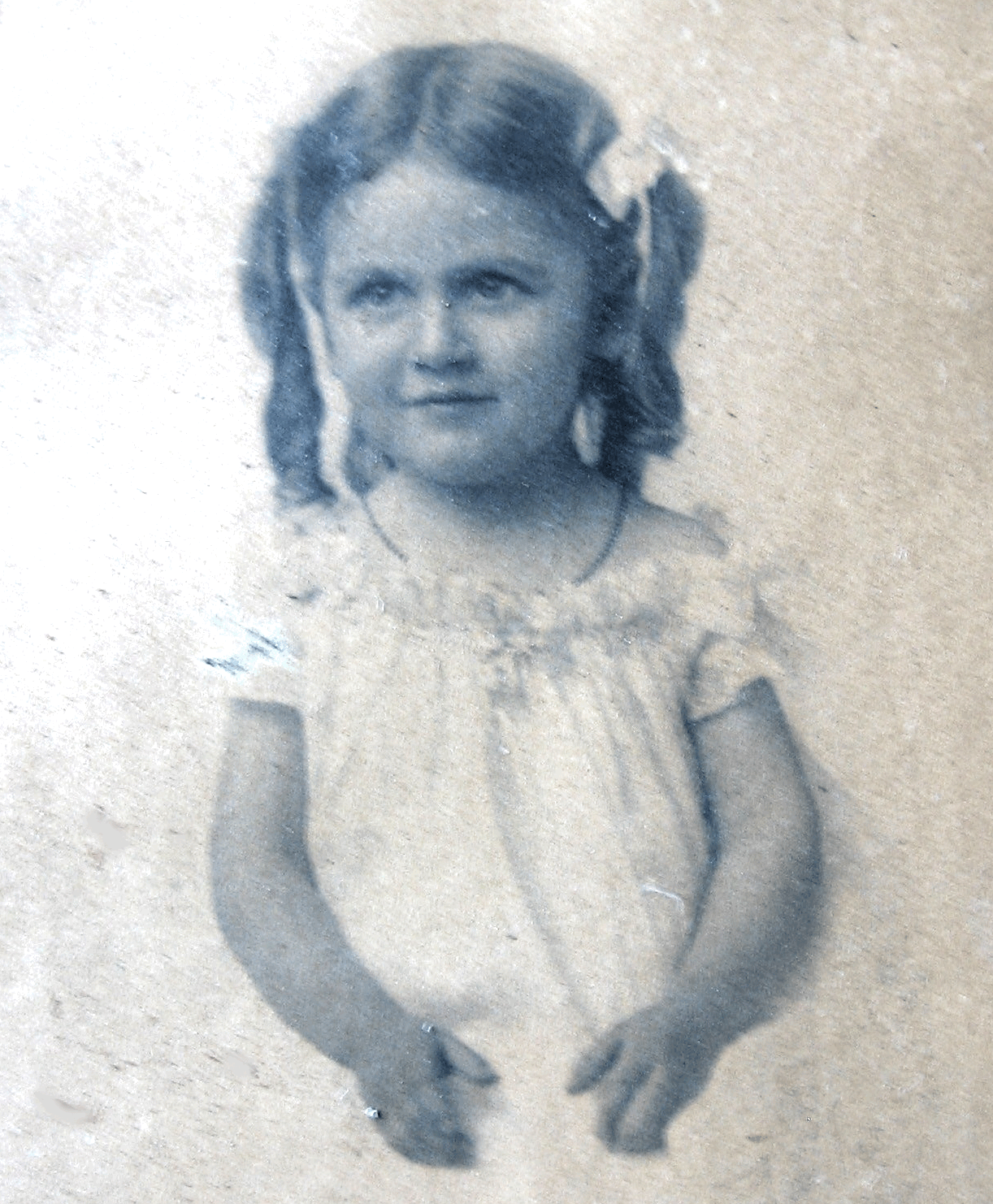
Isabel Wall. Photo from Wall family album, courtesy of Larissa Clayton
Little 7-year-old Isabel Wall, blonde and blue-eyed, bounced along beside her mother as they walked the two blocks from their home at 1019 Kearny Street to the Brookland School at 10th and Monroe. Isabel was to be enrolled in the first grade.
The principal, Mary Little, asked some basic questions and then filled out the form to admit the child and let her begin classes. It wasn’t to last. Ten days later, she withdrew the admission, due to “information subsequently obtained.” The information? School officials had heard that Isabel’s father, Stephen, though he was light-skinned and had a white wife, was in reality a black man. The Brookland School was for whites only…
The extent to which elite universities like Columbia worked to keep black students outside their walls makes the accomplishments of Columbia’s hailed “first” black graduates even more impressive, as these students existed within institutions that found identity through racialized exclusivity. That being said, James Parker Barnett’s story highlights a problem with these narratives of “firsts”, not only within Columbia University, but at historically white institutions across the United States. As mentioned above, Columbia’s refusal to admit black students into the University created the conditions that encouraged black students to pass as white, and James Parker Barnett may be a case of just that. However, the only reason we know about James Parker Barnett was because he was caught. There were high levels of racial mixing occurring in the United States through the 1850s when Barnett was expelled from P&S [School of Physicians and Scientists], and estimates about the frequency of racial passing are contentious. Walter White, a famous fair-skinned black man who passed as white while doing investigative work for the NAACP, estimated that “approximately 12,000 white-skinned Negroes disappear” into white society every year”.52Roi Ottley, a famous African-American journalist in the early 1900s, claimed that there were approximately five million white-passing black people with forty to fifty thousand passing into whiteness every year.53 While these men lived in the early to mid-1900’s, well past Barnett’s time, their research proves that racial passing had become increasingly common as African descendants continued to mix with those of white ancestry. I argue that this information lends itself to the idea that it was highly unlikely that Barnett, if indeed passing, was the first nor the last black individual to pass as white at Columbia University before it officially began accepting black students. How then, can the university endeavor to honor the “first black” students at Columbia if it has no way of knowing the identities of black passers who, by racial standards of the time, were the first graduating students of African “blood”?
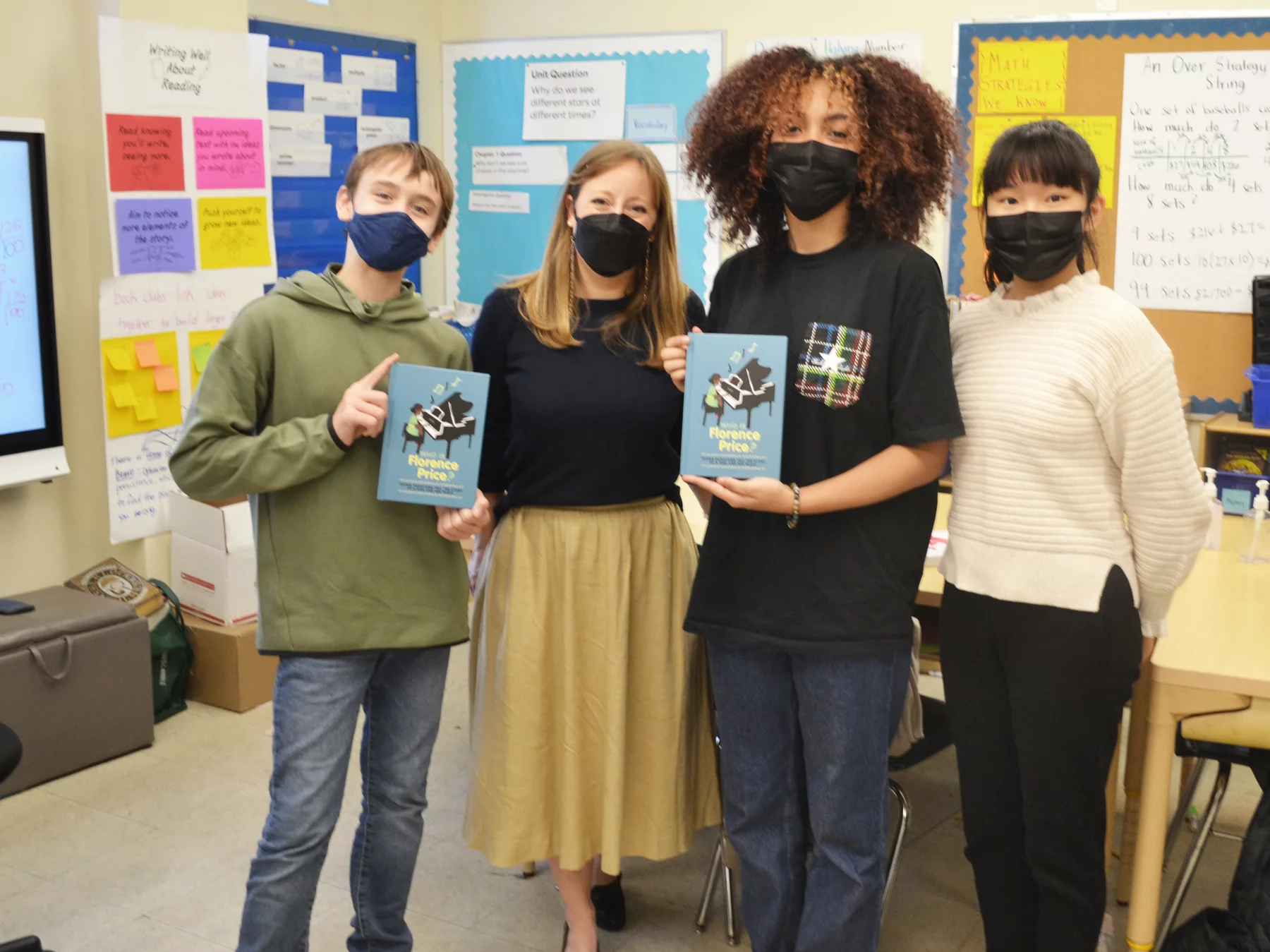
Three of the student authors of Who Is Florence Price? (left to right: Sebastián Núñez, Hazel Peebles and Sophia Shao), joined by their English teacher, Shannon Potts. Courtesy of Special Music School
For decades, it was almost impossible to hear a piece of music written by Florence Price. Price was a Black, female composer who died in 1953. But a group of New York City middle school students had the opportunity to quite literally write Florence Price’s history. Their book, titled Who Is Florence Price?, is now out and available in stores.
“Our children are musicians, so whether or not we intentionally draw it together, they bring music into the classroom every day in the most delightful ways,” Potts says. “So if you’re talking about themes and poetry, immediately a child will qualify it with the way that a theme repeats in music.”
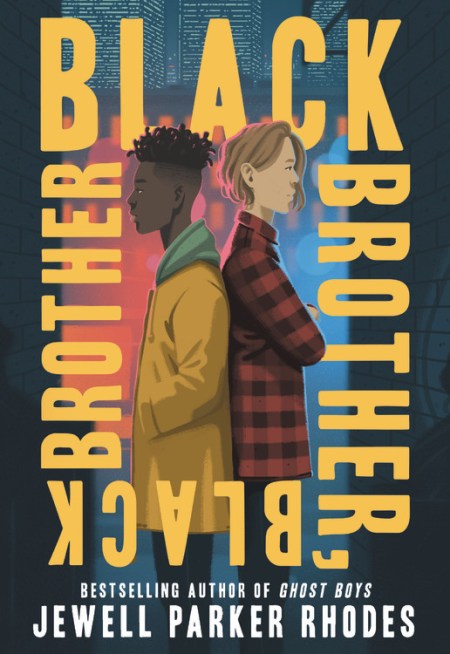
From award-winning and bestselling author, Jewell Parker Rhodes comes a powerful coming-of-age story about two brothers, one who presents as white, the other as black, and the complex ways in which they are forced to navigate the world, all while training for a fencing competition.
Framed. Bullied. Disliked. But I know I can still be the best.
Sometimes, 12-year-old Donte wishes he were invisible. As one of the few black boys at Middlefield Prep, most of the students don’t look like him. They don’t like him either. Dubbing him “Black Brother,” Donte’s teachers and classmates make it clear they wish he were more like his lighter-skinned brother, Trey.
When he’s bullied and framed by the captain of the fencing team, “King” Alan, he’s suspended from school and arrested.
Terrified, searching for a place where he belongs, Donte joins a local youth center and meets former Olympic fencer Arden Jones. With Arden’s help, he begins training as a competitive fencer, setting his sights on taking down the fencing team captain, no matter what.
As Donte hones his fencing skills and grows closer to achieving his goal, he learns the fight for justice is far from over. Now Donte must confront his bullies, racism, and the corrupt systems of power that led to his arrest.
Powerful and emotionally gripping, Black Brother, Black Brother is a careful examination of the school-to-prison pipeline and follows one boy’s fight against racism and his empowering path to finding his voice.
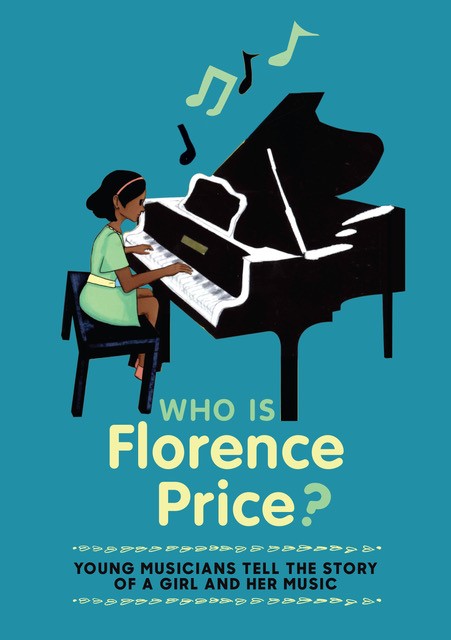
Young musicians tell the story of a girl and her music
Florence [Price] loved her mother’s piano playing and wanted to be just like her. When she was just four years old she played her first piano concert and as she grew up she studied and wrote music hoping one day to hear her own music performed by an orchestra.
The story of a brilliant musician who prevailed against race and gender prejudices to become the first Black woman to be recognised as a symphonic composer and be performed by a major American orchestra in 1933.
Mystic surprised the world by walking away from a record deal after her successful debut album. But for her, it was all part of the plan to create and be of service, completely on her own terms. (Nastia Voynovskaya/KQED)
Mystic sits in her backyard on the kind of warm, autumn afternoon that makes people remark at how good it is to live in Oakland, California. Dappled light shines through a lush canopy of persimmon, fig and guava trees. Her pet lovebird chirps in the distance, and she’s snacking on almonds between Zoom calls with young musicians she mentors.
This is the veteran hip-hop artist’s little oasis, away from the unruliness of the city, where she ponders the changing seasons of life, love and art.
It’s a good time for reflection. The recent loss of her longtime close friend and Digital Underground collaborator, Shock G, shook her deeply. That, and the grief of living during a global pandemic, prompted her to listen inward and ask herself what would fulfill her soul right now.
“I mean, shouldn’t we be doing what we love? Isn’t it the time now?” she asks in her naturally poetic cadence, lowering her voice into a near-whisper. Then, she starts to get louder and more passionate, as if proclaiming a manifesto: “If we’re artists, and art is part of our healing journey, then we should all be making art right now, right? There should be art flooding our speakers and our museums and our buildings, right? Public art.”
And for Mystic, one of the roles of hip-hop as a public art form is to bring traumas out of darkness and into the light, where they can be examined and processed—maybe even let go—in communion with others. That’s the power of her classic album Cuts for Luck and Scars for Freedom, whose 20th anniversary Mystic is celebrating this year. She recently took ownership of the master recordings and put out a podcast series looking back at its creation. Now, she’s gearing up for a vinyl rerelease in December.
From the outside, it might look like Mystic is recommitting to her art after years of focusing on her other loves: academia and teaching. After Cuts for Luck and Scars for Freedom was released to great acclaim, she walked away from a record deal and took a different path that brought her to UC Berkeley and, eventually, the University of Oxford for her master’s degree in education. For years, she spent more time in kindergarten classrooms than on stage in front of fans. But to Mystic, these multiple pursuits are all part of one continuous quest to create, express and be of service.
“It takes life to make art,” she texts me after one of our conversations. “There are times of input and times of output. I take my time for input, and that includes healing, living, loving, working with children, school and community. When my art is ready to be born, that is output. That is all 😉.”…
A classroom exploration and discovery led students to create an illustrated biography of a composer whose music is being widely celebrated around the world today. Their book Who is Florence Price? will be published by Schirmer Trade Books, part of Wise Music Group, on November 18th 2021.
Florence Price became the first Black woman to have her music played by a major American orchestra when the Chicago Symphony Orchestra performed her Symphony No. 1 in 1933. The new children’s book Who Is Florence Price? tells the story of a brilliant musician who prevailed against race and gender prejudices to achieve this important milestone. The book was written and illustrated by 45 middle school students at Kaufman Music Center’s Special Music School, New York City’s only K-12 public school that teaches music as a core subject. The project began when English teacher Shannon Potts realized that there were no materials about Price’s life at the lower school reading level. The students studied Price’s biography and mapped out her life story on a wall, discussing which elements were most important to the narrative for their intended audience: children at approximately the third-grade reading level. After collaboratively writing and revising the text, the students created the illustrations, beginning with backgrounds of cut paper. The book was originally self-published as a classroom project shortly before the [COVID-19] pandemic shut down NYC in the spring of 2020 and has been revised for the 2021 release…
Director Rebecca Hall’s recent adaptation of Nella Larsen’s exquisite second novel, Passing (1929), is visually stunning. I had the pleasure of seeing the film on the big screen, during its limited theatrical run and before its Netflix release. It was the ideal atmosphere for absorbing this cinematic rendering of Larsen’s eerie, anxiety-ridden plot: ensconced with a sparse audience (my companion and I comprising two of the four patrons for the 5:10pm showing) in a small independent theater in Manhattan, just a few miles from where the story is set, and with Halloween everywhere looming on this late-October evening.1
These qualities of the novel were only enhanced by Hall’s decision to film it in black and white, a daring choice that she, a first-time filmmaker, had to fight for, as Alexandra Kleeman of the New York Timesreports. On the one hand, this artistic decision conjures all the nervous palpitations that Hitchcock made synonymous with black-and-white mise-en-scène, maintaining the unshakable uneasiness one experiences while reading Larsen’s novel. On the other, it hurls the either-or terms of Jim Crow racial binarism into conflict with a predominating grayscale—an all-pervading sign of the fictionality of the dichotomizations structuring American culture. Nothing could be more in the spirit of Nella Larsen’s novel. I suspect, however, that Hall’s departures from the source text will attract the attention of modernists far more than her convergences…