Mixed Race Studies

Scholarly perspectives on the mixed race experience.

    • About This Site
    • Bibliography
    • Contact Information
    • Date and Time Formats
    • Forthcoming… (Updated 2021-09-01)
    • Likely Asked Questions
    • List of Book Publishers
    • List of Definitions and Terms
    • My Favorite Articles and Papers
    • My Favorite Posts
    • My Recent Activities
    • Praise for Mixed Race Studies
    • Tag Listing
      • Tag Listing (Ordered by Count)
    • US Census Race Categories, 1790-2010
    • 1661: The First ‘Mixed-Race’ Milestone
    • 2010 U.S. Census – Some Thoughts

recent posts

  • The Routledge International Handbook of Interracial and Intercultural Relationships and Mental Health
  • Loving Across Racial and Cultural Boundaries: Interracial and Intercultural Relationships and Mental Health Conference
  • Call for Proposals: 2026 Critical Mixed Race Studies Conference at UCLA
  • Participants Needed for a Paid Research Study: Up to $100
  • You were either Black or white. To claim whiteness as a mixed child was to deny and hide Blackness. Our families understood that the world we were growing into would seek to denigrate this part of us and we would need a community that was made up, always and already, of all shades of Blackness.

about

  • Twitter
  • Facebook
  • Instagram
  • UCF Faculty Member Holly McDonald Inspires Change Through Theatre

    2021-09-28

    UCF Faculty Member Holly McDonald Inspires Change Through Theatre

    University of Central Florida News
    Orlando, Florida
    2018-03-27

    Ashley Garrett

    Holly McDonald can pinpoint the exact moment her love for the theatre began.

    When she was 16, she rode a bus from her small hometown of Keyser, WV, to The Kennedy Center in Washington, D.C., to watch a production of the musical 42nd Street.

    “I’d never seen a stage show of that magnitude,” McDonald says. “It was an enormous adventure for me. I saw the performance on stage and waited outside for the actors to come out, and I just fell in love.”

    While studying theatre performance as an undergraduate then graduate student, her love grew when she discovered and explored how theatre can be used for social good. She found herself drawn to performance art that could convey a deeper message and teach a lesson…

    …A Journey to Self-Discovery

    McDonald credits her parents for instilling a sense of social justice within her from early childhood by “taking an active role in their community and stressing the importance of engagement with others.” It was her mother, in particular, who pushed her to help others whenever given the chance.

    “My mother is a huge inspiration. She is someone who would frequently call and give me encouragement,” McDonald says. “She always said to me, ‘Follow your heart and do the right thing.’”

    Her mother’s guidance led McDonald to take professional leave about five years ago to write her play, Proclamation of a Multiracial Woman. The semi-autobiographical play, which tells the story of an adopted biracial woman who searches for self-identity, relies heavily on themes from McDonald’s own life. She credits the play for providing her with an opportunity for self-reflection. Like her fictional counterpart, she searched for answers as a mixed-race woman, ultimately finding peace from within…

    Read the entire article here.

  • Bernardine Evaristo on a childhood shaped by racism: ‘I was never going to give up’

    2021-09-28

    Bernardine Evaristo on a childhood shaped by racism: ‘I was never going to give up’

    The Guardian
    2021-09-25

    Bernardine Evaristo


    Bernardine Evaristo: ‘I liked the same music as my little white pals, ate the same food, had the same feelings – human ones.’ Photograph: Suki Dhanda/The Observer

    My creativity can be traced back to my heritage, to the skin colour that defined how I was perceived. But, like my ancestors, I wouldn’t accept defeat

    When I won the Booker prize in 2019 for my novel Girl, Woman, Other, I became an “overnight success”, after 40 years working professionally in the arts. My career hadn’t been without its achievements and recognition, but I wasn’t widely known. The novel received the kind of attention I had long desired for my work. In countless interviews, I found myself discussing my route to reaching this high point after so long. I reflected that my creativity could be traced back to my early years, cultural background and the influences that have shaped my life. Not least, my heritage and childhood

    Through my father, a Nigerian immigrant who had sailed into the Motherland on the “Good Ship Empire” in 1949, I inherited a skin colour that defined how I was perceived in the country into which I was born, that is, as a foreigner, outsider, alien. I was born in 1959 in Eltham and raised in Woolwich, both in south London. Back then, it was still legal to discriminate against people based on the colour of their skin, and it would be many years before the Race Relations Acts (1965 and 1968) enshrined the full scope of anti-racist doctrine into British law.

    My English mother met my father at a Commonwealth dance in central London in 1954. She was studying to be a teacher at a Catholic teacher-training college run by nuns in Kensington; he was training to be a welder. They married and had eight children in 10 years. Growing up, I was labelled “half-caste”, the term for biracial people at that time…

    Read the entire article here.

  • Colin Kaepernick Netflix Series ‘Colin in Black and White’ Drops New First-Look Clip

    2021-09-27

    Colin Kaepernick Netflix Series ‘Colin in Black and White’ Drops New First-Look Clip

    Variety
    2021-09-25


    COURTESY OF NETFLIX

    Netflix has released a new first-look clip of “Colin in Black and White,” which tells the story of former NFL player Colin Kaepernick during his high school years growing up in central California.

    The clip was released as part of the Netflix Tudum fan event. Kaepernick explained during his introduction of the clip that the six-part narrative drama produced with Ava DuVernay focuses on his high school years growing up in Turlock, Calif., a mid-sized city 60 miles east of San Jose, as the Black adopted son of white parents in a largely white community. As depicted in the clip, in high school Kaepernick set his sights set on becoming a professional baseball player.

    The half-hour series is set to debut on Netflix on Oct. 29. Jaden Michael will star as a young Kaepernick, with the real Kaepernick appearing throughout as the narrator…

    Read the entire article here.

  • She became a park ranger at 85 to tell her story of segregation. Now 100, she’s the oldest active ranger.

    2021-09-27

    She became a park ranger at 85 to tell her story of segregation. Now 100, she’s the oldest active ranger.

    The Washington Post
    2021-09-24

    Sydney Page


    Betty Reid Soskin at the Rosie the Riveter World War II Home Front National Historical Park in Richmond, Calif. Soskin is the oldest active ranger in the National Park Service. (Luther Bailey/NPS photo)

    When asked how it feels to be 100 years old, Betty Reid Soskin gave a subtle shrug, smiled and said: “The same way I felt at 99.”

    But she’s not just any centenarian: Soskin is the oldest active ranger in the National Park Service, and after celebrating her birthday on Sept. 22, she’s still going strong.

    Seated in the study of her apartment in Richmond, Calif., dressed proudly in her park ranger uniform, Soskin reflected on her life.

    When it comes to sharing her story, Soskin is not shy. As a park ranger at the Rosie the Riveter World War II Home Front National Historical Park in Richmond, she spends her days recounting her rich and complicated history, in the hope that her firsthand account will resonate with people, and encourage them to share their own stories.

    “I think everyone’s story is very important. There is so much diversity,” Soskin said. “It’s in that mix that the great secret of a democracy exists.”…

    Read the entire article here.

  • NKF and ASN Release New Way to Diagnose Kidney Diseases

    2021-09-27

    NKF and ASN Release New Way to Diagnose Kidney Diseases

    National Kidney Foundation
    2021-09-23

    Both Organizations Recommend Race-Free Approach to Estimate GFR

    Sept. 23, 2021, New York, NY – Today, the National Kidney Foundation (NKF) and the American Society of Nephrology (ASN) Task Force on Reassessing the Inclusion of Race in Diagnosing Kidney Diseases has released its final report, which outlines a new race-free approach to diagnose kidney disease. In the report, the NKF-ASN Task Force recommends the adoption of the new eGFR 2021 CKD EPI creatinine equation that estimates kidney function without a race variable. The task force also recommended increased use of cystatin C combined with serum (blood) creatinine, as a confirmatory assessment of GFR or kidney function. The final report, published today online in the American Journal of Kidney Diseases (AJKD) and the Journal of the American Society of Nephrology (JASN), was drafted with considerable input from hundreds of patients and family members, medical students and other trainees, clinicians, scientists, health professionals, and other stakeholders to achieve consensus for an unbiased and most reasonably accurate estimation of GFR so that laboratories, clinicians, patients and public health officials can make informed decisions to ensure equity and personalized care for patients with kidney diseases…

    Read the entire press release here.

  • Emma Dabiri: ‘When race begins and ends with social media, we have quite reductive, distorted interpretations of what we’re dealing with’

    2021-09-27

    Emma Dabiri: ‘When race begins and ends with social media, we have quite reductive, distorted interpretations of what we’re dealing with’

    The Irish Independent
    2021-07-18

    Liadan Hynes


    Writer Emma Dabiri, photographed by Steve Ryan

    Irish-Nigerian writer and academic Emma Dabiri talks about growing up in Ireland as an outsider, how this shaped her activism and career, and why leisure is liberation

    ‘I had already been angry, had spent most of my life angry,” Emma Dabiri writes in her latest book, What White People Can Do Next. She’s talking about her reaction to the murder of George Floyd in America last May at the hands of a police officer, and the subsequent protests that broke out around the world.

    Now, though, she no longer gets angry. Last summer’s events were, Emma reflects, in terms of racism, “just business as usual”.

    She recalls wryly now how people contacted her in the wake of Floyd’s murder.

    “So, for me, it’s completely horrific, but why was it that murder that sparked the world? State-sanctioned killing has been happening regularly for centuries; that one captured the public’s imagination,” she says.

    “I had people messaging me saying ‘this time must be unbearably distressing for you’, and I’m like, well, why is it wildly more distressing than any of the millions of other times this has happened? Because you happened to hear of it this time? Because this time it happened to move you? Why do you think this is the first time I’m engaging with something like this?”

    Broadcaster, author and academic Emma, whose father was Nigerian and whose mother is Irish, was born in Dublin but moved to Atlanta, Georgia, where she lived before returning to Ireland with her mum when she was four. She grew up here in the 1980s and early 1990s, before moving to London when she was 19.

    “I experienced racism from quite a young age. My response to those experiences was to read, and try and make sense of what I was experiencing through reading,” explains Emma, who left Ireland to do a degree in African studies and post-colonial theory at SOAS University of London.

    She understood racism at an early age: “These weren’t things that I decided, or discovered recently, I have been living and working with and through this stuff for many, many years.”…

    Read the entire article here.

  • Why Didn’t Movies about Passing Cast Black Actors?

    2021-09-23

    Why Didn’t Movies about Passing Cast Black Actors?

    JSTOR Daily: Where News Meets Its Scholarly Match
    2021-02-03

    Matthew Wills


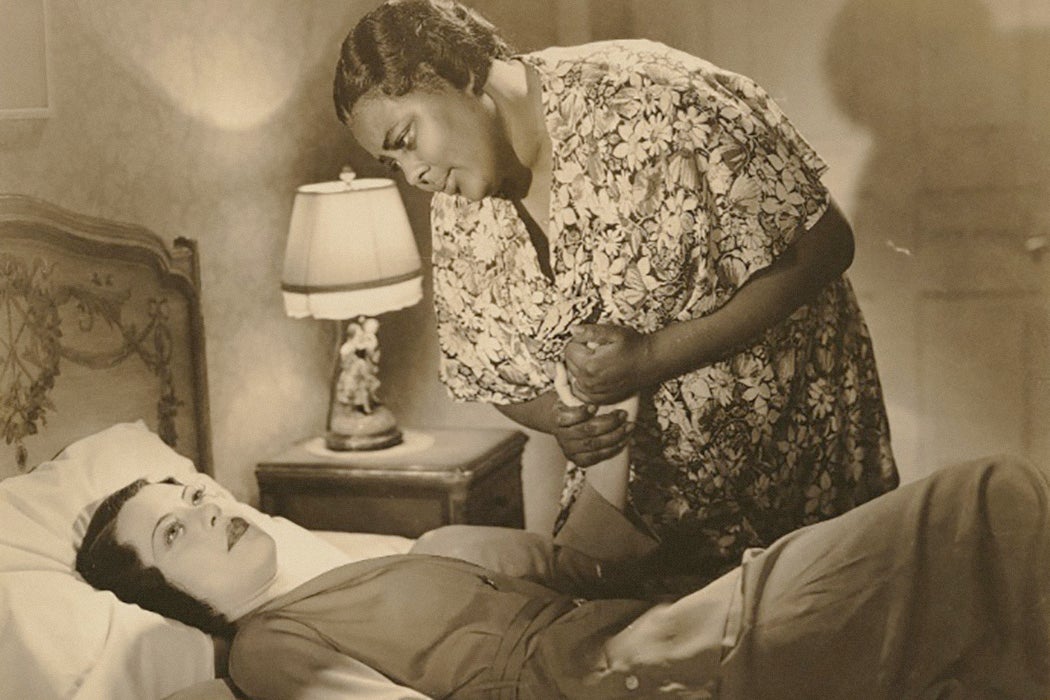
    Fredi Washington and Louise Beavers in a scene from Imitation of Life via New York Public Library

    “Social problem” films were all the rage after World War II. So how could movies about racism be so conservative?

    After World War II, Hollywood tried something new: realism, tackling social problems like mental illness, drug addiction, anti-Semitism, and racism. But as media-studies scholar Karen M. Bowdre argues, films “about” race and racism “often focused on the concept of passing, a Black character claiming his or her White heritage while denying any African ancestry.”

    Passing movies also tended to cast white actors in the roles of mixed-race characters who passed as white. But that wasn’t the case with the original version of Imitation of Life, made in 1934. Fredi Washington made history by being the first Black actress to play a character (“Peola”) who passes as white. Even more unusually, two Black children were cast to play the part of Peola at ages three and seven.

    The Production Code Administration (PCA), the industry’s self-censorship office, was roiled by director John Stahl’s casting choices. The PCA’s “voluminous” file on the film is filled with references to miscegenation, which isn’t a topic of the movie, but presumably would be raised by white viewers who would want to know why Washington looked so “white.”…

    Read the entire article here.

  • A Novelist Dissects the Claustrophobic Evil of Jim Crow

    2021-09-23

    A Novelist Dissects the Claustrophobic Evil of Jim Crow

    The New York Times
    2017-10-06

    Ayana Mathis


    Melinda Beck

    Eleanor Henderson, The Twelve-Mile Straight, A Novel (New York: Ecco/HarperCollins, 2017)

    Every couple of decades the nation revisits, publicly and painfully, its oldest violence. The wounds of race — still open, still weeping over the course of 400 years — preoccupy our literature for a time. This is a good thing, given that the wages of silence are most certainly death. At its best, historical fiction isn’t a stump speech or a school lesson, but it sure does illuminate the past, give soul and body to our history so we can sojourn with it a while, in privacy and contemplation. As a useful byproduct, it gives us a fighting chance at recognizing the past’s reverberations in our present. And reverberate it does.

    When plunging into the bloody abyss of the American racial past, as Eleanor Henderson does in her second novel, “The Twelve-Mile Straight,” the stakes are high. The novel is set in 1930 in Cotton County, Ga. In its opening pages a black man, Genus Jackson, is lynched for raping a young white woman named Elma Jesup: “Genus dropped, his neck snapping like a chicken’s, his body falling limp.”

    We suspect that Genus is innocent, and indeed, he is. We hope his luridly described murder by lynching proves more than a mere point of departure for Henderson’s sprawling Southern Gothic family drama. Genus was a field hand on the farm that Elma Jesup sharecrops alongside her father, Juke, and a mute black girl, 14-year-old Nan Smith. The girls live like sisters and, at least when they are home on the farm, the racial lines that divide them are blurred by affection and proximity…

    Read the entire review here.

  • Being biracial and, more recently, bicoastal (having been away from her L.A. home during the residency), there’s a sense of a constant effort of recentering and reworking through a whole host of feelings that’s relatable for many people, especially during this time of reckoning with the state of race, health, and politics in our country.

    2021-09-23

    Looking at [Genevieve] Gaignard’s work, you can see what she might be trying to work through—feelings of home, identity, family, and belonging. Being biracial and, more recently, bicoastal (having been away from her L.A. home during the residency), there’s a sense of a constant effort of recentering and reworking through a whole host of feelings that’s relatable for many people, especially during this time of reckoning with the state of race, health, and politics in our country. “Sometimes I think, ‘How many feelings can you hold on to?’” she said. “I can put this particular feeling here or this mood can live here,” she added, nodding to the way her works become vessels for her emotions and concerns.

    Dominique Clayton, “Genevieve Gaignard’s Timely Work Documents Racial Injustice and Calls for Change,” Artsy, October 13, 2020. https://www.artsy.net/article/artsy-editorial-genevieve-gaignards-timely-work-documents-racial-injustice-calls-change.

  • Retrospection: Agassiz’s Expeditions in Brazil

    2021-09-23

    Retrospection: Agassiz’s Expeditions in Brazil

    The Harvard Crimson
    2016-04-21

    Michelle Y. Raji


    Louis Rodolphe Agassiz

    But for Agassiz, the trip to Brazil was about more than science. Not only was evolution—a process not immediately observable to the human eye—deeply antithetical to Agassiz’s staunch empiricism, evolution was profoundly at odds with his perceived world order.

    Three decades after the then-obscure scientist Charles Darwin quietly sketched his now-famous finches aboard the HMS Beagle in the Galapagos, influential Harvard professor Louis Rodolphe Agassiz set out with much greater fanfare on a lesser-known expedition. In 1865, Agassiz and his wife, accompanied by a small group of Harvard scientists and students, set sail from New York to Rio de Janeiro on The Colorado.

    In a lecture en route to Brazil, Agassiz challenged Darwin’s revolutionary theory of evolution on the grounds that the theory relied too much on argument and too little on fact. Agassiz posited that evolution was not plausible according to the geologic record. The trip to Brazil was an attempt to disprove Darwin once and for all. Agassiz saw in the unique biodiversity of Brazil a perfect laboratory to test his counter-theories of phylogenetic embryology and glacial catastrophe in the tropics.

    But for Agassiz, the trip to Brazil was about more than science. Not only was evolution—a process not immediately observable to the human eye—deeply antithetical to Agassiz’s staunch empiricism, evolution was profoundly at odds with his perceived world order. Though only moderately religious, Agassiz believed in the existence of a creator in all his work. Fortunately for Agassiz, this belief fit well with comparative zoology, which at the time focused heavily on hierarchal classification…

    Read the entire article here.

Previous Page
1 … 67 68 69 70 71 … 1,428
Next Page

Designed with WordPress