• Feeling proud and confident in one’s racial-ethnic identity can potentially protect Multiracial individuals from discrimination and the negative mental health consequences associated with rejection or attacks on their identity.

    Annabelle Atkin, “Multiracial identities and resilience to racism: The role of families,” Medical News Today, September 14, 2021. https://www.medicalnewstoday.com/articles/multiracial-identities-and-resilience-to-racism-the-role-of-families.

  • We have grown tired of the pressure to claim one side of our heritage over another. The antiquated social and legal principle that one drop of blood determines if we’re Black or that complexion, hair texture or facial features decides whether someone of mixed ancestry is more White, Asian or Latino has been harmful.

    Steve Majors, “A birth certificate masked my multiracial truth. For me and 33 million others, the 2020 Census asserts it.The Washington Post, August 31, 2021. https://www.washingtonpost.com/s/nation/2021/08/31/its-about-time-2020-census-caught-up-with-my-multiracial-life/.

  • ‘America’s Oldest Park Ranger’ Is Only Her Latest Chapter

    The New York Times
    2021-09-20

    Jennifer Schuessler


    Chanell Stone for The New York Times

    Betty Reid Soskin has fought to ensure that American history includes the stories that get overlooked. As she turns 100, few stories have been more remarkable than hers.

    The Rosie the Riveter / World War II Home Front National Historical Park, which sprawls across the former shipyards in Richmond, Calif., on the northeast edge of San Francisco Bay, tells the enormous story of the largest wartime mobilization in American history and the sweeping social changes it sparked.

    Visitors can climb aboard an enormous Victory ship, one of more than 700 vessels produced in Richmond — and, in the gift shop, pick up swag emblazoned with the iconic image of the red-kerchiefed Rosie herself, arm flexed up with “We Can Do It!” bravado.

    But for many, the park is synonymous with another woman: Betty.

    Betty Reid Soskin, who turns 100 on Sept. 22, is the oldest active ranger in the National Park Service. Over the past decade and a half, she has become both an icon of the service and an unlikely celebrity, drawing overflow crowds to talks and a steady stream of media interviewers eager for the eloquent words of an indomitable 5 feet 3 inch great-grandmother once described by a colleague as “sort of like Bette Davis, Angela Davis and Yoda all rolled into one.”…

    Read the entire article here.

  • A Love Letter to Indigenous Blackness

    NACLA: Report on the Americas
    Volume 53, Issue 3, November 2021 (Published online 2021-09-13)
    pages 248-254

    Paul Joseph López Oro, Assistant Professor of Africana Studies
    Smith College, Northampton, Massachusetts


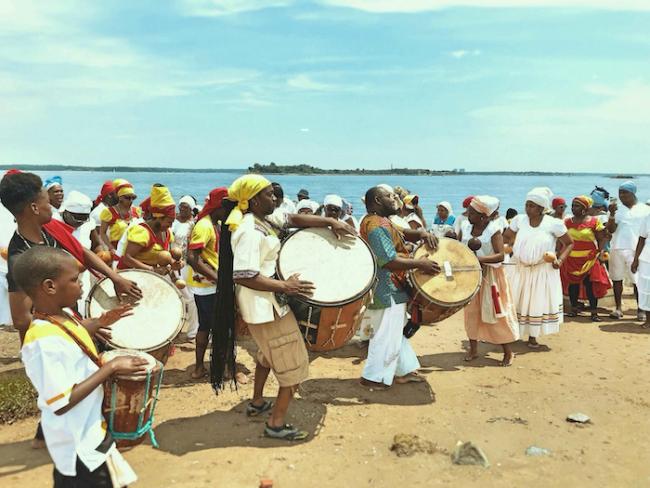
    A Garifuna ritual gathering to honor the ancestors at Orchard Beach in the Bronx, New York, June 2017. (Paul Joseph López Oro)

    Garifuna women in New York City working to preserve life, culture, and history across borders and generations are part of a powerful lineage of resistance to anti-Blackness.

    Mirtha Colón. Janel Martinez. Aida Lambert. Tania Molina. Carla Garcia. Tola Guerrero. Karen Blanco. Miriam Miranda. Ofelia Bernandez. Olga Nuñez. Luz Solis. Siria Alvarez. Isha Sumner. Sulma Arzu-Brown. Dilma Suazo-Gordon. Isidra Sabio. These are just some names of Garifuna women whose hemispheric political labor highlights a transgenerational and transnational tradition of preserving Garifuna life. Garifuna women are the very foundation of conjuring, mobilizing, and safeguarding Garifuna ancestral memory, rituals, language, and oral histories—all embodied histories of knowledge production—across generations and national boundaries. Some of these Garifuna women live in New York City, and some of them live in Central America’s Caribbean coasts. Some have never been to Central America, but their family’s nostalgia remains with them.

    Garifuna life is matrifocal. Garifuna women are not simply the head of the household, but they are also at the center of organizing and governing every family structure, which extends beyond biological kinship. This is not a uniquely Garifuna experience. Throughout the African diaspora in the Americas, Black women are often the head of the household. Especially if we consider non-heteronormative notions of family and kinship, Black women have been at the forefront of preserving and protecting Black life over centuries, as anthropologists Christen A. Smith and Keisha-Khan Y. Perry have documented. However, a matrifocal or matrilineal society does not dismantle misogynoir, patriarchy, racial capitalism, and anti-Blackness. I write this matrilineal love letter to honor, celebrate, and center Garifuna women’s political, intellectual, spiritual, cultural, and knowledge producing labor that often goes unseen, uncited, or undervalued in a world that remains heteropatriarchal and anti-Black…

    Read the entire article here.

  • Pauli Murray Should Be a Household Name. A New Film Shows Why.

    The New York Times
    2021-09-15

    Melena Ryzik


    A scene from “My Name Is Pauli Murray.” The documentarian Betsy West, who made the film with Julie Cohen, said, “We just thought, why didn’t anybody teach us about this person?” Amazon Studios

    The lawyer, activist and minister made prescient arguments on gender, race and equality that influenced Thurgood Marshall and Ruth Bader Ginsburg.

    When the lawyer, activist, author and educator Pauli Murray died in 1985 at the age of 75, no obituary or commemoration could contain all of her pathbreaking accomplishments. A radical and brilliant legal strategist, Murray was named a deputy attorney general in California — the first Black person in that office — in 1946, just a year after passing the bar there. Murray was an organizer of sit-ins and participated in bus protests as far back as the 1940s, and co-founded the National Organization for Women. Murray was also the first Black woman to be ordained an Episcopal priest. In 2012, she was sainted.

    Murray has been saluted in legal, academic and gender-studies circles, and in the L.G.B.T.Q. community. But her overarching impact on American life in the 20th and now 21st centuries has not been broadly acknowledged: the thinking and writing that paved the way for Brown v. Board of Education; the consideration of intersectionality (she helped popularize the term “Jane Crow”); the enviable social circle, as she was a buddy of Langston Hughes and a pen pal of Eleanor Roosevelt, and worked on her first memoir alongside James Baldwin at the MacDowell Colony in the first year it allowed Black artists.

    Murray was devoted to feminism and the rights of women even as, it turned out, she privately battled lifelong gender identity issues. She should be a household name on par with Gloria Steinem or Ruth Bader Ginsburg, both of whom cited her work often. Instead Murray is an insider’s civil rights icon.

    Now a documentary, “My Name Is Pauli Murray,” aims to introduce Murray to the masses. Made by the same Academy Award-nominated filmmakers behind the surprise hit “RBG,” it uses Murray’s own voice and words as narration, drawn from interviews, oral histories and the prolific writing — books, poems and a collection of argumentative, impassioned and romantic letters — that Murray meticulously filed away with an eye toward her legacy. And the film arrives at a moment when the tenacious activism of people of color, especially women, is being re-contextualized and newly acknowledged, at the same time that many of the battles they fought are still raging…

    Read the entire article here.

  • Choosing Blackness

    The Philadelphia Inquirer
    2021-09-15

    Elizabeth Wellington, Staff Columnist


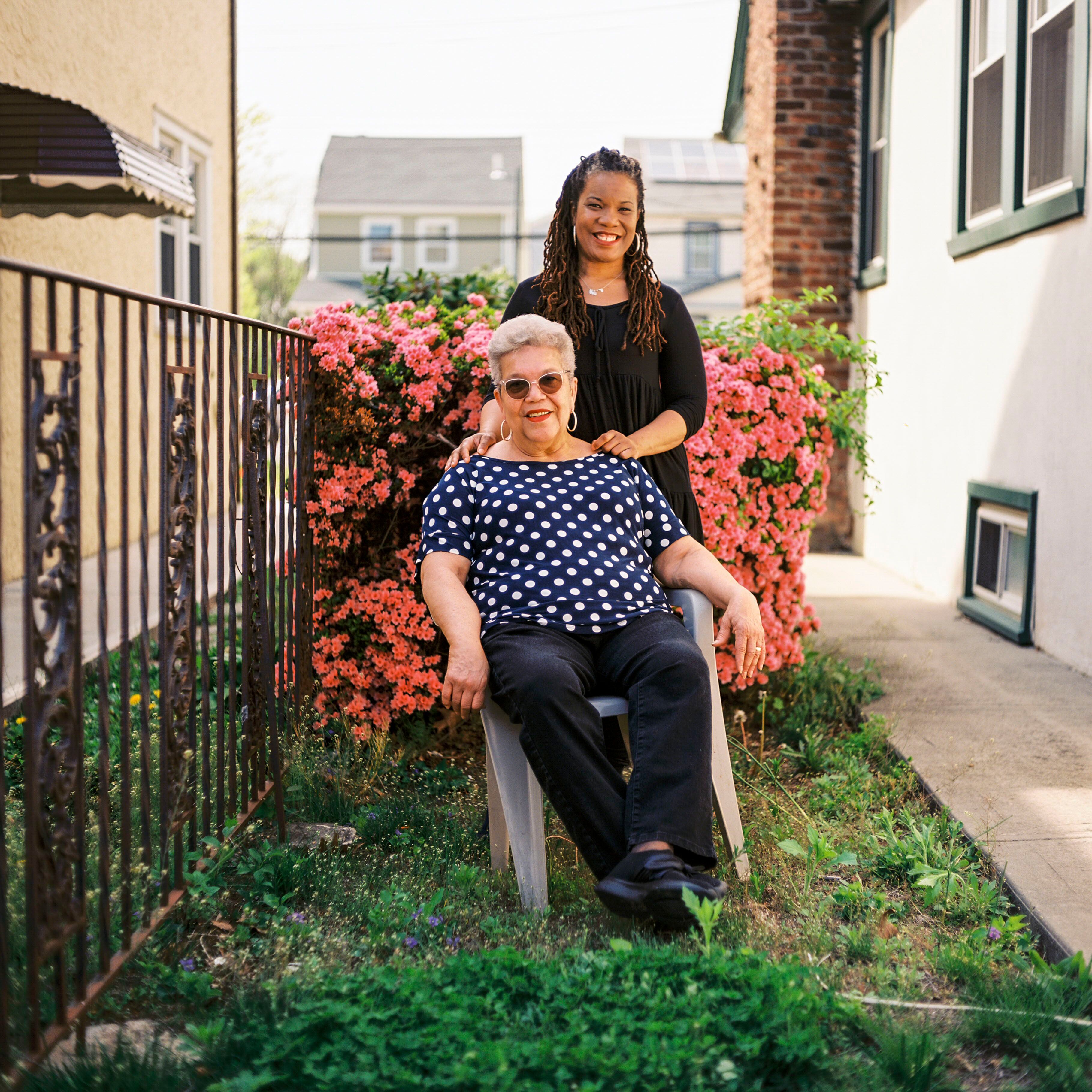
    Columnist Elizabeth Wellington poses for a photograph with her mother Margaret outside of the family home in New York. MONICA HERNDON / Staff Photographer

    Black identity is usually wrapped up in not having choice. My family used their light-skinned privilege to flip that choice and turned Blackness into a celebration of pride and identity and love.

    I thought my mother was a white woman until I was about five years old.

    So I will never forget the day she told me she was Black. The conversation started simple enough: I described someone on television as white, like she was.

    If um, hell to the no was a person, she would have been Margaret Wellington in that moment.

    My mother is so fair that whether she styled her hair in a Pam Grier-esque, mega Afro or a blonde-streaked press and curl, she was sometimes mistaken for a white woman. I’m sure she wasn’t surprised by my question given my milk chocolate hue. But she wasn’t angry. She settled into her rocking chair and motioned for me to sit next to her. We were wearing matching green cardigans. I may have been darker, but to her, I was still her toddler-sized replica. She took my chubby little hand into her slender one, and looking me in the eye said, “Beth, I’m Black.”

    Clearly I looked confused. Because she said it again. This time with more soul. “I AM BLACK. I do not have the same pretty brown skin that you have. But I AM BLACK. And I am YOUR MOTHER.”

    My 5-year-old self was relieved….

    Read the entire article here.

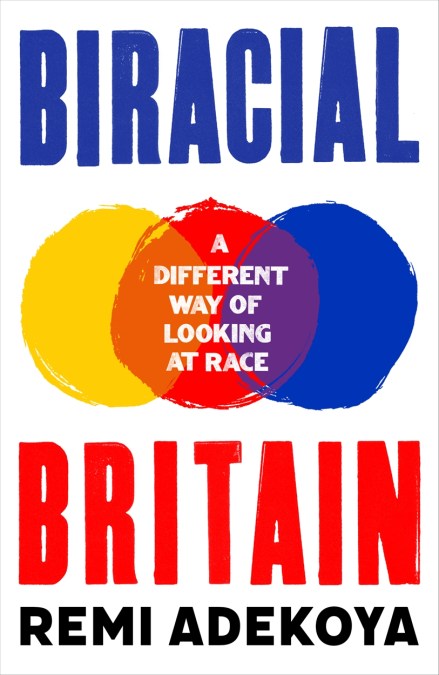
  • Biracial Britain: A Different Way of Looking at Race

    Constable
    2021-01-28
    352 pages
    Hardcover ISBN: 9781472133458
    Ebook ISBN: 9781472133434
    Paperback ISBN: 9781472133441

    Remi Adekoya, Associate Lecturer of Politics
    University of York

    Mixed-race is the fastest-growing minority group in Britain. By the end of the century roughly one in three of the population will be mixed-race, with this figure rising to 75 per cent by 2150. Mixed-race is, quite literally, the future.

    Paradoxically, however, this unprecedented interracial mixing is happening in a world that is becoming more and more racially polarized. Race continues to be discussed in a binary fashion: black or white, we and they, us and them. Mixed-race is not treated as a unique identity, but rather as an offshoot of other more familiar identities – remnants of the twentieth century ‘one-drop’ rule (‘if you’re not white, you’re black’) alarmingly prevail. Therefore, where does a mixed-race person fit? Stuck in the middle of these conflicts are individuals trying to survive and thrive. It is high time we developed a new understanding of mixed-race identity better suited to our century.

    Remi Adekoya (the son of a Nigerian father and a Polish mother, now living in Britain) has come to the conclusion that while academic theories can tell us a lot about how identities are socially constructed, they are woeful at explaining how identities are felt. He has spoken to mixed-race Britons of all ages and racial configurations to present a thoughtful and nuanced picture of what it truly means to be mixed-race in Britain today.

    A valuable new addition to discussions on race, Biracial Britain is a search for identity, a story about life that makes sense to us. An identity is a story. These are our stories.

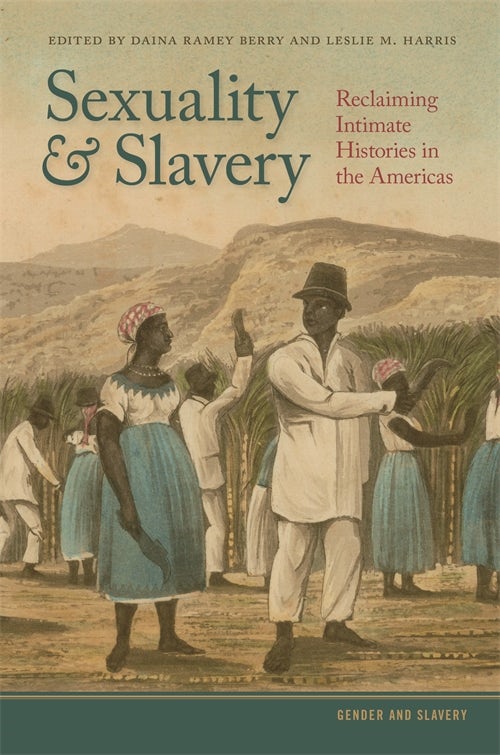
  • Sexuality and Slavery: Reclaiming Intimate Histories in the Americas

    University of Georgia Press
    2018-10-01
    240 pages
    5 b&w images
    6.000in x 9.000in
    Hardcover ISBN: 9-780-8203-5403-3
    Paperback ISBN: 9-780-8203-5404-0

    Edited by:

    Daina Ramey Berry, Oliver H. Radkey Regents Professor of History
    University of Texas, Austin

    Leslie M. Harris, Professor of History
    Northwestern University, Evanston, Illinois

    Foreword by:

    Catherine Clinton, Denman Endowed Professor in American History
    University of Texas, San Antonio

    An examination of the many facets of sexuality within slave communities

    In this groundbreaking collection, editors Daina Ramey Berry and Leslie M. Harris place sexuality at the center of slavery studies in the Americas (the United States, the Caribbean, and South America). While scholars have marginalized or simply overlooked the importance of sexual practices in most mainstream studies of slavery, Berry and Harris argue here that sexual intimacy constituted a core terrain of struggle between slaveholders and the enslaved. These essays explore consensual sexual intimacy and expression within slave communities, as well as sexual relationships across lines of race, status, and power. Contributors explore sexuality as a tool of control, exploitation, and repression and as an expression of autonomy, resistance, and defiance.

    Table of Contents

    • Foreword / Catherine Clinton
    • Acknowledgments
    • Introduction / Daina Ramey Berry and Leslie M. Harris
    • Chapter 1 : Early European Views of African Bodies: Beauty / Stephanie M. H. Camp
    • Chapter 2: Toiling in the Fields: Valuing Female Slaves in Jamaica, 1674-1788 / Trevor Barnard
    • Chapter 3: Reading the Specter of Racialized Gender in Eighteenth-Century Bridgetown, Barbados / Marisa J. Fuentes
    • Chapter 4: As if She Were My Own: Love and Law in the Slave Society of Eighteenth-Century Peru /Bianca Premo
    • Chapter 5: Wombs of Liberation: Petitions, Law, and the Black Woman’s Body in Maryland, 1780-1858 / Jessica Millward
    • Chapter 6: Rethinking Sexual Violence and the Marketplace of Slavery: White Women, the Slave Market, and Enslaved Peoples Sexualized Bodies in the Nineteenth-Century South / Stephanie Jones-Rogers
    • Chapter 7: The Sexual Abuse of Black Men under American Slavery Thomas A. Foster
    • Chapter 8: Manhood, Sex, and Power in Antebellum Slave Communities / David Doddington
    • Chapter 9: What’s Love Got to Do with It? Concubinage and Enslaved Women and Girls in the Antebellum South / Brenda E. Stevenson
    • Chapter 10: When the Present Is Past: Writing the History of Sexuality and Slavery / Jim Downs
    • Contributors
    • Index
  • Historian of Race in America Gets an Unusual Four-Book Deal

    The New York Times
    2021-09-16

    Jennifer Schuessler


    Martha S. Jones said she was already working on the first book, which she said will have an element of family history as well. Johns Hopkins University

    Martha S. Jones, a professor at Johns Hopkins University, will write four books for Basic Books, starting with an exploration of the history and legacy of slavery’s sexual violence.

    The historian Martha S. Jones has a nose for writing deeply researched histories that land in the middle of the rough and tumble of our national politics — sometimes deliberately, sometimes not.

    Birthright Citizens,” her 2018 scholarly study of the history of 19th-century debates about Black citizenship in America, arrived at a moment when some conservatives had floated the idea of ending the 14th Amendment’s guarantee that all people born in America are automatically citizens.

    Vanguard,” a political history of Black women that challenged popular narratives of the suffrage movement, was timed to coincide with the centennial of the 19th Amendment last August — but also happened to coincide with the election of Kamala Harris as America’s first female vice president.

    Now, Jones, a professor at Johns Hopkins University, has signed an unusual four-book deal with Basic Books for a series of works that will address the tangled history of race, slavery and identity. And among them will be a “manifesto” on the role of history in the current racial reckoning…

    Read the entire article here.

  • A family story as complex as American history, tracing to 1820s Berlin Crossroads in Ohio: Michael A. Chaney

    Cleveland.com: Covering Northeast Ohio
    2020-07-03

    Michael A. Chaney, Professor of English
    Dartmouth College, Hanover, New Hampshire


    Michael A. Chaney, an author and professor of English at Dartmouth, traces some of his roots to a storied African American community in Berlin Crossroads in Ohio’s Appalachia.

    HANOVER, New Hampshire — As the celebration of this country’s revolutionary independence looms, I cannot help but reflect on my own ancestry and what it says about place and race, politics and perspective. A mixed-race Ohioan, I was born in Cuyahoga Falls and raised in the Akron/Cleveland area. Like most Ohioans, I am proud of our wooded forests, our first-rate colleges, our winning sports teams. I want to believe that if more people knew about Ohio’s Black and mixed-race histories, we would be cautiously optimistic to note those times when Black lives have mattered in Ohio — in the solemn presence of mourning those times when Black lives should have mattered more.

    This won’t be a linear story. As with all history, including complicated family histories, and, particularly, family trees made more complicated by the intersection of different races, it moves from Akron to Germany and back to Ohio, with some side branches that go back 200 years to a once-storied and now largely forgotten African American community in Ohio’s Appalachia

    Read the entire article here.